Bitcoin Supply In Loss Turns Up: A Potential Bear Market Signal

Bitcoin's supply in loss just flipped—and the charts are flashing a warning sign that's hard to ignore.
The Red Flag in the Data
When more Bitcoin starts trading below its purchase price, the market takes notice. This metric—supply in loss—doesn't just track red numbers on a screen; it maps collective investor pain. And right now, that pain is spreading.
Historically, a sustained uptick in this metric has often preceded broader downturns. It signals that weaker hands are starting to capitulate, selling at a loss and adding downward pressure. It's a classic fear indicator, one that seasoned traders watch like hawks.
Not a Crystal Ball, But a Compass
Let's be clear—no single metric dictates the market's next move. Bitcoin has a habit of humbling both bulls and bears. However, this shift adds a crucial data point to a complex puzzle. It suggests increased selling pressure from cost-basis sensitive holders, the kind that can fuel a negative feedback loop.
It's the market's way of separating diamond hands from the paper ones—a process that's rarely pretty but often necessary for the next leg up. Consider it a stress test for the current price level.
The Bottom Line for Your Portfolio
Does this mean dump everything? Absolutely not. But it does argue for heightened caution and rigorous risk management. Check your leverage, re-evaluate your entry points, and maybe let those limit orders sit a little lower. In a market driven by sentiment as much as scarcity, psychology becomes an asset class of its own—or, as any cynical finance vet would say, the only thing more volatile than crypto is the average investor's conviction when the charts turn red.
Watch this metric closely. If the trend of increasing supply-in-loss continues, it could confirm a shift in market structure. Either way, buckle up. The road ahead just got a bit bumpier.
Supply in Loss Turns Up, Raising Early Bear Market Concerns
In previous market cycles—2014, 2018, and 2022—the behavior of Bitcoin’s Supply in Loss (%) followed a consistent pattern. The metric began to trend upward well before the market reached its final bottom, while price continued to grind lower or remain under pressure. In each case, this early increase did not mark an immediate reversal.

Instead, it reflected a gradual expansion of unrealized losses across the market, as downside pressure extended beyond short-term traders and increasingly affected longer-term holders. True cycle bottoms only formed later, after Supply in Loss had risen substantially and broad capitulation had taken place.
At present, Supply in Loss remains well below those historical capitulation thresholds. From a purely quantitative perspective, this suggests the market has not yet reached a point of widespread distress. However, the importance lies less in the absolute level and more in the change in direction. The recent uptick indicates that losses are beginning to spread again, a condition that has historically coincided with transitions toward more defensive market regimes.
This shift challenges the narrative that the current weakness is merely a corrective pause within a broader bull trend. Instead, it raises the possibility that Bitcoin is entering a bear market structure, characterized by prolonged consolidation, repeated downside tests, and delayed recovery.
While this does not preclude short-term rebounds, the on-chain signal suggests that risks remain skewed to the downside until loss expansion either stabilizes or accelerates toward historical extremes, where durable bottoms have previously formed.
Bitcoin Testing Key Resistance Level
Bitcoin price action on this daily chart reflects a market stuck in consolidation after a sharp structural breakdown. Following the rejection NEAR the $125,000 region in October, BTC entered a clear downtrend, marked by lower highs and lower lows. The aggressive sell-off into late November pushed price below the 50-day and 100-day moving averages, confirming a loss of bullish momentum and shifting market control toward sellers.
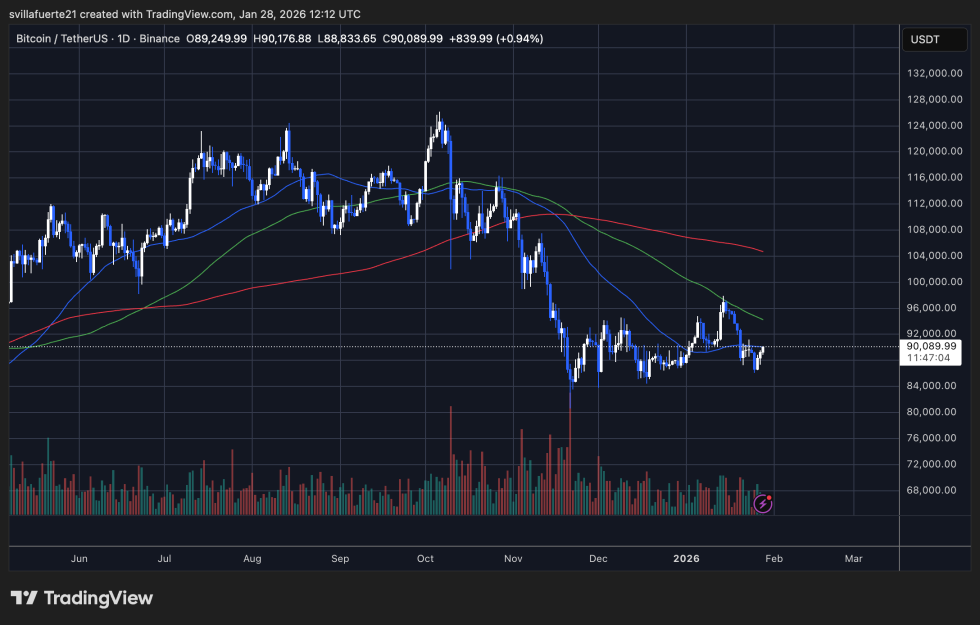
Since early December, Bitcoin has stabilized between roughly $85,000 and $92,000, forming a sideways range rather than an immediate continuation lower. This suggests that forced selling pressure has eased, but conviction remains limited.
The 50-day moving average (blue) continues to slope downward and currently caps upside attempts, while the 100-day (green) also trends lower, reinforcing overhead resistance in the $94,000–$96,000 zone. The 200-day moving average (red) remains well below the price near the mid-$70,000s, indicating that the broader cycle has not fully reset, despite the correction.
Selling volume peaked during the November breakdown but has since declined, signaling reduced participation rather than renewed demand. As long as BTC remains below the declining 50-day and 100-day averages, rallies are likely corrective. A sustained hold above $92,000 WOULD be needed to improve short-term structure, while a breakdown below $85,000 would reopen downside risk.
Featured image from ChatGPT, chart from TradingView.com
