Tether’s Endgame? CEO Ardoino Reveals Plan to Transform into a ’Gold-Backed Central Bank’

Forget stablecoins—Tether's aiming for the vault.
Chief Executive Paolo Ardoino just laid out a vision that would make most central bankers blush: morphing the world's largest stablecoin issuer into a digital gold-backed monetary authority. It's a pivot from digital dollars to digital bullion, and it's got the entire crypto ecosystem leaning in.
The Gold Standard 2.0
The playbook is audacious. By backing its upcoming token, a digital representation of physical gold, with massive bullion reserves, Tether isn't just launching another asset. It's building infrastructure. Think mint, treasury, and settlement network—all rolled into one decentralized entity. The goal? To create a liquid, transparent, and accessible global gold market that operates 24/7, bypassing the century-old, clubby London and New York systems.
Why This Isn't Just Another Stablecoin
This isn't about pegging a token to a fiat currency. This is about reclaiming a millennia-old store of value for the digital age. Tether's move targets the trillion-dollar physical gold market, aiming to solve its core problems: illiquidity, high custody costs, and cumbersome verification. Suddenly, transferring gold could be as simple as sending an email—assuming you trust the algorithm over the armored truck.
The Regulatory Tightrope
Becoming a 'central bank'—even a digital, gold-based one—invites scrutiny from every financial watchdog on the planet. Tether's path is littered with potential landmines: securities laws, commodity regulations, and the ever-present specter of systemic risk. They're betting that utility and transparency will win over skeptics, but in finance, the old guard loves nothing more than a new player with audacious plans—it gives them something to regulate.
A Provocative, if Cynical, Close
If Tether pulls this off, it won't just be a crypto story; it will be a monetary one. It promises a future where sound money is programmable and borderless. Yet, for all its revolutionary talk, the plan has a familiar ring: another financial intermediary promising stability, just with a blockchain wrapper. Because in the end, whether it's a bank vault or a cryptographic ledger, someone always ends up holding the keys—and charging a fee for the privilege.
Tether’s Gold Strategy
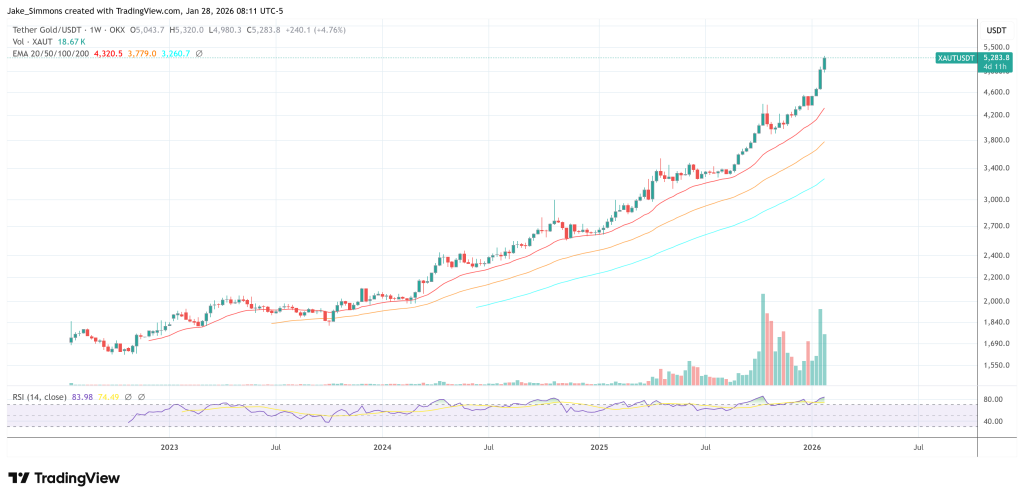
The remarks land as bullion keeps rewriting the macro playbook. Gold pushed to fresh records above $5,200 an ounce this week after President Donald TRUMP said he was not concerned about a weaker dollar, reinforcing the “debasement trade” that has pulled flows out of sovereign bonds and currencies and into hard assets.
Tether’s gold push is physical, not just balance-sheet accounting. More than a TON of bullion is hauled into a high-security vault in Switzerland every week, according to the report, with the hoard described as the largest known stash outside banks and nation states.
Ardoino framed the accumulation as an ongoing policy decision rather than a one-off allocation. “Maybe we are going to reduce, we don’t know yet. We are going to assess on a quarterly basis our demand for gold,” he said, suggesting Tether intends to manage the position dynamically as the macro backdrop evolves.
The cash engine is USDT. With roughly $186 billion in circulation, Tether takes in dollars for its stablecoin issuance and invests reserves across assets including Treasuries and gold, generating interest and trading profits that can be recycled into further purchases.
Ardoino’s comments also point to a shift in posture, from an accumulator of bullion to an active participant in the market’s plumbing. He said the company needs “the best trading floor for gold in the world” to keep buying at scale and to exploit inefficiencies, adding that whatever strategies it adopts WOULD be structured so the firm “remains very long physical gold.”
“Our goal is to have a steady, stable, long-term access to gold,” Ardoino said, describing logistics that look more like commodities trading than crypto treasury management. “Because one to two tons per week is a very sizable amount,” he added, as Tether looks to make the acquisition process more efficient, buying directly from Swiss refiners and also sourcing from major financial institutions, with large orders sometimes taking months to arrive.
The buildout is already reflected in staffing. Tether has hired two senior gold traders from HSBC, and Ardoino said the firm is evaluating opportunities to trade around dislocations between futures and physical pricing.
Ardoino’s broader argument is explicitly monetary. “Gold is ‘logically a safer asset than any national currency,’” he said in an earlier Bloomberg interview. “Every single central bank in the BRICS countries is buying gold.” This week, he tied that demand to the user base that made USDT a dominant offshore dollar proxy: “Exactly the people that love gold and have been using gold as to protect themselves from their own government that have been debasing their currency for a long time,” he said. “We believe that the world is going towards darkness. We believe that there is a lot of turmoil.”
That thesis feeds directly into Tether Gold (XAUT), the company’s token redeemable for bullion. Tether has issued XAUT equivalent to about 16 tons of gold, or roughly $2.7 billion, and Ardoino said there is a “good chance” it ends the year with $5 billion to $10 billion in circulation. “The way I see it, is that there are foreign countries that are buying a lot of gold, and we believe that these countries will soon launch tokenized version of gold as a competitive currency to the US dollar,” he said.
For now, Tether’s own messaging is that it’s already operating on sovereign-like scale. “We are operating at a scale that now places the Tether Gold Investment Fund alongside sovereign gold holders, and that carries real responsibility,” Ardoino said.
At press time, XAUT traded at $5,283.