Bitcoin Hashrate Plunges 200 EH/s: Foundry USA Buckles Under Brutal US Winter Storm

The Bitcoin network just took a massive, weather-induced punch to the gut. A savage cold snap sweeping across the United States has forced one of the world's largest mining pools, Foundry USA, to power down—slashing a staggering 200 exahashes per second from the global hashrate in a matter of hours.
The Great Freeze-Out
It's a stark reminder that the world's most resilient digital asset is still physically tethered to the old-world grid. When temperatures plummet and power grids strain, miners are often the first to be unplugged. This isn't a software bug or a protocol flaw—it's Mother Nature calling in a margin call, exposing the raw infrastructure risk hiding behind the hash rate charts.
Network Shockwaves
The immediate effect is a dramatic drop in total computational power securing the Bitcoin blockchain. Fewer miners hashing means block times could temporarily slow, and mining difficulty—that self-correcting mechanism—will take note. The next adjustment will likely swing in favor of the miners who stayed online, a small consolation prize for braving the cold. It's a brutal, automated efficiency drive, cutting the weak power contracts from the herd.
Resilience on Ice
These events stress-test the network's decentralized promise. Can the hash rate scatter and rebound, or does it reveal an over-concentration in geopolitically tricky or weather-vulnerable regions? Every major mining operation is now running the numbers on their own 'blizzard scenario,' weighing the cost of backup systems against the risk of going dark. Meanwhile, the suits in TradFi will likely cluck about volatility and operational instability—conveniently ignoring that a frozen pipeline or a grounded fleet would cause similar havoc in their own antiquated systems.
The hashrate will recover. The miners will reboot. But this deep freeze delivers a chilling lesson: true decentralization means weathering every storm, both metaphorical and literal. The network adapts; the question is whether the industry's infrastructure can keep up—or if it will keep getting iced out by the very elements it sought to transcend.
Foundry USA Has Seen A Bitcoin Hashrate Decline Of 200 EH/s
The United States is currently experiencing an extreme weather event, with a powerful winter storm sweeping across much of the country. The Arctic air accompanying the storm has brought with it a severe drop in temperatures, causing widespread disruptions to travel and power infrastructure.
Thousands of flights have been canceled nationwide, while the strain on the power grid has left more than 800,000 homes without access to electricity, according to a report from the BBC. Amid all this chaos, the Bitcoin blockchain has also faced a noticeable blow; the cryptocurrency’s Hashrate has sharply gone down as American miners have curtailed power consumption to ease pressure on the grid.
A mining pool that has been significantly affected by the storm is Foundry USA. On Friday, the pool had a total computing power of around 340 exahashes per second (EH/s), while as of Monday, that figure has reduced to just 139 EH/s, according to data from MiningPoolStats.
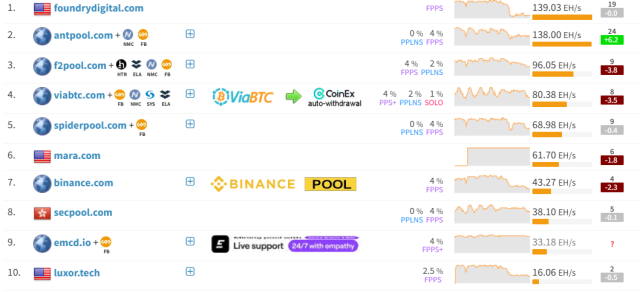
Before the storm disruption, Foundry’s pool was the largest in the world by some distance, but after the Hashrate drop of almost 60%, its power has come in line with the second-largest Antpool. Due to Foundry being so big, its miners pulling back on power has had a real effect on the total network Hashrate, as data from CoinWarz shows.
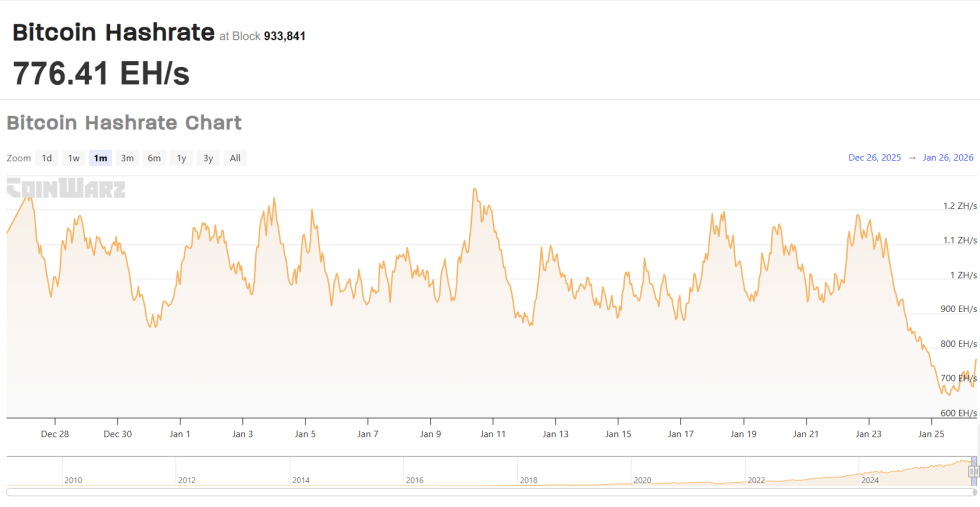
Before the weekend, the Bitcoin Hashrate was floating around 1,118 EH/s, but on Sunday it dropped to a low of just 668 EH/s. The metric has seen a rebound on Monday, but its latest value of 776 EH/s is still down more than 30%. The result? The blockchain is processing each block in an average interval of 12.28 minutes, which is 2.28 minutes slower than the expected rate of 10 minutes.
While the storm has impaired Bitcoin for now, the network won’t take long to bounce back. Even in the scenario that Foundry USA’s downtime remains prolonged, BTC will correct for the absence of American miners in the next Difficulty adjustment. Satoshi Nakamoto programmed BTC so that the network always targets a block time of 10 minutes. If miners diverge from this rate, the network adjusts a metric known as the “Difficulty” just enough that miners get back to the desired speed.
Given the scale of the latest Hashrate drop, a sustained disruption WOULD mean that the Bitcoin blockchain would be forced to ease up its Difficulty by a significant factor. Currently, the next network adjustment is estimated to reduce Difficulty by 18%.
BTC Price
At the time of writing, Bitcoin is trading around $87,700, down 5.7% in the last week.
