Bitcoin Difficulty Drops 3.3%: Miner Retreat Signals Market Pivot

Bitcoin's backbone just got a little softer. The network's difficulty—the measure of how hard it is to mine new blocks—just took a 3.3% haircut. That's not a routine tweak; it's a direct signal from the mining trenches.
The Hashrate Exodus
Miners are pulling back. The computational firepower securing the network, the hashrate, is dropping off. This automatic adjustment is Bitcoin's built-in shock absorber—when miners power down, the protocol makes it easier for those who remain to keep the blocks flowing. It's a survival mechanism, plain and simple.
Reading Between the Lines
This isn't just about electricity costs or hardware cycles. It's a capital flight. When the margin gets squeezed between the coin's price and operational costs, the big players unplug. They're not sentimental; they're running a business. It's the crypto-equivalent of a factory shutting down a production line—efficiency over everything.
The drop hints at a thinning of the herd. Less efficient rigs go offline, consolidating power among those with the cheapest energy and newest tech. It's a brutal, Darwinian efficiency drive that happens right on the blockchain ledger for everyone to see.
The Silver Lining Playbook
History shows these pullbacks often precede a stabilization. Lower difficulty means higher profitability for the miners who stick around. That can halt the exodus, steady the ship, and lay the groundwork for the next push. It's the network breathing out before its next breath in.
For the market? It's a reminder that beneath the speculative frenzy, there's a physical, energy-guzzling engine. And sometimes, that engine needs to idle. It's a feature, not a bug—even if it makes traditional finance guys, who prefer their assets to not have self-adjusting difficulty algorithms, scratch their heads. After all, what's a little volatility when you're building a new financial system?
Bitcoin Blockchain Has Eased Mining Difficulty
According to data from CoinWarz, the Bitcoin mining Difficulty has gone through a decline in the latest network adjustment. The “Difficulty” here refers to a metric built into the blockchain that controls how hard miners would find it to discover a block.
The indicator’s value automatically changes roughly every two weeks in events called adjustments, based on how miners performed since the last such event. The blockchain follows one simple rule to adjust the Difficulty: miner blockchain production rate should converge to 10 minutes per block.
If miners find the average block in an interval greater than 10 minutes, then the network responds by raising its Difficulty just enough that these validators are slowed back down to the standard rate. On the other hand, this cohort performing slower than needed forces the blockchain to ease things up.
The latest Bitcoin Difficulty adjustment occurred on Thursday, and as the below chart shows, it resulted in a decrease for the metric.
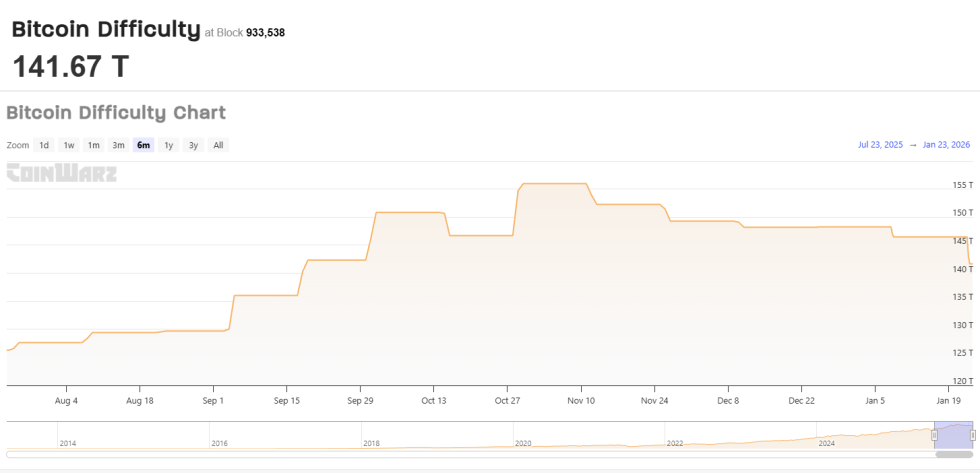
Prior to the change, the indicator had a value of 146.47 trillion hashes. Now, it has dropped to 141.67 trillion hashes, indicating a decrease of 3.28%. This is the second-consecutive reduction in the network Difficulty.
In fact, the indicator has been in a long-term decline since November, with five of the six Difficulty changes that have occurred in the period leading to a drop in its value. Even the one adjustment that didn’t lead to a decrease in the metric had an almost neutral effect, so while the decline didn’t strengthen during it, it didn’t correspond to a change of direction either.
The reason for this long drawdown in the Bitcoin Difficulty lies in the trend witnessed by the Hashrate, a measure of the total amount of computing power connected by the miners to the network.
As data from Blockchain.com shows, the 7-day average value of the Hashrate has been going down during the last few months.
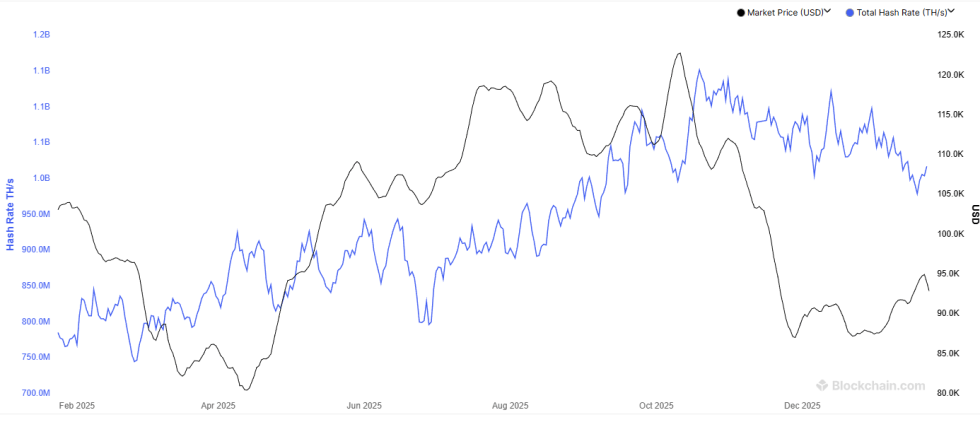
On January 18th, the 7-day average Bitcoin Hashrate fell to 978.8 exahashes per second (EH/s), its lowest level since the first half of September. The indicator has observed a rebound since this low, but its value still remains notably lower than earlier in the month.
Miners’ pace tends to directly correlate with the amount of computing power that they possess, so a decline in the Hashrate usually results in a correction for the Difficulty. The continued downtrend in the former since October is why the latter has also plunged.
BTC Price
At the time of writing, Bitcoin is trading around $90,000, down more than 5% over the last week.
