Bitmine’s Ethereum Vault Hits 1.94M ETH Staked — Institutional Lockup Reaches Unprecedented Scale

Ethereum's supply just got a whole lot tighter. Bitmine, the institutional staking behemoth, has crossed a threshold that sends shockwaves through crypto markets: over 1.94 million ETH are now locked in its validators. That's not just a number—it's a statement of intent from the big-money players.
The Institutional Stampede
Forget retail FOMO. This is capital deployment on an industrial scale. When a single entity amasses a stake this colossal, it's not chasing yield—it's building infrastructure. Every ETH staked is one less coin sloshing around on exchanges, one less token vulnerable to panic sells. Bitmine isn't just participating in the network; it's effectively taking a chunk of the future supply off the table, betting the house on Ethereum's long-term transition from 'ultrasound money' to the backbone of global finance.
What This Lockup Really Means
The mechanics are simple but profound. Staked ETH is illiquid ETH. It's committed to securing the network for the long haul, locked in a digital vault with no quick-release lever. This scale of commitment from an institutional player signals a seismic shift in perception. They're not trading it; they're building on it. It transforms Ethereum from a speculative asset into productive capital—the kind that powers smart contracts, DeFi protocols, and the next generation of the internet. Of course, to a traditional finance suit, this probably just looks like 'tying up capital in a glorified digital savings account'—but then again, they said the same thing about the internet.
The Ripple Effect Across Crypto
This isn't an isolated event. It's a catalyst. Bitmine's move validates the staking thesis for every other fund, family office, and corporation sitting on the sidelines. Watch for others to follow, scrambling to secure their own piece of the staking pie before the best yields get arbitraged away. It creates a virtuous cycle: more staking means more security, more security means more trust, and more trust means—you guessed it—more institutional capital. The flywheel is spinning.
A New Era of Scarcity
The ultimate takeaway? Real, tangible scarcity is being engineered on-chain. With giants like Bitmine pulling millions of ETH out of circulation, the available liquid supply shrinks. Basic economics takes over from here. When demand meets constricted supply, history suggests only one outcome. The age of Ethereum as a volatile toy for degens is fading. Welcome to the era of Ethereum as institutional-grade bedrock.

Bitmine’s ETH Staking Signals Long-Term Conviction Despite Short-Term Weakness
According to data from Arkham, Bitmine has now staked a total of 1,943,200 ETH, worth roughly $5.71 billion, marking one of the most aggressive Ethereum accumulation and yield-positioning moves currently visible on-chain.
Staking at this scale removes a significant amount of ETH from liquid circulation, effectively shifting supply away from exchanges and into long-term validator positions. In practical terms, it suggests Bitmine is not positioning for a short-term flip, but rather treating Ethereum as a strategic asset that can generate native yield while potentially appreciating over time.
This activity stands out because it is happening while Ethereum is under pressure after losing the $3,000 level. At the moment, the market is stuck in a fragile, risk-sensitive phase, where traders are reacting quickly to breakdowns and failed recoveries. Momentum has weakened, liquidity remains thin, and analysts are increasingly warning that a deeper correction could unfold if key supports continue to fail.
However, Bitmine’s staking expansion provides a counter-signal: large players appear willing to keep committing capital even as sentiment deteriorates. That divergence highlights the current split in the market—short-term participants are defensive, while longer-term allocators are still building exposure. If price stabilizes, this kind of staking-driven supply reduction can become a structural tailwind.
Ethereum Downtrend Pressure Builds
Ethereum is trading NEAR $2,940 after losing the key $3,000 psychological level, putting the market back into a fragile position. The chart shows ETH has been trending lower since the October peak, with a clear sequence of lower highs and heavy sell-side volatility that accelerated into November. Although ETH managed to stabilize into a broad consolidation range between roughly $2,850 and $3,250, the most recent breakdown suggests buyers are struggling to defend support when momentum fades.
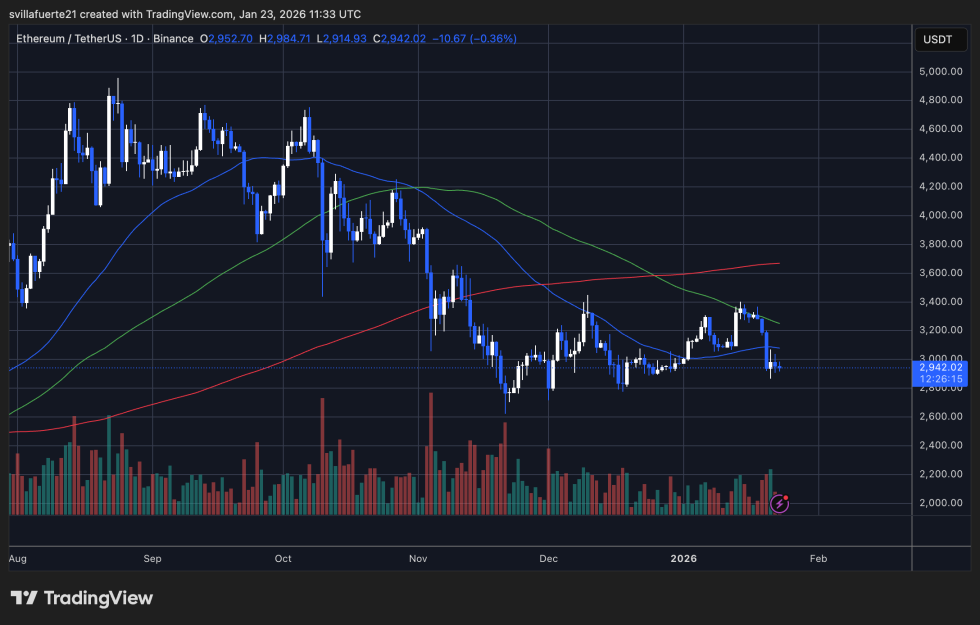
From a trend perspective, Ethereum remains capped beneath its major moving averages. Price is trading below the green long-term average and the blue mid-term average, both of which are sloping downward and acting as dynamic resistance.
The recent rebound attempt toward the $3,300–$3,400 zone failed right under the green line, reinforcing that sellers are still controlling rallies. Meanwhile, the red long-term average sits higher near the mid-$3,000s, highlighting that ETH remains far from reclaiming a macro bullish structure.
Volume has increased on the sharp red candles compared to the slower grind higher, which often signals distribution rather than healthy accumulation. If ETH cannot reclaim $3,000 quickly, downside risk opens toward the $2,850 range floor. A clean recovery back above $3,150–$3,250 WOULD be needed to reduce bearish pressure and reset the near-term trend.
Featured image from ChatGPT, chart from TradingView.com
