Michael Saylor Declares: Strategy Is Becoming Bitcoin’s Central Bank Proxy

Forget the Fed—Bitcoin's creating its own monetary authority.
Michael Saylor just dropped a bombshell that's rattling traditional finance circles. The MicroStrategy founder argues corporate Bitcoin strategies are morphing into something far more powerful: a decentralized central bank. No marble columns or political appointments required.
The New Power Structure
It's a quiet revolution happening on balance sheets. Companies accumulating Bitcoin aren't just making a speculative bet—they're building a parallel monetary system. Saylor sees these strategic holdings as a proxy, executing functions historically reserved for central banks: storing value, setting a benchmark, and providing a hedge against systemic failure. The tool? Corporate treasury policy. The result? A distributed, transparent, and algorithmically constrained alternative to the old guard.
Why This Cuts Through the Noise
This isn't about replacing your local branch. It's about bypassing the entire concept of centralized monetary control. When a publicly traded company adopts a long-term Bitcoin strategy, it signals a fundamental loss of faith in traditional levers. It's capital voting with its wallet, opting for cryptographic rules over committee decisions and political whims. Talk about a shareholder proposal with teeth.
The ultimate finance jab? It turns the most conservative tool in the corporate handbook—treasury management—into the most radical weapon against monetary debasement. The suits are now the revolutionaries. Watch the old banks try to regulate that.
Strategy Is Building A ‘Central Bank of Bitcoin’
That transformation now sits on a scale Saylor claims is often misunderstood. Addressing criticism that Strategy is simply levering up to buy more Bitcoin, he said the firm has raised roughly $44 billion over the past year and a half and characterized “most of that” as equity rather than debt. “There isn’t really leverage,” Saylor said. “Equity is capital that you have forever. We’re funneling that capital into the crypto economy. We’re buying Bitcoin.” He added that Strategy has acquired “about $48 billion worth of Bitcoin” across “like 88 different transactions,” purchasing “as soon as we raise the capital.”
When asked whether Strategy is still just a buyer or something closer to a “shadow central bank of Bitcoin” given its holdings, Saylor leaned into the analogy. “Bitcoin is digital capital. It is the world reserve capital network. It’s replaced gold as the global non-sovereign store of value for the human race,” he said. Then came the framing: “Banks normally buy credit. We actually sell credit. So what we’re doing is the reverse of commercial banking, retail banking. It is sort of like central banking. We are sort of like the central bank of Bitcoin.”
Saylor’s “central bank” claim hinges on a product stack meant to translate Bitcoin’s balance-sheet asset into yield-bearing instruments for investors who won’t hold BTC directly. He described STRC as “a currency that’s pegged to the dollar” and “backed […] with Bitcoin,” with proceeds recycled into BTC purchases. In his telling, that mechanism links “the Bitcoin economy” to “the traditional finance economy and to the money markets of the world.”
Michael Saylor: “We are sort of like the central bank of Bitcoin.” pic.twitter.com/IyZ9EHLAQn
— TFTC (@TFTC21) January 22, 2026
The more material shift, he argued, is Strategy’s progression away from maturity-driven debt toward perpetual structures. Saylor laid out a four-stage evolution: initial use of credit and leverage, a senior note secured by BTC collateral that the company later refinanced and vowed not to repeat, then non-recourse convertible bonds, an approach he said became constrained by market size and retail inaccessibility and finally “digital credit,” which he described as “an equity […]a perpetual preferred equity.”
In one of his clearest statements of intent, Saylor said Strategy’s priority is to prevent principal from ever coming due. “We don’t want to have leverage. We want to have amplification via equity. We never want the principal to come due. We’d rather pay a higher dividend forever,” he said. “I’d rather pay 10% forever than pay 5% for 5 years.” Strategy, he added, has “announced a $1.44 billion cash reserve for the dividends,” giving it “the option to not raise any capital in the capital markets for up to two years,” and in his view “effectively stripped the credit risk off of the business.”
Saylor also pitched liquidity as a differentiator. He said Strategy has raised $7 billion over the last nine months via these instruments and described an emerging market of about $8 billion outstanding. Where preferred stocks typically trade thinly, he argued Strategy’s “digital credit instruments were trading 30 million a day,” with “Stretch […] more than a hundred million a day,” which he framed as a step-change in market access.
The firm’s investor pitch, as Saylor described it, splits the world into capital and credit buyers. “Bitcoin is digital capital. The world will be built on digital capital. But the world will run on digital credit,” he said, arguing that products like Stretch can offer a money-market-like alternative “powered by digital capital” while sidestepping Bitcoin’s volatility.
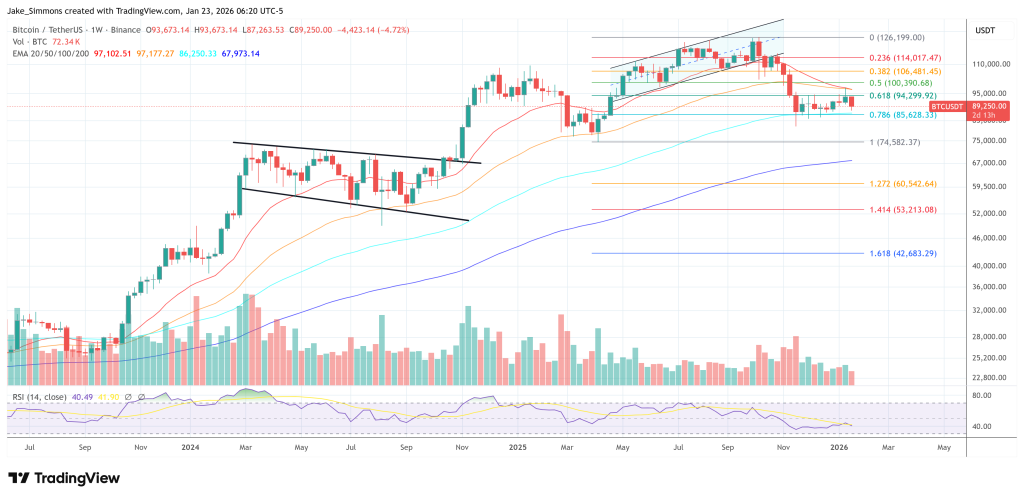
At press time, BTC traded at $89,250.