Qubic’s Dogecoin Mining Build Sparks Fresh 51% Attack Concerns

Qubic's latest move has the crypto community buzzing—and not all the chatter is optimistic. The project's confirmed development of a Dogecoin mining build is reviving long-dormant fears about network security, specifically the specter of a 51% attack.
The Core Concern: Centralization vs. Security
At its heart, the anxiety stems from proof-of-work's inherent vulnerability. If a single entity—or a coordinated group—gains control of over half the network's mining power, they can theoretically manipulate transactions. They could double-spend coins, halt confirmations, and undermine the very trust the blockchain is built on. Qubic's push into Dogecoin mining, while showcasing technical ambition, inadvertently shines a harsh light on this structural risk.
Why Dogecoin? Why Now?
Dogecoin, the meme-turned-mainstay, runs on a merged mining model with Litecoin. This has historically provided a security boost by pooling hashpower. A dedicated, large-scale Dogecoin mining initiative could disrupt that equilibrium. The question isn't just about Qubic's intentions—which may be perfectly benign—but about the precedent it sets and the potential concentration of power it could enable in a network valued for its decentralization.
A Calculated Risk or a Necessary Evolution?
Proponents might argue that increased hashpower strengthens a network, deterring smaller bad actors. The counterpoint is that it creates a single, larger point of potential failure or coercion. It's the classic crypto tightrope: innovation versus immutability, progress versus protection. In the high-stakes game of blockchain security, sometimes the biggest risk isn't a hack—it's a headline that makes everyone check the hash rate distribution. After all, in crypto finance, sometimes the most profitable move is to sell the shovels—or in this case, the mining rigs—while whispering about the gold rush's pitfalls.
The takeaway? Qubic's build is a technical milestone, but it's also a stark reminder. In the decentralized world, every leap forward requires a glance back at the foundational principles—lest we build castles on suddenly shiftable sand.
Could Dogecoin Suffer A 51% Attack?
The announcement lands with baggage. In August 2025, Qubic ran what it publicly described as a Monero “takeover demonstration,” claiming it had achieved “over 51% hashrate dominance” during parts of the experiment and reporting a brief chain disruption that included a six-block reorganization and orphaned blocks. That episode became a lightning rod for the broader PoW security debate: how quickly external incentives can concentrate hashpower, and how markets react when “51%” enters the conversation.
Subsequent research challenged the strongest interpretation of those claims. A December 2025 paper reconstructing Qubic-attributed activity on Monero describes the operation as an advertised “selfish mining campaign,” finding Qubic’s hashrate share rising into the 23–34% range in detected intervals, while “sustained 51% control is never observed.”
Dogecoin’s mining economy is structurally unlike Monero’s CPU-oriented RandomX landscape. dogecoin uses Scrypt and has, since 2014, supported merged mining alongside Litecoin, an architecture that has historically helped bolster its security budget by tapping into a broader Scrypt ASIC miner base.
That hardware reality is central to Qubic’s own messaging. The project said “integrating ASIC hardware into uPoW requires real engineering, deep protocol work, and time to do it right,” explicitly acknowledging that this is not a simple pool launch.
It is also where most of the immediate 51% attack fears run into friction. In an August 2025 research note, published when Qubic first began floating Dogecoin as the “next” network after Monero, 21Shares argued that a brute-force Dogecoin majority WOULD be economically prohibitive, estimating that Qubic would need to match and then exceed roughly 2.78 PH/s, implying about $2.85 billion in hardware plus roughly $2.5 million per day in electricity (before logistics).
The more plausible risk vector, if any, is not Qubic buying its way to majority hashrate, but whether it can engineer incentives and integrations that convince existing Scrypt ASIC operators to route meaningful hashpower through a Qubic-mediated setup, an approach 21Shares characterized as “vampire mining.”
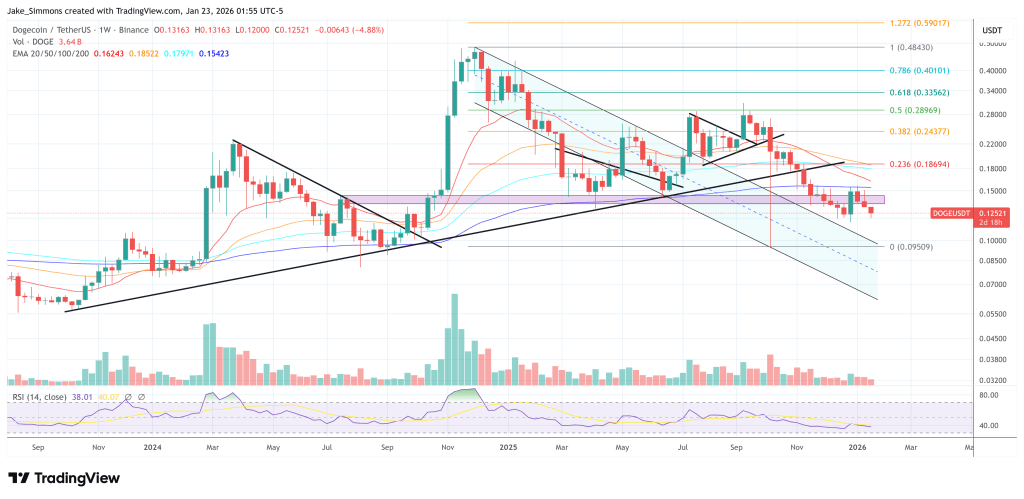
At press time, Doge traded at $0.12521.