Russia’s A7A5 Stablecoin Moved $100 Billion Before Global Crackdown: Elliptic Report Reveals

Before regulators slammed the brakes, a Russian stablecoin quietly shifted a mountain of capital—$100 billion worth—across borders without a trace. Elliptic's latest blockchain forensics expose the scale, revealing how digital assets bypass traditional finance controls with chilling efficiency.
The Mechanics of Evasion
Built for opacity, the A7A5 token leveraged blockchain's inherent pseudonymity. Transactions settled in minutes, not days, leaving compliance teams scrambling. It wasn't just moving money—it was rewriting the rulebook on cross-border value transfer under the noses of global watchdogs.
Why This Changes Everything
Forget sanctions paperwork and frozen accounts. This $100 billion pipeline proves decentralized networks can route around geopolitical blockades. It's a masterclass in financial agility that traditional banks—weighed down by legacy systems and regulatory overhead—can only watch with envy. Another win for the 'move fast and break things' crowd, while traditional finance is still filing its compliance reports in triplicate.
The Aftermath and What's Next
The crackdown came, but the genie's out of the bottle. Every successful evasion, especially at this scale, becomes a blueprint. It pressures regulators to innovate their surveillance while pushing legitimate crypto projects to prove their transparency bona fides. The race isn't just about adoption anymore—it's about who controls the narrative: those building the future of finance, or those trying to police its past.
Elliptic Finds Rapid Growth And Large Volumes
According to analysis by Elliptic, A7A5 grew quickly after its launch and was used heavily for settlement between firms that could not rely on regular banks. The firm traced huge daily flows, with transaction totals rising into the billions and aggregate transfers passing major milestones.
Origins And Backing
A7A5 was set up in a way that tied it to rouble deposits and to a handful of private entities connected to Russia’s financial network.
Reports say the project was linked to a payments group and to banking partners that have been under western scrutiny. Some of the people and firms behind the token were later sanctioned by authorities in the US and the UK.
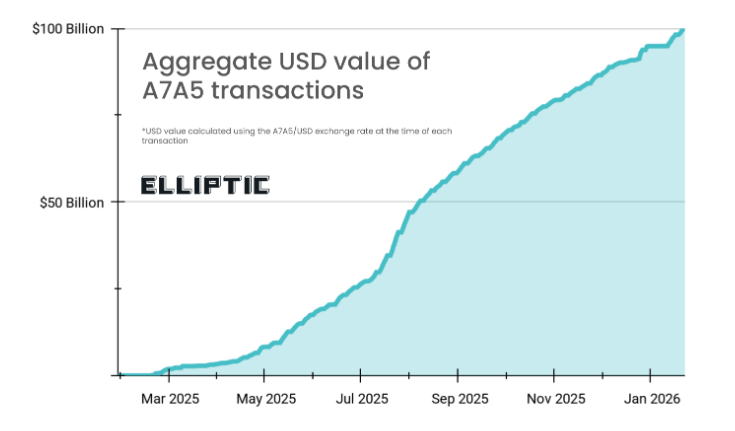
Transactions were concentrated on a small number of exchanges and on on-chain routes that made cross-border transfers possible without the usual banking rails.
In practice, the coin served as a bridge into other stablecoins and crypto markets. That routing let trade keep moving even when formal channels were closed to certain actors.
Reports note that regulators and analysts view those flows as a tool that could help avoid sanctions. Regulators in several countries have taken action against linked platforms and individuals after patterns of transfers were uncovered.
Some of the design choices around the token made monitoring harder for a time, and in a few cases tokens were reissued in new wallets to muddy traces.
Markets noticed. The token’s market cap surged, and exchanges that handled it saw sharply higher volumes.
Ordinary traders were not the main users; activity was often timed with business hours and weekdays, which suggested corporate or institutional flows rather than retail swaps. This type of pattern changed how people outside the region looked at crypto as a payments tool.
Authorities responded by blacklisting some addresses and platforms and by stepping up enforcement against those named in the network.
The moves show that a token can MOVE a lot of value, but it can also draw regulatory heat and prompt countermeasures that affect every participant in the chain.
Featured image from Pixabay, chart from TradingView
