Thailand SEC Greenlights Crypto ETFs: New Regulatory Framework Drops This Year

Bangkok's financial regulators are throwing open the doors to mainstream crypto investment. The Securities and Exchange Commission (SEC) confirmed it will launch definitive rules for cryptocurrency exchange-traded funds within the year—a move set to transform Thailand's digital asset landscape.
From Niche to Mainstream
This isn't just another regulatory tweak. It's a structural shift. By creating a regulated pathway for crypto ETFs, the SEC is effectively bridging the gap between Thailand's traditional capital markets and the volatile world of digital assets. Expect custodians, brokers, and asset managers to scramble for position.
The Institutional On-Ramp
The framework will provide the guardrails institutional capital demands—clear custody solutions, robust disclosure requirements, and standardized reporting. It’s the financial infrastructure play that has been missing, designed to attract pension funds and conservative portfolios that have watched crypto from the sidelines. Finally, a way to get exposure without having to explain private keys to the board.
A Regional Race for Relevance
Thailand isn't acting in a vacuum. This move positions it as a frontrunner in Southeast Asia's fierce competition to become a digital asset hub. By establishing clear rules now, the SEC aims to capture first-mover advantage, drawing both investment and fintech talent away from neighboring markets still stuck in regulatory deliberation.
The Fine Print and The Future
Details matter. The market will dissect the SEC's final rulebook—looking at eligible cryptocurrencies, leverage limits, and investor qualification criteria. A restrictive list could dampen enthusiasm; a pragmatic one could ignite a wave of product launches. Either way, it signals that Thai regulators are choosing structured adoption over outright resistance.
For the average investor, it means potentially buying Bitcoin through their existing brokerage account—a mundane action that would represent a revolutionary step for market accessibility. It’s the classic finance play: repackage the risky asset, slap a ticker on it, and watch the inflows follow. Sometimes, the biggest innovations in crypto are just old Wall Street tricks in a new wrapper.
Thailand To Regulate Crypto ETFs And Futures This Year
As reported by Bangkok Post, the Thailand SEC is preparing regulatory changes related to crypto to support the growth of investment in the sector. Jomkwan Kongsakul, deputy secretary-general of the SEC, said the regulator is planning to issue guidelines supporting the launch of digital asset ETFs, while also working to enable crypto futures trading on the Thailand Futures Exchange (TFEX).
ETFs are investment vehicles that allow investors to gain exposure to an underlying asset without having to directly own it. In the context of digital assets, ETFs enable traders to invest into coins like bitcoin without interacting with any on-chain element like wallets or exchanges.
In the United States, spot ETFs gained approval by the nation’s SEC in January 2024 for Bitcoin and July 2024 for Ethereum. Since then, these funds have attracted notable attention, capturing demand from traditional investors who were reluctant to deal with blockchain infrastructure.
Kongsakul noted:
A key advantage of crypto ETFs is ease of access; they eliminate concerns over hacking and wallet security, which has been a major barrier for many investors.
Within Asia, Hong Kong approved spot ETFs for both Bitcoin and ethereum in April 2024, while South Korea is planning to roll out similar investment vehicles this year.
According to Kongsakul, Thailand’s SEC board has already approved crypto ETFs in principle, with detailed investment and operational rules currently being finalized. Although an exact timeline is unknown, the SEC is expected to introduce the regulations “early this year.”
Alongside ETFs, the SEC is also moving to formally recognize crypto within Thailand’s derivatives framework, allowing digital asset futures products to trade on the TFEX. Kongsakul said crypto futures WOULD provide traders with hedging tools and more sophisticated risk management options.
In related news, the US spot Bitcoin ETFs have faced weak demand recently, with the netflow for the current week sitting at a notable negative value, according to data from SoSoValue.
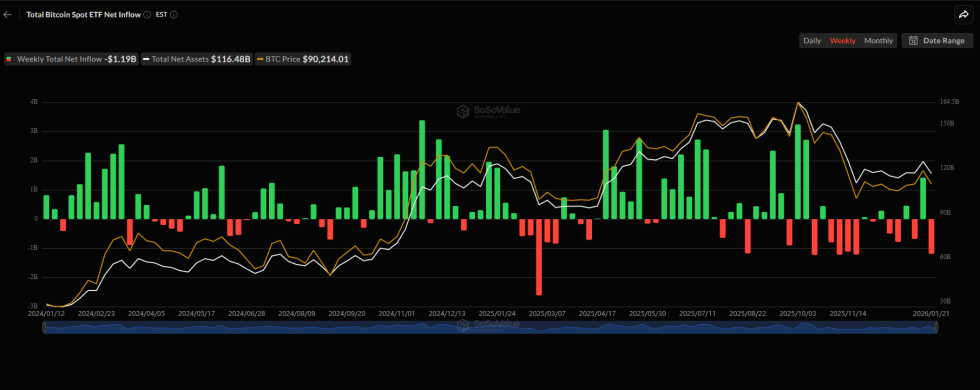
As displayed in the above graph, the US Bitcoin spot ETFs have witnessed net outflows of $1.19 billion this week so far. These negative netflows have come as the asset’s price has gone through a bearish shift, retracing the recovery it had made earlier this year.
Last week, the funds actually saw net inflows of $1.42 billion, breaking the trend of weak inflows or outright outflows that had persisted since mid-October. But this week’s netflow suggests the bullish market mood couldn’t last.
BTC Price
At the time of writing, Bitcoin is trading around $89,100, down more than 8% over the last week.
