Iran’s $507 Million USDT Move: How Crypto Became a National Currency Defense Tool

When traditional finance fails, nations turn to digital lifelines. Iran just made a half-billion dollar bet on stablecoins to shield its economy—and the implications ripple far beyond its borders.
The Sanctions Sidestep
Forget gold reserves or currency swaps. Tehran's latest maneuver involves acquiring $507 million worth of Tether's USDT—a digital dollar proxy that operates outside the conventional banking system. This isn't retail speculation; it's state-level adoption of crypto infrastructure for sovereign financial strategy. The move directly targets currency stabilization, using blockchain's borderless nature to bypass international payment roadblocks that have crippled traditional channels.
Stablecoins as Strategic Assets
The playbook is clear: when your national currency faces pressure, deploy assets that maintain peg to stronger economies. USDT's dollar linkage provides immediate liquidity without navigating correspondent banking delays or exposure to freeze risks. For Iran, this represents both a practical solution and a symbolic shift—acknowledging that digital assets now occupy space once reserved for central bank agreements and bilateral treaties.
The New Financial Arsenal
What we're witnessing isn't just adoption; it's weaponization of crypto economics. Nations under financial pressure now have tools that previous generations lacked: instant settlement, reduced counterparty risk, and access to global liquidity pools without intermediary approval. The $507 million acquisition signals that sovereign entities now view stablecoins not as speculative instruments, but as functional components of monetary policy—even if that policy exists outside IMF guidelines.
Global Ramifications
Iran's move sets precedent. Other nations facing similar constraints now have a proven template: convert reserves to crypto, stabilize domestic currency, maintain economic operations despite international pressure. This creates parallel financial systems where geopolitical adversaries can't easily intervene—a development that should make traditional bankers nervous as they watch their monopoly on cross-border finance erode.
The ultimate irony? While regulators debate crypto's legitimacy, nation-states are already deploying it in high-stakes economic warfare—proving once again that innovation moves faster than legislation, especially when survival's on the line. Sometimes the most bullish case for digital assets comes not from Silicon Valley evangelists, but from finance ministers desperate to keep their economies afloat.
Central Bank’s Crypto Moves
According to a blockchain analysis by Elliptic, the Central Bank of Iran acquired at least $507 million in USDT over 2025, a figure the firm treats as a conservative minimum because it only counts wallets it could tie to the bank with high confidence.
Reports say much of the buying happened in the spring months of 2025 and that payments were routed through channels that included Emirati dirhams and public blockchains. Those stablecoins were then used in local crypto markets to add dollar-linked liquidity and help slow the rial’s slide.
 New Elliptic research: We have identified wallets used by Iran’s Central Bank to acquire at least $507 million worth of cryptoassets.
The findings suggest that the Iranian regime used these cryptoassets to evade sanctions and support the plummeting value of Iran’s currency,… pic.twitter.com/I7NHGO0wtP
— Elliptic (@elliptic) January 21, 2026
How The Money Flowed
Elliptic’s tracing shows an early flow of USDT into Nobitex, Iran’s biggest crypto exchange, where the coins could be swapped into rials and fed into the market. After a breach and growing scrutiny in mid-2025, other paths were used, including cross-chain bridges and decentralized exchanges, to MOVE and convert funds.
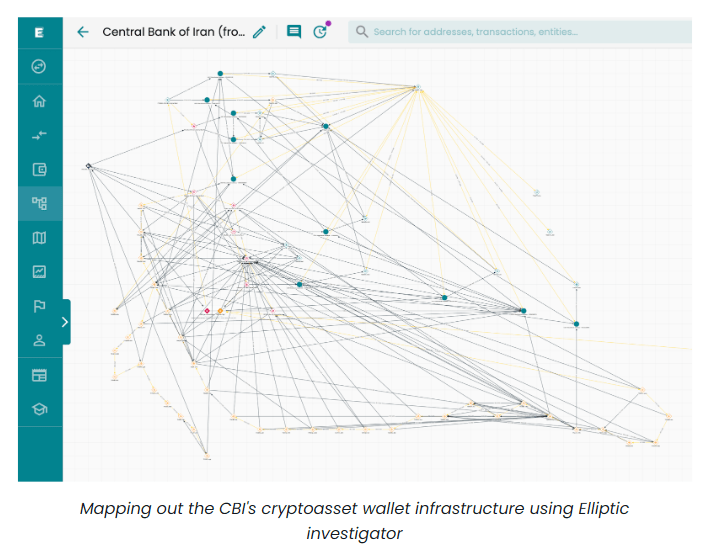
That open ledger also left the transactions visible to outside observers. On June 15, 2025, Tether blacklisted several wallets linked to the central bank and froze about $37 million in USDT, showing that stablecoins can be cut off when issuers or regulators step in. That intervention narrowed some options for on-chain liquidity.
This episode matters for two reasons. First, it shows how a state institution can use stablecoins to gain access to dollar value when normal banking routes are closed.
Second, it highlights a weakness: if a private issuer can freeze balances, those reserves are not the same as cash held in hard foreign accounts.
Trade, Sanctions, And A New ToolReports note the purchases likely served a twin goal — to smooth domestic exchange rates and to help settle trade with partners who avoid direct dollar banking.
The method is blunt. It gives a way to move value, but it also creates new points of control and exposure that can be tracked on public ledgers.
Analysts will be watching how regulators and stablecoin issuers respond. They will also track whether other countries under pressure turn to similar mixes of centralized and decentralized tools.
The public tracing of these flows makes it harder to hide big moves, even when actors try to obscure them across chains and exchanges.
Featured image from Unsplash, chart from TradingView
