Epoch Ventures Warns: Bitcoin Should Hold Off on Quantum Fixes Until 2026

Quantum computing's threat to crypto is real—but rushing a fix could be worse.
Why the Wait Makes Sense
Epoch Ventures argues the quantum apocalypse isn't imminent. Current systems can't yet crack Bitcoin's encryption. A premature overhaul might introduce more bugs than it solves—creating fresh attack vectors while the old ones still stand.
The Cost of a Panic Upgrade
Forcing a network-wide protocol shift now would be a logistical nightmare. It could split the community, freeze transactions, and tank market confidence. Remember the last hard fork drama? Multiply that by ten.
Timing is Everything
The firm suggests a coordinated, industry-wide timeline. Let the science mature, then implement a battle-tested solution across major blockchains simultaneously. Rushed tech usually means another round of VC funding pitches and consultant fees—classic finance grift disguised as innovation.
Bitcoin's survival hinges on strategic patience, not fear-driven code commits. The quantum clock is ticking, but the smart money says watch the hands, don't smash the watch.
Bitcoin Could Pay A High Price If It Rushes Quantum Signatures
Where Yakes becomes most concrete is in describing the trade-offs of “quantum-resistant” mitigation. He doesn’t argue the ecosystem lacks candidate solutions, he argues the network should be careful about choosing the wrong one too early. “Quantum-resistant signature algorithms exist — implementing one of them is not the issue,” he wrote. “The issue is that they’re all too large for Bitcoin and would consume block space, thereby lowering transaction throughput on the network. New signatures emerging today are being tested and are increasingly data-efficient.”
That sizing problem is central to his warning about premature action. In a network where block space is scarce and transaction throughput is a persistent constraint, large signature schemes don’t just change security posture; they reshape the economics of using the chain. Yakes called out what he sees as the “worst-case scenario” for quantum risk planning: not a sudden cryptographic collapse, but a rushed upgrade that hard-codes an avoidable performance penalty.
“The worst-case scenario we see for quantum risk is that a solution is implemented prematurely, with an exponentially lower efficiency trade-off had we waited longer before implementing,” he wrote.
Yakes pointed to existing research and mitigation pathways that could buy time if quantum progress suddenly accelerates. He cited Chaincode Labs’ work recommending “a 2-year contingency plan and a 7-year comprehensive plan,” and described a near-term lever tied to modern Bitcoin script and address design.
“For the short-term contingency plan, we know that taproot address types can make commitments to spend before the public key is revealed — thus hiding the public key from a quantum computer and protecting quantum-vulnerable public keys,” he wrote. “Basically, modern address types have a hidden FORM of quantum resistance that can be unlocked, and this could be used if quantum factorization suddenly grows exponentially.”
The harder question, in his telling, is governance and coordination. Bitcoin’s bar for consensus is deliberately high, and “achieving bitcoin consensus for improvement proposals is very challenging,” Yakes noted, emphasizing the ecosystem’s history of adopting soft forks. If an existential threat materialized, he expects a broader stakeholder alignment could emerge, yet he still flags the risk that any adopted signature transition “would materially decrease the efficiency of the blockchain,” pointing to ongoing work by “the BIP360 team” on such proposals.
For investors, Yakes’ bottom line is to triage: quantum is worth understanding, but not worth displacing more immediate risks in a “geopolitical environment with monetary commodities and fiat currencies.” “We do not view quantum computing as a primary risk for the reasons above,” he wrote. “If you’re reducing your allocation because of quantum risk, you’re being driven by behavioral bias and failing to see the benefits of a bitcoin allocation on net.”
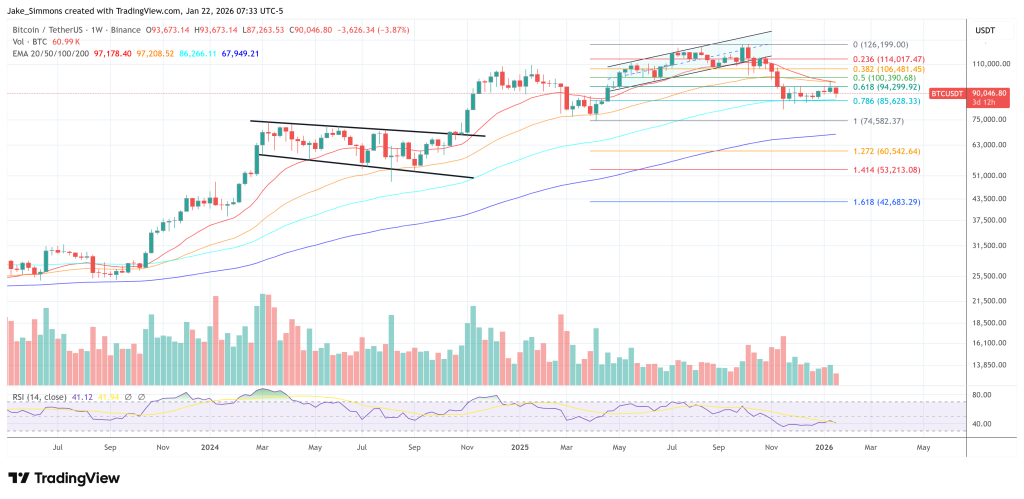
At press time, BTC traded at $90,046.