BlackRock CEO Demands ’One Blockchain’ for Tokenization - Is Ethereum the Answer?

Wall Street's trillion-dollar gorilla just dropped a blockchain bombshell.
BlackRock CEO Larry Fink isn't just dabbling in digital assets anymore—he's calling for a single, dominant ledger to underpin the entire tokenized economy. No more fragmentation. No more interoperability headaches. Just one chain to rule them all.
The Unspoken Frontrunner
Fink's vision points directly at Ethereum. Its established developer ecosystem, robust security, and first-mover advantage in smart contracts make it the logical backbone for institutional tokenization. This isn't about picking a favorite; it's about standardizing the plumbing for trillions in assets.
Why One Chain Wins
Fragmentation kills efficiency. A unified blockchain means seamless settlement, universal liquidity, and a single source of truth for everything from Treasury bonds to real estate deeds. It cuts through the noise of competing Layer 1s and bypasses the costly bridges that currently slow everything down.
The Institutional Mandate
This isn't crypto-anarchy—it's finance demanding order. BlackRock's push signals that tokenization has moved past the experimental phase. The market needs a settled, institutional-grade rails system, not a dozen different protocols all vying for attention while burning VC cash.
A Cynical Take on the Old Guard
Of course, the traditional finance crowd will nod along while secretly hoping their legacy systems can somehow catch up—a bit like a horse-and-buggy manufacturer betting on a slowdown in automobile production.
The bottom line? The race to become finance's foundational layer is heating up, and the world's largest asset manager just signaled it's tired of waiting for a winner. The market may finally get the clarity—and the consolidation—it desperately needs.
Why Ethereum Is Coming Up
In the abstract, “one common blockchain” could be read as a generic appeal for shared rails. In practice, BlackRock’s public-market crypto lineup and its tokenization work have concentrated around bitcoin and Ethereum.
On the ETF side, BlackRock’s flagship US spot products track Bitcoin and ether — iShares Bitcoin Trust (IBIT) and iShares Ethereum Trust (ETHA) — with ETHA launching in 2024 and now sitting in the center of the firm’s public-facing Ethereum exposure.
On the tokenization side, BlackRock’s first tokenized fund, the BlackRock USD Institutional Digital Liquidity Fund (BUIDL), debuted on Ethereum via Securitize in March 2024, making Ethereum the original issuance network for what has become one of the market’s most closely watched institutional RWAs.
While BUIDL has expanded across multiple networks over time, the key point for Fink’s “common blockchain” framing is that Ethereum has been BlackRock’s default starting point for public-chain issuance, a meaningful signal in a market where “standards” tend to follow whoever already has the deepest liquidity, the broadest integration surface, and the most conservative counterparties.
The stronger tell came this week from BlackRock research rather than Davos soundbites. In its 2026 thematic outlook, BlackRock explicitly floats the idea of Ethereum as the infrastructure LAYER that collects the “toll” as tokenization scales. One slide asks: “Could Ethereum represent the ‘toll road’ to tokenization?” and adds that stablecoin adoption may be an early proxy for tokenization “in action,” with “blockchains like Ethereum” positioned to benefit.
In the same section, BlackRock cites RWA data “as of 1/5/2026” and notes that “of tokenized assets 65%+ are on Ethereum,” underscoring the network’s lead in today’s tokenized-asset stack.
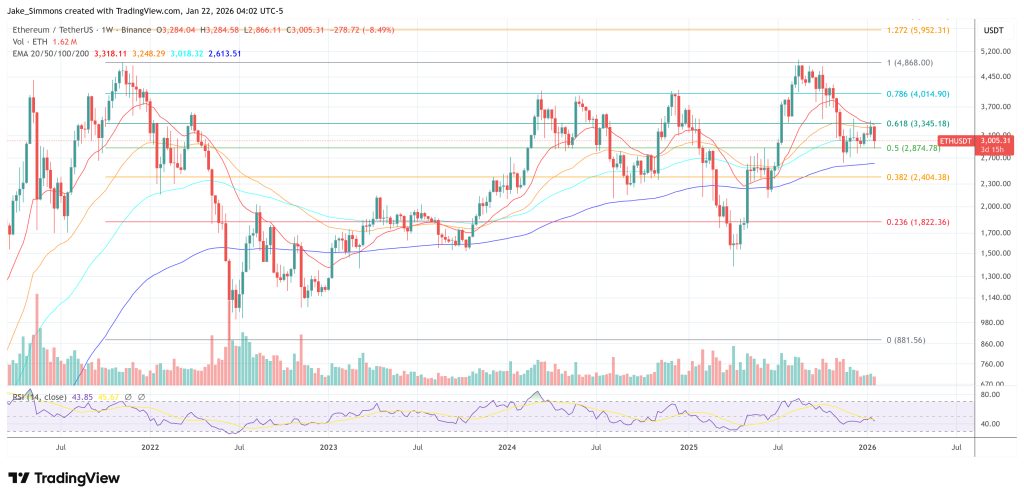
At press time, ETH traded at $3,005.