Bitcoin’s January Rebound: Funding Divergence Signals Shift to Spot-Driven Market

Bitcoin shakes off the holiday hangover with a January surge, but the real story isn't on the price chart—it's in the derivatives data. A growing chasm between spot buying and perpetual futures funding rates suggests a fundamental power shift. The speculative froth is thinning, making way for a market built on actual asset accumulation.
The Quiet Divergence Telling a Loud Story
While headlines chase green candles, the critical signal flashes in the funding rates for perpetual swap contracts. These rates, which typically align with spot market momentum, are now lagging. This divergence isn't a technical glitch; it's a market diagnosis. It indicates buy pressure is increasingly organic, coming from direct Bitcoin purchases rather than leveraged bets on its future price. The casino is getting quieter as the vault gets fuller.
Goodbye Leverage, Hello Foundation
This spot-driven dynamic cuts both ways. It likely dampens the explosive, liquidity-fueled pumps that characterize pure speculation. But in exchange, it builds a more stable foundation. A market propelled by spot accumulation is less prone to the violent, cascading liquidations that wipe out portfolios and trader sentiment in hours. It's a trade-off: less moonshot potential for more bedrock resilience. The kind of shift that bores day-traders but delights long-term holders.
The move signals a maturation, or perhaps just a weary pragmatism, as the market bypasses financial engineering for the simpler act of just buying the asset. It’s a bullish indicator that whispers patience over hype, suggesting this recovery is being built to last—not just to fuel the next round of over-leveraged gambles. After all, nothing terrifies Wall Street more than a market that starts valuing assets over narratives.

CryptoQuant notes that spot-driven conditions can also create more durable rallies, since they attract organic inflows and allow price to climb without relying on unstable speculative positioning. Historical comparisons to the 2021 and 2024 cycles show similar divergences between spot strength and muted funding rates often preceded extended upside expansions, ranging from 20% to 50%.
Is the Four-Year Bitcoin Cycle Breaking Down?
The CryptoQuant report raises a bigger question that many investors are now debating: is the traditional four-year bitcoin cycle starting to fade? As the market matures, analysts argue that the old post-halving pattern may no longer apply in the same way. Since 2024, spot Bitcoin ETFs and corporate treasuries have been absorbing a growing share of supply, potentially creating steadier demand and reducing the boom-and-bust dynamics that defined prior cycles.
This argument gained traction in 2025. Despite being a post-halving year, Bitcoin failed to deliver the type of parabolic rally seen in previous cycles, while altcoins also struggled to produce a true “altseason.” That divergence has led some analysts to conclude that halvings are becoming less dominant as a driver, especially now that Bitcoin trades as a $2T+ macro asset.
Instead, market direction may be increasingly shaped by global liquidity conditions, including Federal Reserve policy, M2 growth, geopolitical risk, and large-scale institutional flows. Analysts like Raoul Pal have framed this as a shift toward longer liquidity cycles that could last five years or more, reinforcing the idea that the four-year framework may be outdated.
The report also highlights Binance as a critical reference point. Historically favored by whales, Binance remains a major leading indicator for broader crypto market positioning and flows.
Bitcoin Weekly Chart Signals Fragile Recovery
Bitcoin is attempting to stabilize after weeks of heavy selling pressure, but the weekly structure still reflects a market fighting to reclaim lost ground. BTC is trading NEAR $91,075 after printing a sharp weekly pullback, reinforcing that volatility remains elevated even as price tries to base. The recent rebound from the sub-$85,000 region shows buyers stepping in aggressively, yet the recovery still looks fragile while broader macro uncertainty keeps risk appetite limited across crypto.
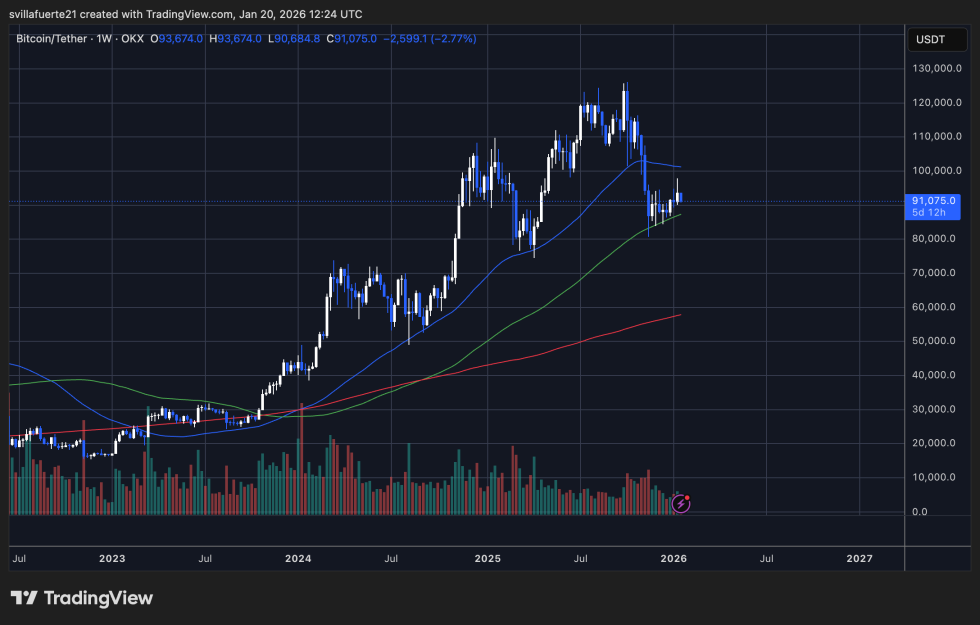
From a technical perspective, Bitcoin is hovering around the zone where previous support has flipped into resistance. Price is currently sitting near the rising 100-week moving average (green), which is acting as a key pivot for bulls. Holding above this level WOULD signal that demand is strong enough to absorb supply during dips. However, the 50-week moving average (blue) has rolled over and remains above price, highlighting that the broader trend has not fully reset bullish momentum.
The 200-week moving average (red) continues to trend higher far below current levels, confirming the long-term uptrend remains intact. For now, the market likely needs a clean weekly reclaim above $95,000 to shift sentiment. Until then, this bounce risks being treated as corrective rather than trend-confirming.
Featured image from ChatGPT, chart from TradingView.com
