Ethereum’s Busy Network Hides a Looming Security Crisis, Analysts Warn

Beneath the surface of Ethereum's bustling transaction flow, a critical vulnerability is quietly festering. The very activity that signals a thriving ecosystem may be masking systemic risks that could threaten the network's foundational security.
The Hidden Cost of Success
Analysts point to the immense strain placed on Ethereum's consensus mechanism by its own popularity. High network utilization, while a bullish signal for adoption, creates a perfect storm—congestion that doesn't just slow things down but potentially weakens the chain's defensive posture. It's the blockchain equivalent of a building so packed with people that no one can check the structural integrity of the walls.
A Security Model Under Pressure
The core issue isn't just about fees or speed. It's about the economic incentives that secure the network becoming distorted under heavy load. Validators and node operators face perverse pressures, potentially prioritizing transaction throughput over protocol robustness. Think of it as a security guard forced to also work the ticket booth during a rush—something's bound to get overlooked.
The Balancing Act
Ethereum's development roadmap, with its relentless march toward scalability through layer-2s and sharding, aims to alleviate this pressure. But the transition itself is a high-wire act. Each upgrade introduces complexity, and a network this valuable is a constant target. The race isn't just to scale; it's to scale securely without creating new attack vectors faster than old ones are patched.
Finance's favorite new toy is learning that being too popular has its own unique set of problems—turns out, even digital gold can have a stress fracture. The ultimate test for Ethereum won't be hitting a new price peak, but proving its security can scale as relentlessly as its hype.
Address Poisoning On The Spotlight
In a recent blog post, researcher Andrey Sergeenkov warned that a recent ethereum upgrade is being exploited to send tiny transactions that create misleading wallet history entries, a tactic known as address poisoning.
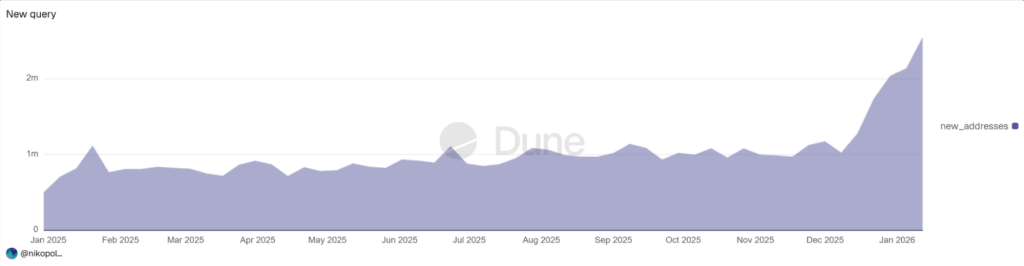
According to the expert, a big slice of the traffic may be the result of “dusting” or address poisoning attacks. Small, almost worthless transfers — sometimes less than a dollar — are being sent to a wide range of addresses.
Record-high Ethereum activity that everyone’s celebrating is an address poisoning attack.
– Over $740K already stolen, and growing – This became possible thanks to the Fusaka upgrade – This attack is ongoing right nowhttps://t.co/cqoEvqttQd
— Andrey Sergeenkov (@Nikopolos) January 19, 2026
These tiny transfers create fake-looking entries in a wallet’s history. People who skim their recent transactions or copy addresses from a short list of past contacts can be tricked into sending funds to a scammer by mistake. It is a basic trick that gets more power when fees fall.
Why It Happened
Reports say that after recent updates and lower average gas costs, sending millions of tiny transactions became affordable. When fees drop, attackers can spray dust across large numbers of wallets and run follow-up scams at scale.
The tactic uses two steps: first, make a history entry that looks like a real counterparty; second, hope a user copies that wrong entry. Some attacks aim to deanonymize users, while others are pure bait to steal funds later.
An Ethereum wallet owner might glance at a list and use the wrong address. Or they might be prompted by a message that seems to match a past transfer. Either way, if funds are sent to the attacker, those funds are usually gone.
Reports estimate that hundreds of thousands of dollars have been siphoned from victims who fell for different versions of this trick. The sums are not always massive per case, but they add up when many victims are targeted.
Look for small incoming transfers from addresses you do not recognize, especially when those transfers appear in large batches. Watch for identical token amounts or for many transfers with the same memo or pattern.
Wallets that show sudden clusters of tiny token receipts are worth extra caution. Security tools and some wallets can hide tiny transfers or warn users about unusual incoming dust. Use those features if they are available.
What Experts AdviseBased on reports, researchers urge people to verify the full address they are sending to, not just the start or end of it. Use address book features, QR codes, or trusted contacts to confirm destinations.
Avoid copying addresses from a short recent-history view. If you receive a small, unexpected deposit, take it as a warning sign, not an invitation.
Featured image from Pexels, chart from TradingView
