Global Pension Funds & Insurers Are Piling Into XRP ETFs — Canary CEO Drops Bombshell

Institutional money is finally breaking down the door. Forget the cautious toe-dipping—pension funds and major insurance companies are now making serious allocations to XRP exchange-traded funds, according to a CEO who sees the floodgates opening.
The New Institutional Playbook
It’s a seismic shift in strategy. For years, these trillion-dollar managers treated crypto like a speculative sideshow. Now, they’re using the ETF wrapper as their golden ticket, bypassing the operational headaches of direct custody to gain clean, regulated exposure. The appeal? A digital asset positioned at the crossroads of payments and regulation, wrapped in a familiar, reportable format their boards can stomach.
Why XRP, Why Now?
The timing isn’t random. As regulatory clouds begin to part for some assets, institutions are hunting for established players with real-world utility narratives. XRP’s long-touted use case for cross-border settlement provides a tangible story—something fund managers can pitch beyond mere ‘digital gold’ or memecoin mania. It’s a bet on the plumbing of future finance, not just the shiny new faucets.
A Cynical Nod to Tradition
Let’s be real—this is the same industry that once needed a decade and a financial crisis to embrace junk bonds. Their sudden ‘innovation’ often looks a lot like chasing yield dressed up as a visionary thesis.
The bottom line? When pension funds move, markets listen. This isn’t retail FOMO; it’s the sound of old money building a new position, one ETF share at a time. The validation wave for crypto is here, and it’s wearing a very expensive suit.
Why XRP ETFs Are So Successful
McClurg made the comments in a Wealthion podcast interview with CoinFund President Chris Perkins, discussing Canary’s strategy in crypto ETFs and why single-asset products like XRP can pull demand from both US and international channels. The throughline was familiar to anyone who has watched ETFs reshape other markets: access and execution matter, and they often matter more than ideology.
“A lot of our clients are retail,” McClurg said, estimating “probably 20 to 30%” of flows are coming from retail channels based on visible brokerage activity. The larger share, he added, is currently coming from faster trading-oriented capital. “It’s probably about 70% — I don’t want to call it institutional, but it’s probably 70% fast money at the moment.”
Even so, McClurg’s view is that the stable end state for products like an XRP ETF is the advisor and allocator channel that already lives inside the ETF ecosystem. “ETFs are going to be probably primarily used by financial advisors,” he said. “Because they’re simple, they’re clean, they can hold them in their accounts, they can explain it.”
For crypto, he argued, the problem is not subtle.“Most of retail is trading crypto on an exchange and they’re getting charged massive fees,” he said. “We’re talking $100 a trade. Plus the spread.”
His point was not that ETFs are free, but that the ETF wrapper can compress costs and friction, particularly for investors who do not want to operate in exchange-native workflows. “When you think about an ETF… you’ve already won by buying an ETF when you’re talking about pennies spread… and then you’re only paying a 1% management fee,” he said.
McClurg also addressed a factor that tends to drive ETF flows in crypto regardless of narrative: basis. He argued the spot/futures spread can act as a lever for ETF demand, and by extension a source of incremental spot pressure when the trade is attractive.
“The basis trade is really what’s driving crypto ETFs at the moment,” he said, adding that outflows in Bitcoin spot ETFs have, at times, coincided with the collapse of that spread. For XRP specifically, he suggested the dynamic has been supportive since launch.
“We’ve benefited from launching XRP,” he said, “because there’s a great basis trade there.” He went further, claiming the product has seen consistent net buying even as broader markets softened.
McClurg also highlighted the success of all spot XRP ETFs in the US. “Ever since the launch, even at a down market, there’s not been a single day of outflows,” McClurg said.
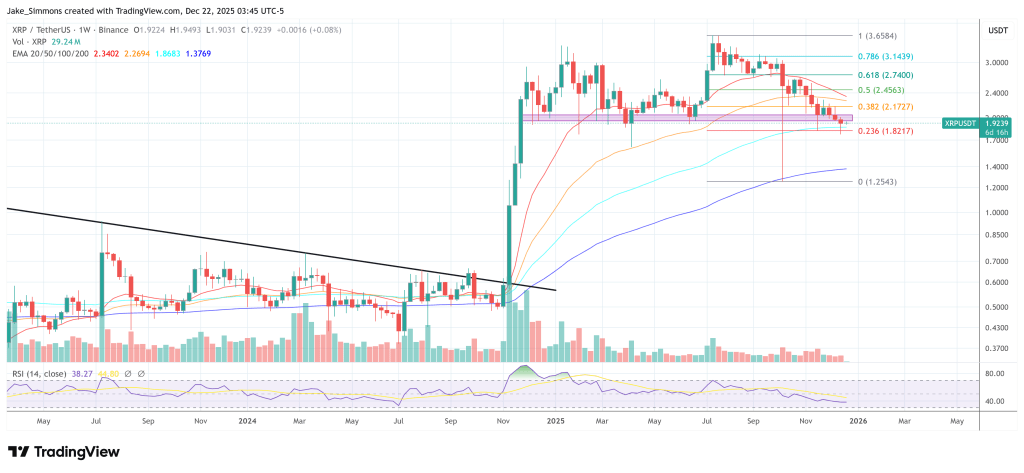
At press time, XRP traded at $1.92.