Ethereum Derivatives See Heavy Unwind As Open Interest Plummets – A Leveraged Flush Before The Next Run?

Ethereum's derivatives market just took a deep breath. Open interest is collapsing—a classic sign of leveraged positions getting washed out in a hurry.
The Great Unwind
When too many traders pile into futures and options with borrowed money, the market gets twitchy. A slight dip triggers margin calls, forcing a cascade of liquidations. That's what the data screams right now: a massive, system-wide deleveraging event. It's not a sell-off based on fundamentals; it's the sound of overconfident speculators hitting the exit all at once.
Bull Market Plumbing
p>Think of this as necessary maintenance. Flushing out excessive leverage resets the playing field, creating a healthier foundation for the next move up. It removes weak, short-term hands and transfers assets to stronger ones. Volatility is the price of admission in crypto—and sometimes, that price gets collected all at once.What Comes After the Flush?
History shows these events often precede powerful rallies. With speculative froth cleared, the underlying asset can move on its own merits. For Ethereum, those merits—its developer ecosystem, institutional adoption roadmap, and core technology upgrades—haven't changed. The narrative didn't break; just some over-leveraged bets did. After all, what's a bull market without a few traders learning the hard way that leverage works both ways?
Sharp Drop In Ethereum Open Interest
In the current volatile state of the cryptocurrency landscape, the Ethereum derivatives market is signaling a key indicator. This crucial signal is coming from the ETH Open interest, which has witnessed a significant pullback in the past few months. According to the research from the advanced investment and on-chain data analytics platform Alphractal, the metric has dropped by half or 50% since August this year.
A significant drop in this metric is a clear indication that trader positioning and risk appetite have shifted notably. Following a period of high leverage and aggressive speculation, the sharp collapse indicates that positions are being unwound, exposure is being decreased, and momentum is cooling across futures markets.
Alphractal highlighted that the Ethereum open interest is valued at roughly half of what it was in August 2025, suggesting a drastic decline in market risk. Such a move points to institutions and large whale holders who have closed Leveraged ETH positions. The exiting of positions by big investors shows that they are reducing exposure and speculative pressure.
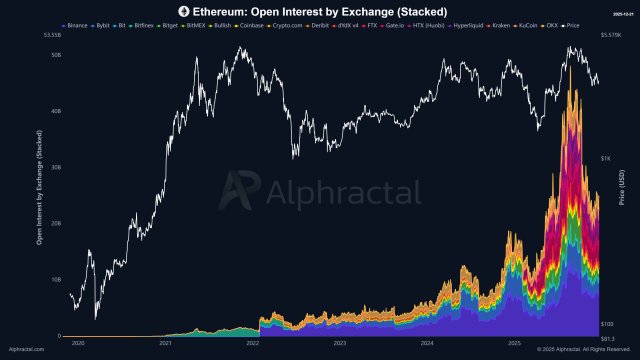
ETH’s open interest has also fallen sharply on cryptocurrency exchanges. After examining the ethereum Open Interest distribution by exchange, Alphractal unveiled a 31% decline to $7.64 billion on the world’s largest exchange, Binance.
On Gateio, open interest is at $3.72 billion, indicating a 15% decrease, while HTX (formerly known as House) has fallen by 12.65% to $3.12 million. Furthermore, Bybit has $2.53 billion with a 10.25% drop, Hyperliquid has $2.51 billion with a 10.18%, and Bitget has $1.79 billion with a 7.25% decline.
With exchanges’ open interest dropping, this tells a compelling story of the current market structure. This outlines robust deleveraging across the Ethereum market and a lower probability of explosive moves in the short term.
Typically, an atmosphere that is more cautious and protective implies stages of consolidation or preparation for the next trend leg. However, DEEP declines in open interest have historically frequently preceded significant structural changes, either a healthier reversal or a downward continuation with less leverage.
ETH Withdrawals From Crypto Exchanges Have Spiked
Ethereum’s open interest drop comes at a time of a massive drop in ETH supply on crypto exchanges. Currently, ETH withdrawals have reached their lowest levels since 2016, reflecting growing trader caution and dampened short-term sell pressure.
As more ETH is taken out of exchanges and placed in long-term holding locations, the liquid supply keeps decreasing. While the supply decrease bolsters ETH’s volatility, it also encourages price pressure to rise.
