Bitcoin Mining Could Be Strengthening The Ruble, Russian Central Bank Says

Russia's central bank drops a bombshell: Bitcoin mining might be propping up the national currency.
The Digital Lifeline
Forget gold reserves or oil exports—Russia's latest economic stabilizer could be humming away in Siberian data centers. The Bank of Russia, long skeptical of crypto's wild swings, now acknowledges a startling possibility: industrial-scale Bitcoin mining is creating a steady flow of foreign currency into the country. Miners sell their freshly minted Bitcoin for dollars or euros, then convert those proceeds into rubles to pay for colossal electricity bills, equipment, and local wages. That consistent buy-pressure for rubles might just be giving the currency an unexpected—and unofficial—backstop.
A Cynical Twist for Finance
It's the ultimate irony for traditional finance: an asset class they've long derided as 'speculative' and 'volatile' is now potentially performing a core central banking function—shoring up a national currency. While Wall Street debates ETFs, in Russia, crypto is doing the gritty work of balance-of-payments support. Talk about a plot twist the IMF didn't see coming.
This isn't about retail speculation or digital gold narratives. This is about raw, industrial-grade crypto infrastructure acting as a de facto export industry. It generates a valuable digital commodity (Bitcoin) on Russian soil, sells it on the global market, and repatriates the capital. The mechanism bypasses traditional financial rails entirely, creating a hard-currency inflow that's as real as any barrel of oil—just significantly harder for sanctions to track.
The Kremlin hasn't officially blessed this theory, of course. But the central bank's mere suggestion sends a powerful signal. It reframes the entire mining debate from one of energy waste to one of strategic economic utility. In a country rich in energy but constrained by financial isolation, Bitcoin mining transforms stranded power into a geopolitical tool.
So, while economists in tailored suits fret over monetary policy, the real action might be in warehouses full of roaring ASICs. The ruble's strength, it seems, could be written in code.
Bitcoin Mining May Support The Ruble
Responding to a question at a press conference, Nabiullina said it is “probably difficult to quantify” mining’s influence “because a significant part of mining is still in a gray area.” Still, she added that mining is “indeed one of the additional factors contributing to the strong ruble exchange rate.”
As Russian business news portal for RBC reported, her remarks come as Russian officials increasingly frame mining and crypto flows as macro-relevant, not just a niche tech or energy story. Earlier, Maxim Oreshkin, deputy head of the presidential administration, said ruble forecasts have been thrown off by the underestimation of financial flows tied to mining and cryptocurrency. In his view, the sector has effectively become a new export item that can influence the currency market, in part because it moves outside standard channels and therefore stays statistically “invisible.”
Nabiullina did not endorse a direct, one-to-one link between ruble strength and a sudden surge in mining. She stressed that mining did not appear in 2025, so it WOULD be incorrect to attribute the ruble’s strengthening specifically to a sharp rise in mining activity this year. “This mining did not appear this year, so it is impossible to link the strengthening of the exchange rate specifically to the fact that it has somehow grown sharply,” she said. “There is probably some increase. Nevertheless, mining is indeed one of the additional factors contributing to the strong ruble exchange rate.”
Crypto Legislation Is Coming?
The central bank’s emphasis on measurement and legality is also tied to its broader push to “whiten” Russia’s Bitcoin and crypto market — bringing activity into a more formal framework where it can be monitored, constrained, and accounted for. Last week, first deputy chairman Vladimir Chistyukhin said it is now fundamentally important to “legalize” the cryptocurrency sector and called for laws governing crypto transactions to be adopted as soon as possible, including strict restrictions and prohibitions.
In parallel, the central bank is discussing rules for crypto trading with the Finance Ministry, Rosfinmonitoring, and other agencies. Under the approach described, crypto transactions would be conducted primarily through existing market participants operating under existing licenses, rather than through informal venues or bespoke structures.
Meanwhile, Anatoly Aksakov, the chairman of the State Duma Committee on Financial Markets, clarified last week that cryptocurrencies “will never” function as money inside Russia or in global trade.
For crypto markets, the significance is not that Russia has officially “blamed” or “credited” mining for the ruble’s moves. It is that senior policymakers are increasingly treating mining-linked flows as an input into currency-market dynamics — while pushing for regulatory plumbing that would make those flows easier to see, categorize, and control.
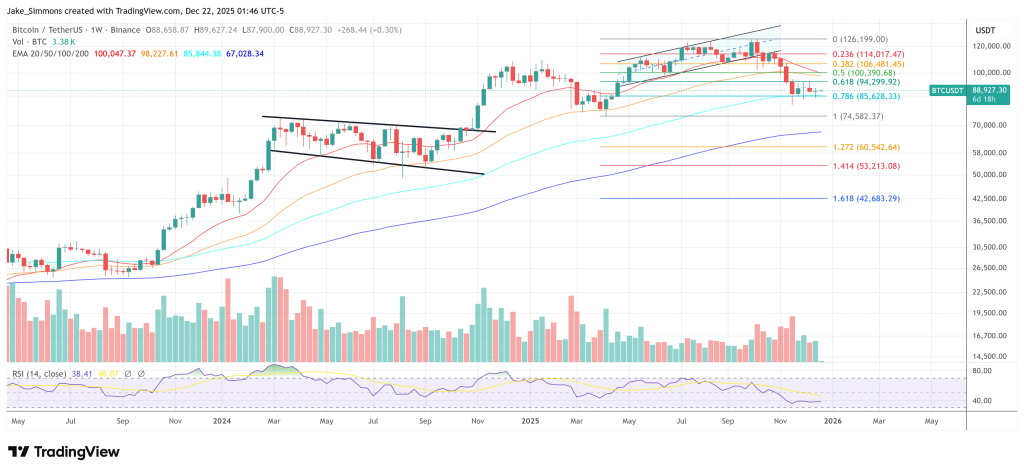
At press time, Bitcoin traded at $88,927.