Bitcoin Mining Profitability Crisis: 2025’s Warning Flashes Match 2022 Stress Levels

Bitcoin mining economics just flashed a red alert—profitability is plunging toward levels not seen since the brutal crypto winter of 2022.
The Squeeze Is On
Forget gradual declines. The data shows a sharp, worrying compression in miner margins. The same economic pressures that crushed profitability three years ago are back with a vengeance, threatening operations that expanded during the bull run. It's a classic case of over-leverage meeting a harsh reality check—Wall Street would call it 'creative destruction,' miners call it survival mode.
Hash Rate vs. Reality
The network's total computational power remains near all-time highs, but the revenue supporting it is crumbling. This isn't a minor correction; it's a fundamental stress test for the entire mining ecosystem. Efficient operators will endure, while the laggards face a brutal shakeout. The so-called 'hash ribbon' indicator is signaling pain, just like it did before the last major downturn.
Adapt or Power Down
Miners aren't sitting idle. They're scrambling—hedging power contracts, upgrading to more efficient hardware, and even relocating to regions with cheaper energy. This isn't just about Bitcoin's price; it's about the brutal calculus of electricity costs, hardware efficiency, and block rewards. When the math doesn't add up, rigs go silent. The industry's resilience is being measured in kilowatts and satoshis per joule.
A cynical take? The 'efficient market' is doing what it does best: separating the prudent from the overzealous, often with the subtlety of a sledgehammer. The coming months will reveal who built a business and who just rode a wave of speculative excess.
NVT Golden Cross Signals a Structural Valuation Reset
CryptoQuant analyst Moreno emphasizes that the most valuable signals from the NVT Golden Cross tend to appear during deep negative deviations, when market psychology and fundamentals diverge sharply. In the current cycle, the indicator fell to a historically depressed level NEAR -0.58, a zone that goes beyond simple bearish sentiment.

According to the analysis, this level reflects a structural undervaluation of the Bitcoin network, where price compression outpaced any meaningful decline in on-chain economic activity.
Such conditions are typically observed during phases of forced deleveraging and elevated risk aversion. In these environments, liquidity exits speculative positions aggressively, pushing prices lower even as the underlying network continues to process transactions at relatively stable levels. This imbalance creates valuation gaps that have, in past cycles, marked important inflection points rather than definitive market tops.
The key development now is the recovery of the NVT Golden Cross from -0.58 toward approximately -0.32. This move suggests that price is beginning to realign with transaction-driven fundamentals following a sharp valuation reset. However, the indicator remains in negative territory, implying that bitcoin is still priced conservatively relative to its on-chain utility.
Moreno notes that this setup is consistent with a transition phase, where the market moves from DEEP undervaluation toward equilibrium. Historically, such periods have aligned with accumulation and more disciplined capital allocation, laying the groundwork for healthier, structurally supported price discovery.
Bitcoin Consolidates Above Long-Term Support as Trend Weakens
The weekly chart shows Bitcoin trading near the $88,000 level after a sharp corrective phase from the cycle highs above $120,000. Price is currently consolidating just above the rising 200-day moving average (green), which sits around the mid-$80,000s and represents a critical long-term trend support. This zone has historically acted as a pivot between sustained bull markets and deeper corrective phases, making the current structure especially important.
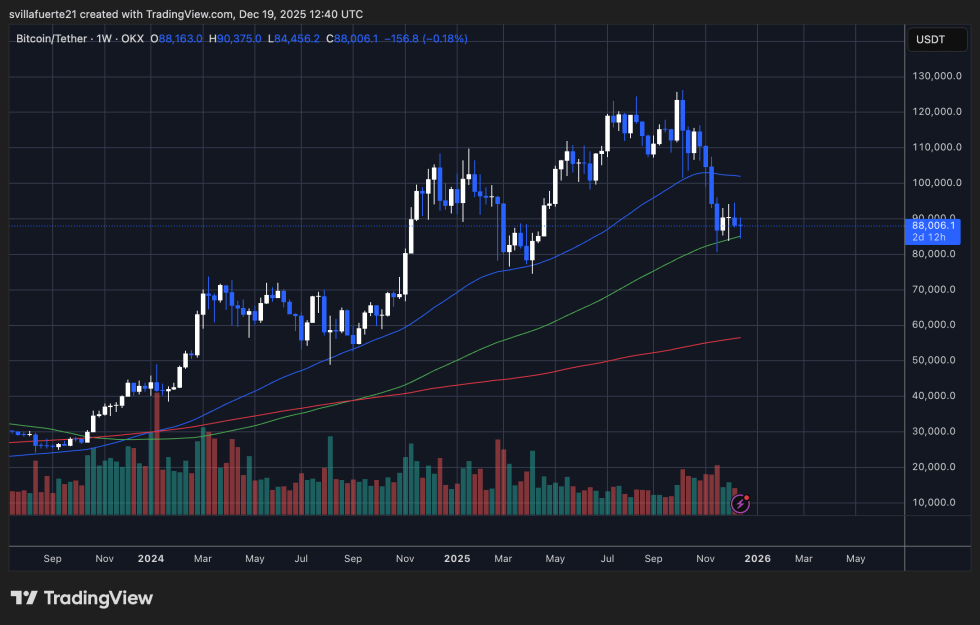
Momentum, however, has clearly weakened. Bitcoin has lost the 50-day moving average (blue) and failed to reclaim it on recent attempts, signaling that short- to medium-term control remains with sellers. The slope of the 50-day MA has started to flatten, reinforcing the idea of a transition from expansion to consolidation. At the same time, the 100-day moving average is curling lower, adding overhead resistance in the $95,000–$100,000 range.
Selling pressure increased during the breakdown from the $100,000 area, while the recent bounce toward $88,000 has occurred on comparatively lighter volume. This suggests that buyers are defending support but lack conviction for a sustained reversal.
As long as Bitcoin holds above the 200-day MA, the broader uptrend remains technically intact. However, failure to defend the $85,000–$88,000 zone WOULD open the door to a deeper retracement, while bullish confirmation requires a decisive reclaim of the 50-day moving average with expanding volume.
Featured image from ChatGPT, chart from TradingView.com
