Japan’s Crypto Market: Why Capital Is Moving, Not Leaving - And What It Stands To Gain

Forget the exodus narrative. Japan's crypto scene isn't bleeding out—it's undergoing a strategic repositioning. Capital isn't fleeing; it's flowing toward new opportunities, reshaping the archipelago's digital asset landscape with a precision that would make a samurai swordsmith nod in approval.
The Regulatory Reboot
Japan's Financial Services Agency (FSA) isn't just tightening rules—it's building a fortress. The push for stricter exchange licensing and robust custody solutions might seem like red tape to some. For serious institutional players, it's a welcome mat. This isn't about stifling innovation; it's about filtering out the noise so the real signal—sustainable, compliant growth—can come through loud and clear. It's the kind of boring, necessary work that rarely makes headlines but always builds empires.
The Institutional Influx
While retail sentiment wobbles, a quieter, more significant shift is underway. Domestic financial giants and forward-thinking corporations are methodically building positions. They're not chasing memecoins; they're deploying capital into infrastructure, tokenization projects, and regulated digital securities. This is patient capital, playing a long game that views market volatility as a feature, not a bug. It's a bet on blockchain's utility, not just its speculative frenzy—a distinction often lost on traditional finance pundits still trying to price crypto like a slightly weirder stock.
Yen On-Chain: The Stablecoin Gambit
Japan's most potent move might be its push to dominate the regulated stablecoin arena. Proposals for a legal framework that treats yen-pegged digital currencies as a legitimate payment method could be a game-changer. It positions Japan not just as a market, but as a potential hub for the next generation of digital finance in Asia. Imagine a world where cross-border trade settles in seconds with a digital yen—that's the prize on the table, and Japan is meticulously setting the table for it.
The path forward isn't about recreating the wild west days of 2017. It's about constructing a sophisticated, mature ecosystem where technology serves finance, not the other way around. The capital moving within Japan's borders is smarter, more demanding, and ultimately, more valuable than the hot money that left. In the end, the market might just gain something it never knew it needed: credibility. And in finance, that's the one asset you can't print—no matter how hard the central banks try.

This behavior does not signal capital fleeing crypto. Rather, it reflects funds temporarily de-risking while remaining fully inside the ecosystem. Capital is accumulating in stablecoins as “waiting liquidity,” positioned on the sidelines and ready to be deployed once clearer directional signals emerge. Liquidity has not disappeared; it is simply paused, patient, and awaiting conviction.
Japan’s Strategic Position in the Global Capital Shift
The analysis also highlights that this shift in global capital behavior carries meaningful implications for Japan’s crypto market. As regulatory clarity improves and tax frameworks gradually become more accommodating, Japan is positioned to benefit from a return of domestic capital that has remained cautious in recent years.
Combined with renewed interest from individual investors, this re-entry of sidelined capital could deepen local liquidity, improve price discovery, and strengthen Japan’s role within the broader global crypto landscape.
A key element in this transition is the growing relevance of JPYC, Japan’s yen-denominated stablecoin. While US dollar–based stablecoins continue to dominate global crypto flows, a yen-native digital currency offers Japan a strategic differentiator.
JPYC is not limited to speculative trading use cases; it is increasingly viewed as an infrastructure LAYER capable of supporting real economic activity. This includes integration with Web3 services, as well as domestic and cross-border payment applications that align more closely with Japan’s existing financial systems.
Looking ahead, the report suggests Japan’s crypto market may gradually shift away from a narrow focus on short-term price speculation. Instead, it could evolve into an ecosystem where capital actively circulates and is deployed for practical use cases. Ultimately, how effectively Japan absorbs and channels this globally mobile liquidity will play a central role in defining the market’s next phase of growth.
Crypto Market Tests Structural Support Amid Broad Risk-Off Sentiment
The total cryptocurrency market capitalization is showing clear signs of structural stress after failing to sustain momentum above recent highs. As the weekly chart highlights, total market cap has retraced toward the $2.9–$3.0 trillion zone, an area that now acts as a critical inflection point for the broader market. This level coincides with the rising 100-week and 200-week moving averages, reinforcing its importance as medium- to long-term support.
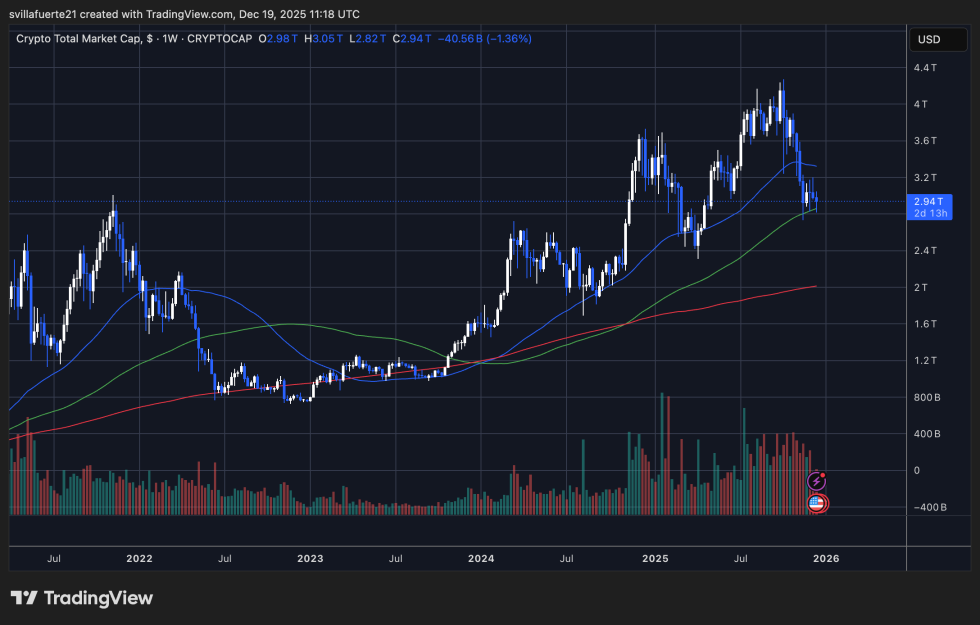
The rejection from the $4 trillion region marks a decisive shift in market structure. After an extended expansion phase through 2024 and early 2025, the market has entered a corrective regime characterized by lower highs and weakening upside follow-through. Volume behavior supports this interpretation: selling pressure has increased during down weeks, while rebound attempts have been met with comparatively muted participation.
Despite the pullback, the long-term trend has not fully broken. The market remains well above the 2022–2023 base, suggesting this MOVE resembles a consolidation or valuation reset rather than a full structural collapse. However, continued trading below the short-term moving averages indicates that risk appetite remains subdued.
For the bullish structure to reassert itself, the total market cap must stabilize above the $3 trillion threshold and reclaim the mid-range resistance near $3.3–$3.5 trillion. Failure to hold current support WOULD expose the market to a deeper retracement toward the $2.4–$2.6 trillion region, where stronger historical demand previously emerged.
Featured image from ChatGPT, chart from TradingView.com
