Bitcoin Shark Accumulation Overstated: Glassnode Researcher Debunks Bullish Narrative

Forget the hype. The story that Bitcoin's big players are quietly gobbling up supply? It's got some serious holes.
The Data Doesn't Lie
A key researcher from on-chain analytics firm Glassnode just cut through the market noise. Their analysis suggests the much-touted 'shark accumulation' narrative—the idea that deep-pocketed investors are stealthily building massive positions—is being significantly overstated by the crypto commentariat. It turns out that not every large wallet movement signals a strategic buy.
Why the Narrative Stuck
In a market hungry for bullish signals, the accumulation story became a perfect fit. It offered a tidy explanation for price stability and fed into the classic 'smart money' versus 'retail' dynamic that finance loves to romanticize. It's the kind of tale that gets retweeted by influencers and whispered about in Telegram groups—often with more conviction than scrutiny.
Reality Check
The researcher's dive into the data points to more mundane explanations for some of the wallet activity: internal exchange transfers, the movement of collateral, or simple rebalancing acts. It's a reminder that in crypto, a narrative can become a self-fulfilling prophecy faster than you can say 'number go up,' even when the foundational data is shaky. Sometimes a whale wallet is just a whale wallet moving funds, not a predator stalking its prey.
So, before you bet the farm on the sharks circling, remember: in both traditional finance and crypto, a compelling story often costs less than due diligence—and usually pays off better for the storyteller.
Bitcoin Shark-Sized Entities Have Been Growing Recently
In a new post on X, Glassnode senior researcher CryptoVizArt.₿ has talked about the recent growth in the supply attached to the bitcoin sharks. “Sharks” are defined as the entities carrying between 100 and 1,000 BTC.
At the current exchange rate, the range of this cohort converts to $8.7 million at the lower end and $87 million at the upper one. Due to the significant size involved, sharks are considered as a investor group, although they are less influential than the whales (1,000+ BTC).
Lately, the supply of the sharks has been following a rapid upward trajectory, as the chart shared by CryptoVizArt.₿ shows.
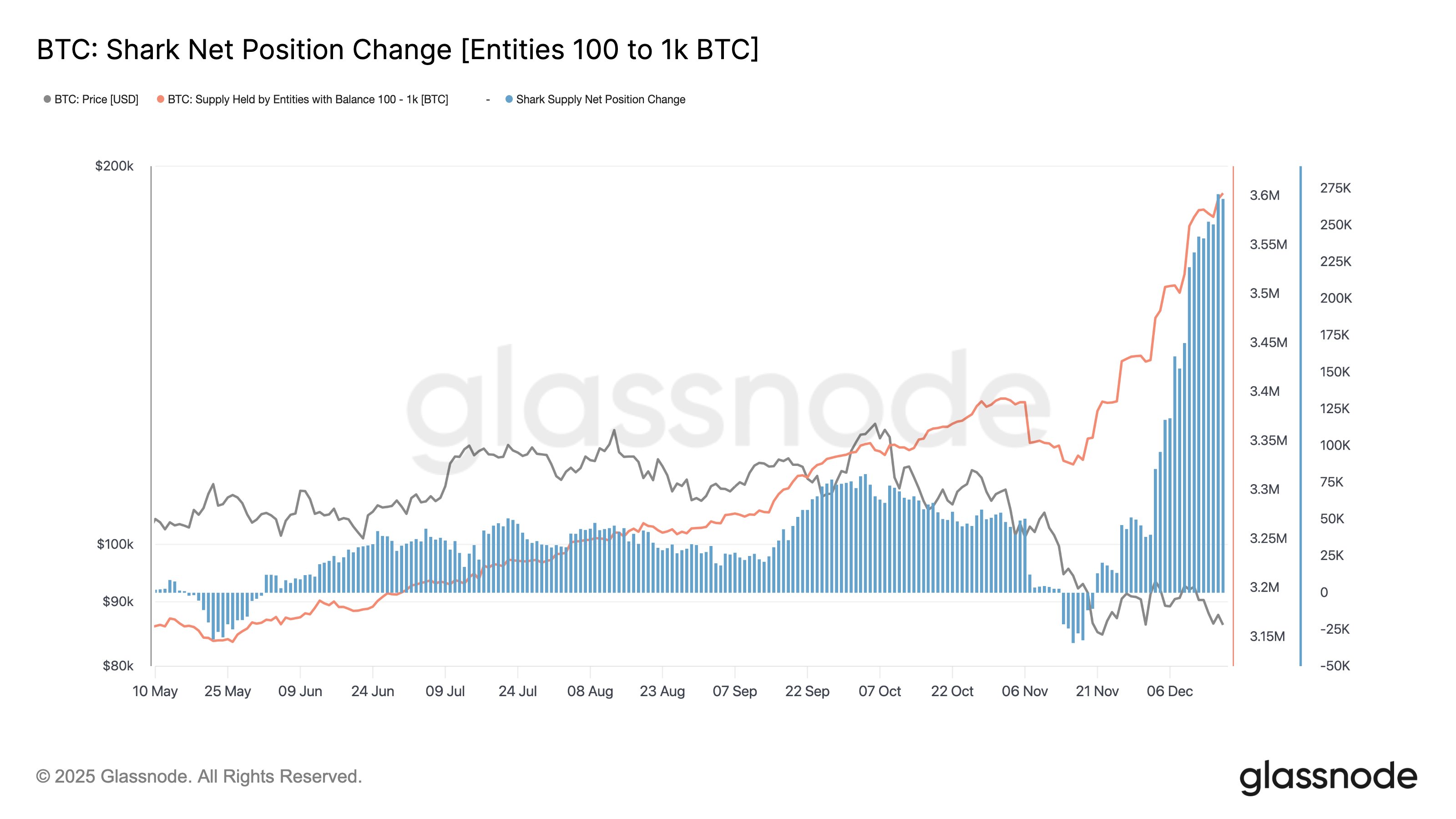
Since November 16th, the Bitcoin sharks have seen their combined balance change from 3.33 million BTC to 3.60 million BTC, reflecting a significant rise of 270,000 tokens. “The key question, however, is whether this reflects genuine net accumulation, or merely internal reshuffling across cohorts, a distinction only deeper on-chain analysis can resolve,” said the Glassnode researcher.
By “reshuffling,” CryptoVizArt.₿ is referring to the merging or splitting of holdings that investors sometimes take part in. For example, a whale deciding to break their balance across multiple wallets can register as a decrease in the whale supply, and an increase in the supply of whatever bracket the smaller holdings fall inside.
Signs point to something similar being a factor behind the recent Bitcoin shark supply increase. Below is another chart shared by the analyst, this one comparing the trend in the supply of the 100,000+ BTC entities against that of the sharks.
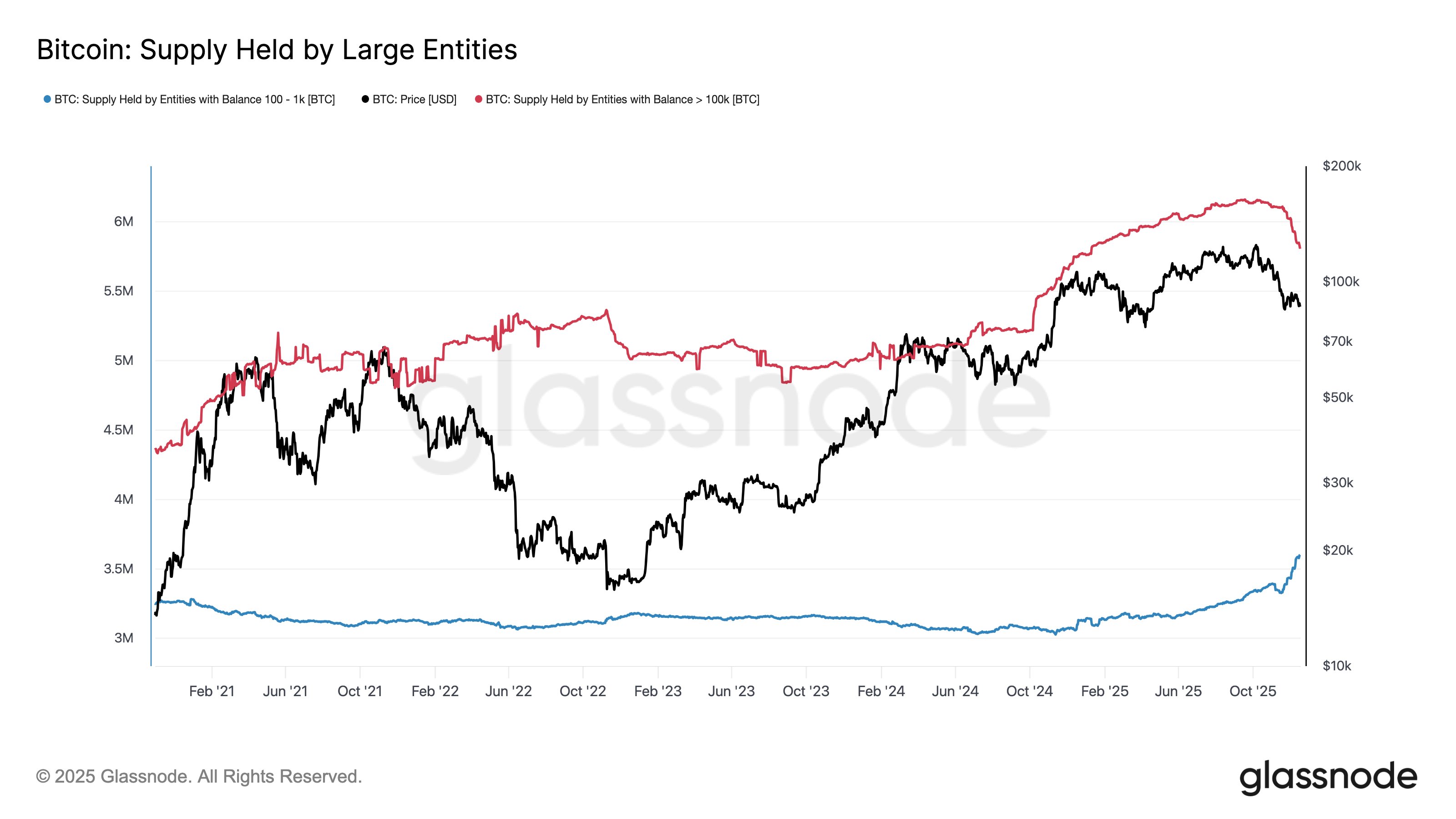
The 100,000+ BTC cohort corresponds to the largest of entities on the blockchain, including exchanges, exchange-traded funds (ETFs), and custodial services. From the graph, it’s apparent that the holdings of this group have been declining recently.
Interestingly, the amount distributed by the cohort in this drawdown is 300,000 BTC, which is roughly equal to that accumulated by the sharks (270,000 BTC). “This pattern strongly points to wallet reshuffling, not organic accumulation,” noted CryptoVizArt.₿.
Since the 100,000+ BTC bracket also includes exchanges, reshuffling out of these platforms (that is, withdrawals) can still point toward positive accumulation. It turns out, however, that the nature of the reshuffling is truly likely to be internal, as Coinbase made internal wallet transfers amounting to a massive 640,000 BTC alongside this trend.
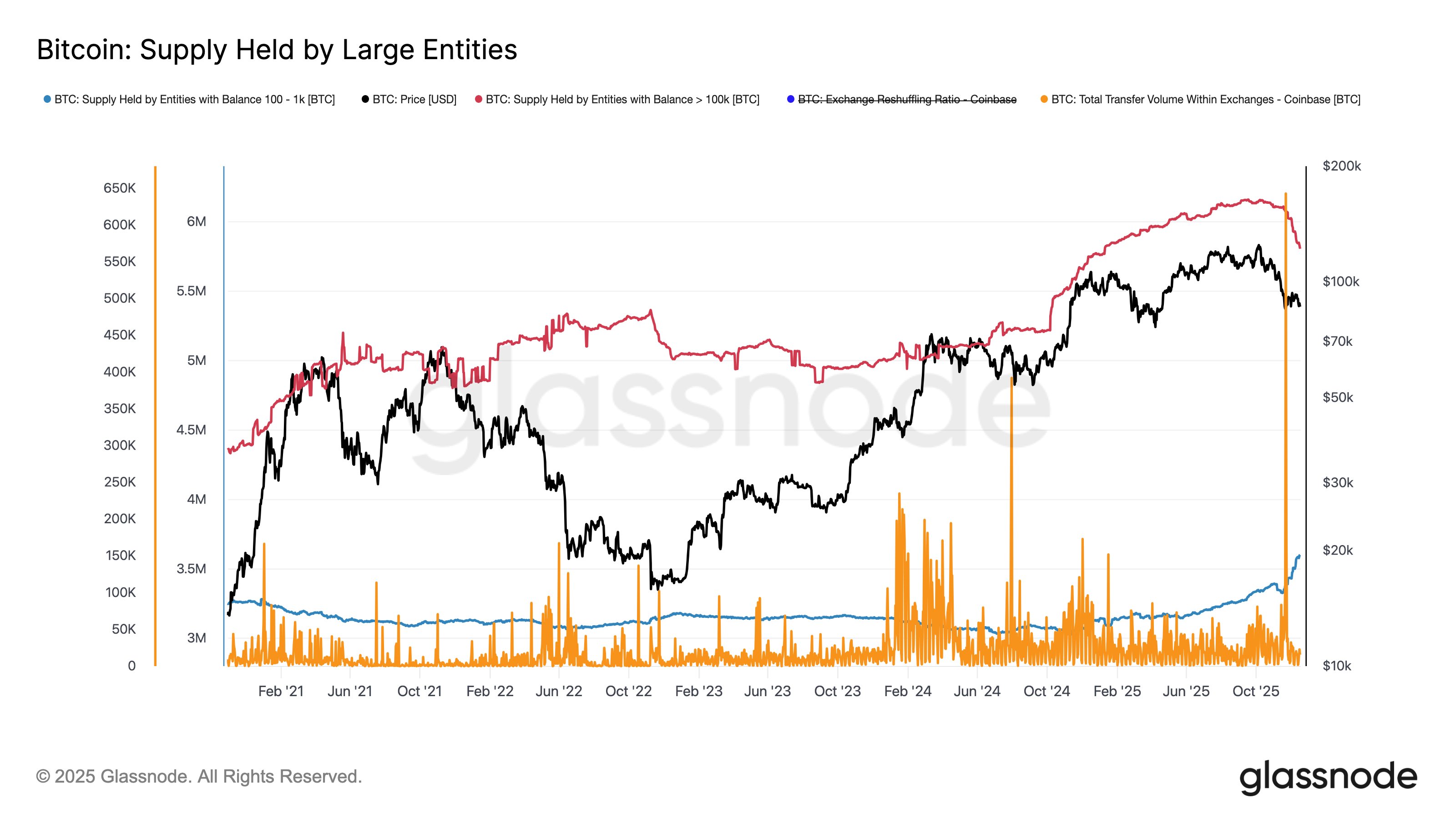
Based on the data, the analyst has concluded:
The key takeaway is that >90% of the apparent “shark accumulation” is likely driven by internal reshuffling by large custodial entities, rather than net buying by new 100–1K BTC holders.
BTC Price
At the time of writing, Bitcoin is floating around $87,300, down over 3% in the last seven days.
