Ethereum’s Negative Supply Dynamics Hold Firm As ETH Issuance Falls Behind Burns – Here’s What You Need to Know

Ethereum flips the script: the network now burns more tokens than it creates.
The Deflationary Machine
Forget the old inflation playbook. Ethereum's post-merge mechanics are delivering a supply shock that traditional finance textbooks didn't cover. The protocol's fee-burning mechanism consistently outpaces new ETH issuance, locking in a negative supply growth rate.
Network Economics on Autopilot
Every transaction, every smart contract interaction, now contributes to a permanent reduction in total ETH supply. It's a built-in, algorithmic response to network usage—high demand doesn't just raise fees; it actively destroys the currency's base supply. A self-correcting mechanism that would give a central banker an existential crisis.
The Burn Rate Reality
The numbers don't lie. The burn address isn't a theoretical concept; it's the most active sink in crypto-economics, continuously pulling more ETH out of circulation than the staking rewards put in. This isn't temporary—it's the new structural norm for an asset once criticized for its unlimited supply.
What This Means for Holders
Scarcity is being programmed directly into the protocol. While traditional markets debate quantitative tightening, Ethereum executes it by code. Each block finalizes a net reduction, making every surviving ETH marginally more rare—a feature, not a bug, for an asset class built on digital scarcity.
The bottom line? While Wall Street funds pay analysts to predict Fed moves, Ethereum's monetary policy runs on immutable math. The 'ultra-sound money' narrative just got its strongest technical backing yet.
Net Negative Ethereum Supply Persists
Even with the current bearish state of the market, the supply dynamics of ethereum are hinting at a quiet but powerful signal to the market. In a post on the social media platform X, Leon Waidmann, a market expert and the head of research at On-Chain Foundation, has delved into the asset’s supply dynamics, revealing a persistent negative trend.
On-chain data indicates that Ethereum supply has remained net negative despite continuous price swings, as seen on the chart shared by Waidmann. The data also shows that the metric has been exhibiting a negative trend over the last 7 days.
When Ethereum’s supply dynamics stay negative, it simply implies that more ETH are being removed from circulation compared to those being added to the market. This pattern is a result of persistent network activity, ongoing fee burning, and rising long-term holding and staking demand.
During the 7-day period, Waidmann highlighted that over 30,000 fresh ETH were added to the market. Meanwhile, Spot Ethereum Exchange-Traded Funds (ETFs) accumulated over 67,100 ETH, with about 11,700 ETH being burned via network fees.
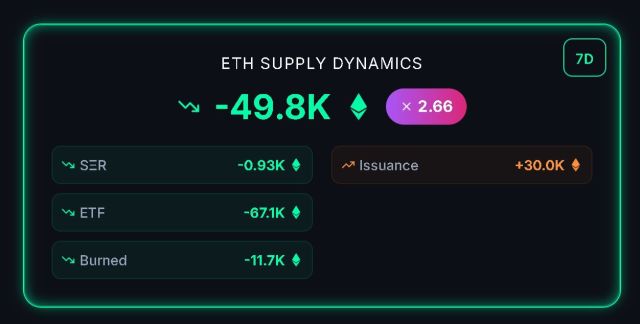
Overall, this brings the network’s net supply change to -49,800 ETH. Therefore, the number of ETH removed from circulation was 2.7x more than those issued in the market within the period. What this means is that the current demand for ETH continues to structurally outpace issuance.
Typically, heightened demand in the market has preceded upward swings in price. However, the price of ETH has failed to respond in this direction. Waidman noted that the price is not moving yet, because most demand is passive and not price-chasing.
Thus, the expert declares absorption first before breakout comes later. Furthermore, large holders are still distributing into rallies, which leads to the capping of short-term moves. Another reason hinges on derivatives, as it often sets the marginal price, not spot flows.
During negative supply dynamics, there is usually a tightening of the floor before it lifts the ceiling. Waidmann has highlighted a market structure where supply breaks first, then price follows, which is a clear pattern of how bases are formed.
ETH Network Throughput Makes Historical Highs
With recent updates, the Ethereum network has sprung back to life at a rapid rate. Joseph Young, a crypto enthusiast, has shared a fresh milestone for ETH, as the network’s execution throughput surges to an all-time high. The newly launched Fusaka Upgrade drives the network’s recent spark.
Since the introduction of the key update, Young stated that ETH’s mainnet capacity has doubled, and rollups such as Base are already processing 10x that execution. According to Young, rollups are scaling in production while ETH is rapidly scaling, reinforcing the growing notion that ETH is the settlement LAYER of finance.
