Crypto Hedge Funds Flee to Stablecoins as Rate Cuts Loom – History’s Warning Signal Flashes Again

Smart money is parking on the sidelines. As whispers of a central bank pivot grow louder, crypto's institutional players are executing a familiar defensive play: a mass migration into stablecoins.
The Safety Trade Is On
Forget diamond hands—this is about preserving dry powder. Data reveals a clear exodus from volatile altcoins back to the dollar-pegged harbors of USDT and USDC. It's not a loss of faith in crypto's long-term thesis; it's a tactical retreat. Hedge funds aren't selling to exit the arena. They're converting their chips into stable tokens, waiting for the post-announcement dust to settle before placing their next big bets.
A Pattern That Pays
This isn't their first rodeo. The same defensive shuffle has preceded major volatility events before, often serving as a contrarian indicator for patient bulls. When the herd panics into stability, it often drains liquidity from the market, setting the stage for a powerful snap-back rally. The funds know this. Their stablecoin hoard isn't just a safe haven—it's a war chest, primed to deploy when fear peaks and valuations get silly.
Timing the Turbulence
The real game begins after the rate decision. Will the cut be a 'risk-on' siren, sending capital flooding back into Bitcoin and high-beta alts? Or will it be a 'sell the news' event, validating the caution? The funds, wallets fat with stablecoins, are positioned for either outcome—ready to buy the panic or chase the breakout. It's a reminder that in crypto, sometimes the most aggressive move is to temporarily do nothing, a concept that gives traditional finance bros hives. After all, why make a risky bet when you can get paid to wait?
So, watch the stablecoin supply. When those parked billions start moving, it won't be a quiet exit. It'll be the starting gun.
Funding Rates Reveal the Market’s True Positioning
According to the XWIN Research Japan report, Funding Rates make the current crypto market structure even clearer. During the August–October 2025 period, funding surged as short-term traders aggressively loaded into long positions ahead of the FOMC decision, only to collapse sharply once the announcement was released.
Bitcoin’s price followed the same pattern: a strong pre-event rally driven by expectations, followed by a swift reversal as Leveraged traders were forced to unwind. This fits the historical sequence of rate-cut expectations followed by a temporary rally, and a post-announcement deleveraging and decline.
The report highlights that today’s crypto market is showing similar behaviors. CME futures open interest has stalled, signaling that institutional traders are avoiding high-conviction directional bets. Whale spot holdings remain flat, suggesting that major players are positioned defensively rather than accumulating. At the same time, stablecoin inflows are accelerating, a hallmark of event-driven hedging as capital waits on the sidelines for clarity.

As XWIN Research Japan notes, whether the Fed cuts rates or not, one pattern remains consistent: volatility expands sharply during FOMC week. The danger lies in chasing the pre-meeting bounce without respecting the historical tendency for post-announcement shakeouts. In this environment, risk management—not prediction—is the winning strategy.
Total Crypto Market Cap Holds Key Support But Lacks Momentum
The Total Crypto Market Cap chart shows the market stabilizing around the $3.1 trillion level after a sharp multi-week decline. This area sits just above the 100-week moving average, a historically important dynamic support zone that often defines whether the broader cycle maintains bullish structure or shifts into deeper corrective territory. For now, buyers have stepped in to defend this region, preventing a breakdown that could have opened the door to a retest of the $2.7T–$2.8T area.
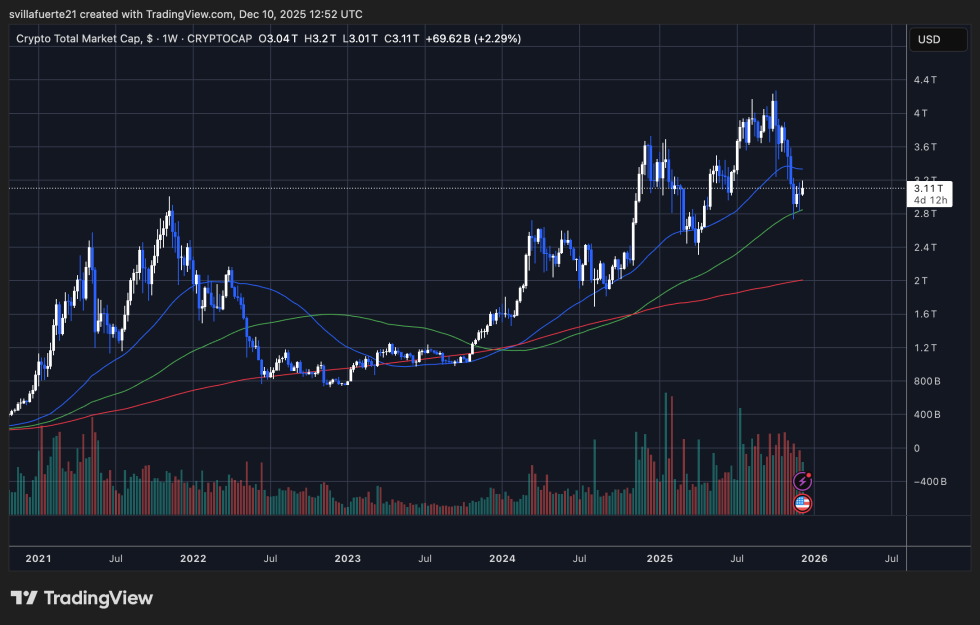
Despite the bounce, the structure remains fragile. The market is still trading below the 50-week moving average, which has now begun to bend downward—a sign that momentum has weakened across major assets like Bitcoin, Ethereum, and key altcoins. Volume has not shown a strong surge on the rebound either, suggesting that institutional conviction remains cautious ahead of the FOMC meeting and macro uncertainty.
A decisive reclaim of the $3.3T–$3.4T zone WOULD shift momentum back in favor of bulls, opening room for a broader recovery. However, failure to break above this cluster of resistance could reinforce the idea that the recent bounce is only corrective. For now, the total market cap hovers at a crossroads, with macro events likely to determine the next major move.
Featured image from ChatGPT, chart from TradingView.com
