Coinbase Triggers Crypto Market Inflection Point—Bitwise Issues Urgent Warning

Crypto's sleeping giant just woke up. Coinbase's latest move has sent shockwaves through digital asset markets, with Bitwise analysts declaring a paradigm shift in investor sentiment.
The catalyst? A seismic shift in institutional participation patterns that's rewriting the rulebook for crypto valuations. Trading volumes tell the story—liquidity is flooding back into major pairs as traditional finance finally stops pretending blockchain is just for 'tech bros'.
Market structure is evolving faster than regulators can draft their next warning memo. While the suits debate custody rules, the smart money's already repositioning—proving once again that in crypto, the early bird gets the decentralized worm.
A Crypto Plot Twist: Coinbase Revives ICOs
Crypto attempted to break this pattern once before. “It was—let’s be honest here—a complete disaster,” he says about the 2017–2018 ICO boom. “The vast majority of ICOs turned out to be scams.” With no guardrails, “charlatans raised billions from the unsuspecting public,” eventually forcing the SEC to intervene. “Its massive crackdown in 2018 destroyed the ICO trend and drove crypto into a DEEP bear market.”
But Hougan insists the failure masked an underlying truth. “As bad as ICOs were, they did prove something interesting: Crypto could be used to raise capital rapidly for new projects.” ICOs showed a model that was “lower-cost, faster, and more egalitarian” than IPOs, even if the execution was fatally flawed.
The difference today, he argues, is regulatory intent and institutional architecture. Hougan highlights SEC Chairman Paul Atkins—formerly co-chair of the Token Alliance and a board member at Securitize—as a driving force behind new thinking. In July, Atkins called for “new regulations and safe harbors that WOULD allow high-quality ICOs to happen.” According to Hougan, Atkins argued that “if we can fix what went wrong with ICOs 1.0, we could see a boom in new capital formation—all led by crypto.”
That is the backdrop for Coinbase’s move. “On Monday, Coinbase took the first major step toward making this a reality,” Hougan writes. Coinbase unveiled a new platform that will launch one “fully-vetted” token sale per month, with enforced team disclosures, mandatory lockups for insiders, and a standardized screening process. “In short,” Hougan says, “through self-regulation, it aims to fix a lot of what was wrong with the 2017-2018 ICO era.”
He is explicit about where he thinks this goes: “I bet we’ll see a half-dozen or more billion-dollar ICOs through platforms like Coinbase in 2026.” While still small relative to the traditional IPO market—“176 IPOs in the US raised $33 billion in 2024”—Hougan argues that even a handful of successful ICOs would prove a structural point: “Entrepreneurs can raise capital directly from investors, often at better terms than they would in the traditional IPO market.”
On the investment side, Hougan points first to Coinbase itself. “The obvious investment is in Coinbase,” he writes, describing the company not just as a brokerage but a multi-lane financial infrastructure giant: “It’s not just the Charles Schwab of Crypto; it’s Charles Schwab + Goldman Sachs + NYSE + …”
He also sees upside for base-layer ecosystems: “A healthy ICO market will bode well for the largest programmable blockchains, like ethereum and Solana.”
Yet the larger thesis is index-level. “An ICO renaissance,” he writes, “is another major proof point for crypto as a whole.” Crypto’s narrative grew stronger as stablecoins and tokenization matured; billions raised through vetted ICOs would strengthen it further. His advice: “Don’t try to pick the horse; bet on the race.”
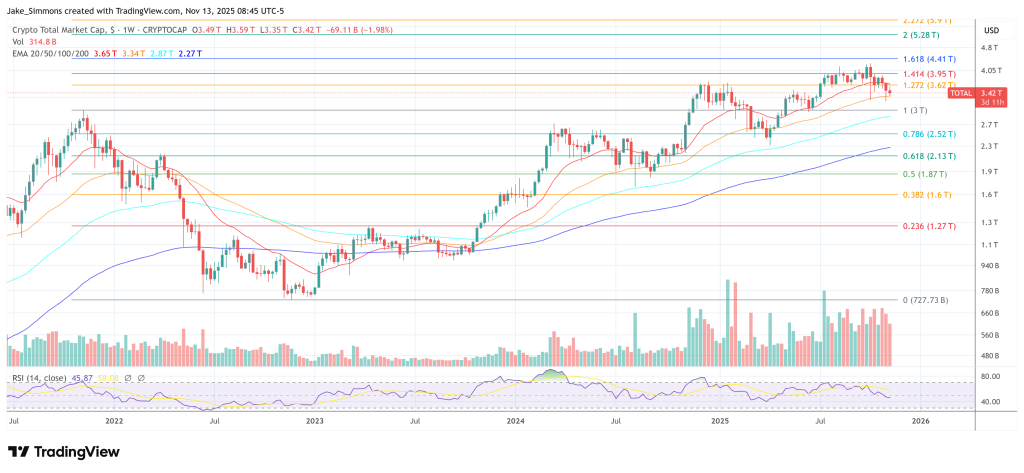
At press time, the total crypto market cap stood at $3.42 trillion.