Bitcoin Exodus Accelerates: Binance Dominates as Rivals Bleed Reserves

Bitcoin's great migration is underway—and Binance is swallowing the flows whole while competitors watch their reserves drain.
The Centralization Conundrum
Exchange wallets don't lie. While Binance's Bitcoin balances swell by thousands of coins weekly, smaller platforms are hemorrhaging digital gold at alarming rates. This isn't just portfolio rebalancing—it's a fundamental shift in market infrastructure that could reshape crypto's entire landscape.
Liquidity Magnet Effect
Deepest order books create their own gravity. As traders chase tighter spreads and faster execution, capital naturally consolidates where action already thrives. The rich get richer while regional exchanges struggle to maintain critical mass—classic Wall Street dynamics playing out in digital asset form.
Trust Deficit Widens
Post-FTX, institutional players aren't taking chances. They're parking assets where proof-of-reserves actually means something. Funny how billion-dollar funds suddenly care about transparency after getting burned—wonder what took them so long.
When one exchange becomes too big to fail in an industry built on decentralization, maybe we're not building the future of finance—just recreating the past with blockchain wallpaper.
Binance Defies The Trend As Bitcoin Inflows Grow
As the market faces bearish action, Bitcoin’s on-chain dynamics and coin movement appear to be taking an interesting turn. The shift in on-chain dynamics and coin movement is a result of investors sending their coins to Binance, the world’s largest cryptocurrency exchange.
A report from CryptoQuant, a leading data analytics provider, indicates that Bitcoin reserves on the Binance platform have increased significantly, despite global exchange balances continuing to experience outflows. Such a divergence may be signaling the potential for more volatility in the near term.
Despite investors elsewhere taking bitcoin out for long-term storage or self-custody, this disparity points to a rising consolidation of liquidity on the leading cryptocurrency exchange. It could also play a vital role in shaping BTC’s liquidity and volatility heading into the next phase of the market.
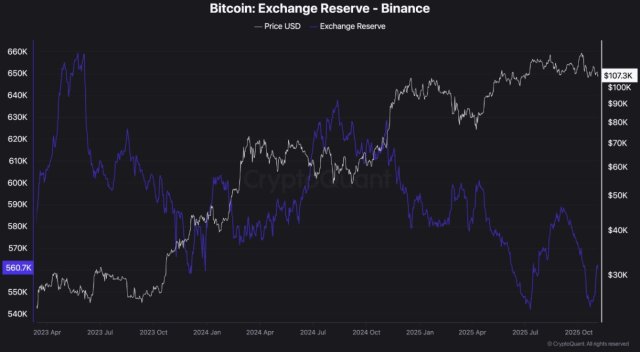
According to ShayanMarkets, the short-term liquidity increase on the Binance platform, coinciding with larger market participants shifting coins into self-custody, is a bullish long-term indication. This trend often represents rising trading activity or hedging by institutional investors.
In the past, when market makers were positioning for the next big move, such inflows to a dominating exchange during consolidation phases sometimes came before increased volatility. If this rising Binance reserve trend continues while total exchange reserves drop, ShayanMarkets highlighted that it may indicate a pre-distribution or rebalancing stage before the start of another accumulation-driven surge.
Long-Term BTC Investors Reduce Sell Pressure
Darkfost, a CryptoQuant author, has outlined a shift in long-term Bitcoin holders‘ activity amid market volatility. At first, the expert noted that these investors moved more than 383,000 BTC in the month of October, a stack that represents over $40 billion at current prices.
Interestingly, the metric shows that the coins reached 405,000 BTC on October 29. Even though this is a significant amount, it is still not up to the levels observed during the corrections of this cycle. Meanwhile, these figures have now dropped to 314,000 BTC, indicating that the trend is stabilizing in the short term.
Typically, when BTC held by LTHs is being moved, it is often meant for a sell-off. However, Darkfost stated that the current levels have been fairly absorbed, which causes Bitcoin to consolidate in a range rather than enter a directional correction. Thus, the expert urges a close monitoring of this trend to prevent it from getting worse.
