Cardano Founder Claps Back At Doubters, Unveils 2026 Comeback Strategy

Charles Hoskinson isn't mincing words—the Cardano founder just delivered a fiery rebuttal to critics while mapping out the blockchain's ambitious 2026 revival plan.
The Counterattack
Hoskinson's response cuts through the noise with surgical precision, addressing every major criticism head-on. No more diplomatic corporate speak—just straight talk about Cardano's actual progress versus perceived shortcomings.
The Roadmap Revealed
Forget vague promises. The 2026 blueprint lays out specific technical milestones and adoption targets that could silence even the most vocal skeptics. We're talking major protocol upgrades, ecosystem expansion, and real-world implementation that moves beyond theoretical advantages.
Why This Time's Different
Previous timelines missed? Development delays? Hoskinson acknowledges past stumbles while presenting concrete evidence that the foundation's finally set for explosive growth. The team's learned from every setback—and they're leveraging those lessons.
Meanwhile, traditional finance continues its slow dance with blockchain technology—always two years away from being two years away from meaningful adoption. Cardano's betting big that by 2026, the institutions still 'evaluating blockchain use cases' will be playing catch-up to networks that actually built something.
The message is clear: write off Cardano at your own peril.
Midnight As Key Adoption Driver For Cardano
A large portion of the AMA elevated Midnight—the privacy-preserving partner chain—as the mechanism to unlock the “interoperability and bridges” critique and to catalyze exchange coverage for Cardano native tokens.
“I’ve spent the last six years building Midnight. We’re getting ready to launch […] [It] resolves pretty much all those concerns,” he said, adding that the token would be a Cardano-native asset with “tier one exchange listings,” “over a 100 partnerships,” and connectivity to “eight ecosystems, seven blockchains—Ethereum, Bitcoin, Solana, Binance Smart Chain, XRP, Avalanche, and obviously Cardano.”
He positioned Midnight as a practical bridge LAYER for cross-chain capital and as a driver of DeFi participation on Cardano: “People are going to want to create yield with their [Midnight tokens], and so they’re going to utilize Cardano DeFi.”
He also previewed distribution mechanics and scale claims around the Midnight drop: “Midnight is shaping up to be the largest drop in the history of the industry […] There are already millions of addresses […] about 200,000 participating in the glacier drops […] I believe Kraken and […] Gate [are participating] […] when you sum up all those people, it’s going to be probably over a million, which makes it larger than Arbitrum.”
On stablecoins specifically, he forecast resolution via Midnight’s negotiation leverage and a trust-minimized “recursive snark bridge” between Midnight and Cardano: “As for the stablecoin side of things, that’s going to get totally resolved in 2026 […] If it’s on Midnight, we’ll have a trustless recursive bridge […] Native issuance on Midnight into Cardano.”
Cardano Scaling
Hoskinson dismissed the “severe network congestion” critique as inconsistent with current utilization. “Our blocks are about a third to half full most of the time or less […] do we really have a throughput problem?”
He pushed back on suggestions that Cardano’s scaling stack was unreleased: “Hydra is working on mainnet right now […] If you participated in the Glacier drop, you were using Hydra […] Hydra has reached version 1.0. There are numerous people on Cardano mainnet using Hydra right now on a per-application basis.” As evidence of efficiency, he cited loading “33.6 million eligible addresses” into a Hydra head for the drop “at a total operation cost” of less than five figures.
On the data availability/throughput track he calls Leios, Hoskinson said “the SIP is done” and that “linear Leios is being planned for released next year,” with a public monthly R&D cadence and an upcoming progress website. He linked those efforts to partner-chain finality work and recursive SNARKs, arguing Cardano is scaling “with values”—maintaining decentralization and resilience while adding throughput.
Marketing And GovernanceWhile rejecting claims of “negligible marketing reach,” Hoskinson conceded underperformance and said he would personally drive an event-centric push in 2026: “Even though it’s not my job, I’m going to make some of it my job […] we’re going to have four major events per year […] bring the top 25 to top 50 dApp/DeFi projects on Cardano to those events to augment the Cardano booth, the IO booth.” He pointed to Token2049 as a model—“we took over that entire event […] even the Wi-Fi codes”—and called for a sustained campaign around Cardano’s “USPs.”
He repeatedly stressed the absence of a single entity accountable for growth. “There is nobody currently accountable […] for the growth of Cardano. If it’s no one’s problem, everyone’s problem is no one’s problem.” The remedy, in his view, is a 2026 framework of delegated authority with explicit KPIs across MAUs, transaction volume, TVL, active dApps, developer counts, integrations and blockchain-to-blockchain partnerships.
In this context he contrasted the Midnight Foundation’s “hungry” execution—“they announce deals every week”—with frustration at the Cardano Foundation’s silence on Midnight partnerships and listings: “Zero tweets saying Midnight is a big thing […] It’s frustrating to me because how do we win if we destroy ourselves?”
Pipeline: Africa, Bitcoin DeFi, PartnershipsHoskinson said IO is preparing Cardano-native DeFi applications for 2026 and emphasized that the “real” Africa microfinance product never stopped.
“We never gave it up. We never stopped. Go to Twitter. People just lie until it becomes reality in their minds. They say we abandon Africa. John O’Conor is still here. It’s a huge team. We’ve been lending money like crazy, my money, and we’re opening it up for micro finance, banking the unbanked, the economic identity side of it. And that is coming in 2026. I think that’s going to be the largest contributor to Cardano’s TVL when that service turns on,” Hoskinson said.
He also tied it to the bitcoin defi initiative. “Bitcoin and ADA can be lent, converted into a stablecoin, and then lent out […] Our belief is that’ll create billions of dollars of TVL for the network and bring a lot of Bitcoin into the network.”
He also referenced conversations and integrations with Near—“you guys saw the Near intents coming through”—and floated blockchain-to-blockchain outreach to Tezos and Algorand including an indirect route to chainlink via Near given “a direct conversation has been less than fruitful due to the price […] mid eight figures.”
On developer experience, he argued the narrative is outdated: “They say it’s Haskell only […] They don’t even talk about Aiken […] Every programming language designer […] says it takes about three to seven years […] we’re right there.” He flagged Plutus v4 “next year,” StarStream “adding contract composition,” and a lane for rollups supported by recursive SNARK primitives, alongside L2 efforts “like Midgard and Gummy.” The strategic thread, he said, is continuity: “We bet big on decentralization […] resilience […] interoperability with Bitcoin […] partner chains. Now it’s about adoption.”
Hoskinson closed by pledging continuing delivery on partner chains—“I want to launch one every year”—core research translated into production, and relentless advocacy, while asking the community to match that with usage and unified messaging. “We can complain about it or we can solve the problem. Together we will succeed.”
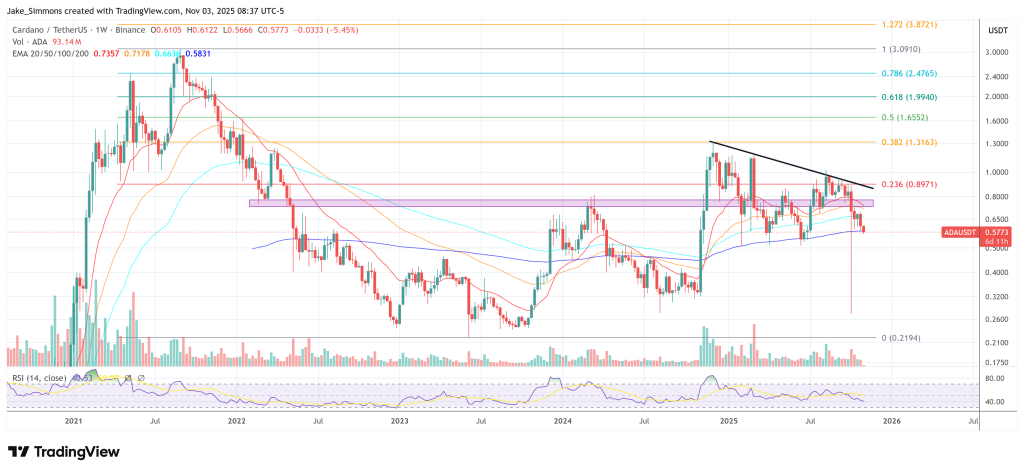
At press time, ADA traded at $0.577.