Grayscale Declares Solana Crypto’s Next Dominant Force

Solana just got the institutional stamp of approval that sends altcoins soaring—and traditional finance scrambling.
The Institutional Endorsement That Matters
Grayscale's latest research positions Solana as the ecosystem poised to capture the next wave of blockchain adoption. Their analysts point to transaction speeds that leave Ethereum gasping and development activity that's attracting serious capital.
Network Performance Meets Market Momentum
While other chains struggle with congestion and soaring fees, Solana's architecture handles throughput that makes legacy systems look prehistoric. The numbers don't lie—developer migration to the ecosystem has accelerated while institutional allocation keeps climbing.
The New Power Dynamic
This isn't just another altcoin season story. Grayscale's endorsement signals a fundamental shift in how major players view layer-one contenders. Suddenly, the 'ETH killer' narrative doesn't seem so far-fetched—especially when traditional finance firms start treating it as credible competition.
Of course, Wall Street will pretend they saw this coming all along—right after they finish reallocating their portfolios to catch up.
Solana Is The Leading Blockchain By Activity
At the token level, Grayscale places SOL squarely in large-cap territory, noting an implied network valuation of roughly $119 billion and ranking SOL as the fifth-largest crypto asset by market capitalization when excluding stablecoins, and the third-most liquid by average daily trading volume. The firm frames SOL as a “digital commodity that helps operate the network and provides investment access to growth in the Solana ecosystem,” positioning future price performance as a function of the network’s user base, throughput, and fee capture rather than narrative alone.
The activity picture is central to the thesis. Grayscale highlights that Solana’s application layer now spans decentralized finance, consumer and social apps, and physical infrastructure networks, with standout traction in each. On the DeFi side, Solana’s DEXs have cleared more than $1.2 trillion in year-to-date volume, the highest tally across any blockchain ecosystem, while aggregator Jupiter is described as the industry’s largest by volume.
In consumer crypto, memecoin launchpad and social venue Pump.fun is cited at roughly two million monthly active users and around $1.2 million in daily revenue. In the DePIN category, Helium’s migration and expansion on Solana anchors a real-world footprint Grayscale finds notable: “1.5 million daily users, 112,000 hotspots, and partnerships with major telecom companies like AT&T and Telefonica.”
Beyond those flagships, Grayscale points to a long tail of more than 500 unique applications and a breadth of use cases that now includes brisk NFT trading (third among networks), significant stablecoin settlement (fifth), and a foothold in tokenized assets (seventh). The cumulative effect shows up in fees. “Although there’s variation over time,” the report states, “the Solana ecosystem earns about $425 million in fees per month — or more than $5 billion annualized,” which Grayscale calls “the most direct measure of total demand for a blockchain and its applications.”
Performance characteristics remain a defining pillar of the analysis. Blocks arrive “every 400 milliseconds,” with transactions reaching probabilistic finality “in about 12–13 seconds.” Critically, low fees have persisted at scale. Users have paid an average transaction fee “of just $0.02 year to date,” while a local-fee-market design keeps congestion effects contained to hotspots of demand; Grayscale says median daily fees this year averaged “just $0.001.” The roadmap aims to compress latencies further. “A forthcoming upgrade to Solana called Alpenglow is expected to reduce finality time to 100–150 milliseconds,” the researchers note.
User experience and architecture are framed as strategic differentiators. Grayscale calls Solana “a fast and cheap blockchain for everyone” that also “offers arguably one of the best new-user experiences in crypto.” The “monolithic” design, in contrast to layered rollup stacks, avoids bridging between execution domains, while wallet infrastructure — led by Phantom — is credited with smoothing onboarding and everyday use.
SOL Tokenomics And Developer Momentum
On the supply side, the tokenomics section emphasizes both dilution and offsetting staking yield. SOL’s issuance currently expands supply by about 4%–4.5% per year, which Grayscale calls a headwind “all else equal.” But with nominal staking rewards “around 7%,” the “real (inflation-adjusted) reward rate” lands in the “roughly 2.5%–3%” range, depending on conditions. “Currently around two-thirds of outstanding SOL tokens are staked,” the report adds.
Developer momentum and potential “moats” are discussed in the context of the Solana VIRTUAL Machine. Where EVM compatibility lets applications port across many chains with relatively low friction, Solana’s SVM “can’t be easily transferred to non-SVM blockchains,” a dynamic Grayscale says “potentially [contributes] to sticky demand.”
The report tallies “more than 1,000 full-time developers working on Solana and SVM-based applications,” and finds that “the number of Solana-focused developers has grown faster than any other smart contract platform over the last two years.” That developer concentration, alongside escalating user activity and fee capture, is presented as reinforcing flywheels for the ecosystem.
Competitive risks remain front and center. Grayscale underscores that some rival chains can be “even faster and/or cheaper,” often by “operating a more centralized network,” a trade-off users may accept depending on the application. Permissioned chains, while limiting openness, can be optimal in specific institutional contexts. At the monetary-asset end of the spectrum, the report is explicit that SOL “may be less suitable as a long-term ‘store of value’” relative to Bitcoin or Ether, citing higher nominal inflation and, more importantly, questions of resilience.
“Solana’s efficiency comes at the cost of comparatively high hardware and bandwidth requirements, such that many of the network’s nodes operate in data centers,” Grayscale writes, warning that this “could become a source of centralization over time and a vector for third-party interference.” These are “complex and unsettled issues,” the report cautions, and investor perceptions may evolve.
By Grayscale’s framework — users, transactions, and fees — Solana presently “is the leading network for on-chain activity.” The firm’s base case is that the scale and variety of Solana’s economy provide a “strong foundation for SOL valuation,” while acknowledging formidable competition and architectural trade-offs. The implicit investment lens is straightforward: if Solana continues to add users, process more transactions, and expand its fee base, “investors can anticipate a rising SOL price,” while accepting that price will not map one-for-one to fundamentals in the short run.
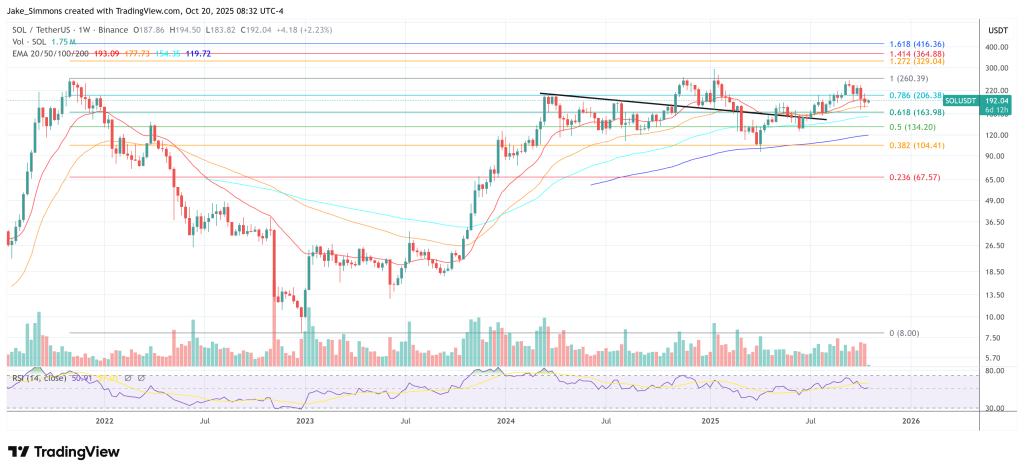
At press time, SOL traded at $