16 Years On: Crypto Privacy Rules Still Thwart Cross-Border Regulation, Warns G20 Risk Report

Crypto's privacy shield just won't crack—and regulators are feeling the heat.
The Regulatory Maze
Sixteen years after the first privacy-focused protocols emerged, cross-border watchdogs still can't pierce crypto's anonymity veil. The G20 risk assessment reveals what insiders have known for years: decentralized networks bypass traditional oversight mechanisms with elegant precision.
Global Coordination Gap
National regulators keep building taller fences while crypto protocols dig deeper tunnels. Financial intelligence units chase shadows across jurisdictions—each country's rules stopping at its digital border. The report highlights how privacy coins and mixing services cut through regulatory frameworks like warm knives through butter.
The Compliance Conundrum
Banks spend millions on AML systems while a single privacy transaction slips through untouched. Traditional finance's compliance departments resemble medieval armies trying to stop drone strikes—all that armor and nowhere to aim. One almost admires the efficiency, if it weren't so terrifying for the suits in charge.
Sixteen years of regulatory evolution versus sixteen lines of privacy code—and the code's still winning. Maybe next time try regulating something that actually wants to be caught.
Privacy Rules Hindering Cross-Border Crypto Regulation
It has been 16 years since Bitcoin’s (BTC) launch, and financial watchdogs around the world continue to face problems when trying to access crypto data. According to a recent report by the FSB, privacy laws are complicating efforts to access such data.
In a detailed 107-page long peer reviewed report, the G20 risk regulator remarked that privacy of data remains a crucial bottleneck that is hindering cross-border cooperation in regulating digital assets such as Bitcoin (BTC), ethereum (ETH), and stablecoins.
It is worth highlighting that the FSB is funded by the Bank for International Settlements (BIS), and works as a global financial authority that monitors and makes recommendations about the evolving global financial system.
The FSB has found several major gaps in how governments of different countries around the world regulate the digital assets market. The authority said that these gaps lead to second-order challenges, including regulatory arbitrage, data gaps, and market fragmentation. It added:
Comprehensive coverage of potentially higher risk activities, such as borrowing, lending, and margin trading, is often lacking. In addition, gaps or the lack of comprehensive reporting frameworks for crypto-asset service providers (CASPs) hinder authorities’ ability to monitor and address potential financial stability risks effectively.
The FSB noted that crypto supervision and enforcement efforts tend to lag behind regulatory development, with many jurisdictions yet to implement the tools necessary for ensuring compliance and oversight.
According to the FSB, the issue of data confidentiality remains a major concern in identifying potential systemic risks and, in turn, supervising cross-border crypto asset activities. Specifically, secrecy or data privacy laws are likely to pose significant barriers to co-operation.
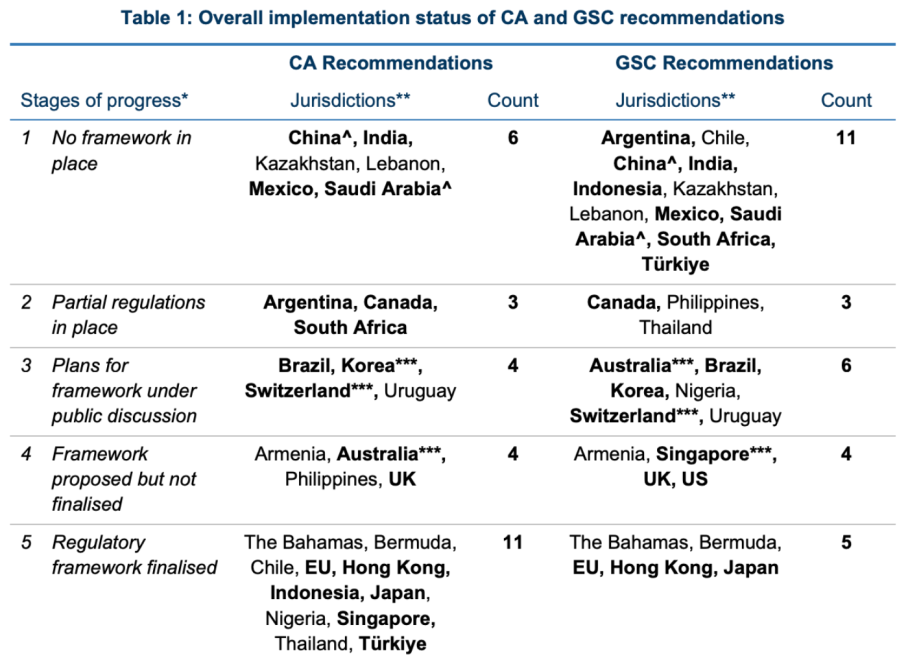
Further, the FSB remarked that a good chunk of users are reluctant to share confidential information due to risks of data breaches and the lack of guaranteed reciprocity. The report shares the following table highlighting the implementation status of the FSB’s policy recommendations.
Little Progress Made By G20
In 2023, the G20 – a group of countries comprising the 20 major global economies – pledged to establish a unified crypto regulatory framework. At the time, the body asked its member countries to share information to better regulate the emerging asset class.
However, little progress has been made since then. The challenges remain the same, if not more complicated, due to the rapid pace of advances in the crypto industry. One G20 member country, India, recently delayed releasing its crypto framework over systemic risk concerns.
Meanwhile, the FSB recently stated that it will take measures to address stablecoin-related risks. At press time, BTC trades at $106,727, down 1.2% in the past 24 hours.

