Japan’s Financial Titans Launch Yen-Pegged Stablecoin - Payment Revolution Begins

Japan's biggest financial institutions are rewriting the rulebook for digital payments.
The Yen Goes Digital
Three banking giants just dropped a yen-denominated stablecoin that could transform how Japan transacts. Forget waiting days for settlements - these institutions are bringing instant, blockchain-powered payments to the mainstream.
Regulatory Green Light
The Financial Services Agency isn't just watching from the sidelines - they've actively cleared the path for this innovation. While other countries debate regulation, Japan's moving forward with actual implementation.
Traditional Banking Meets Crypto
This isn't some startup experiment. We're talking established financial heavyweights putting their reputation behind digital assets. They're not just dipping toes in the water - they're diving headfirst into the crypto pool.
Because apparently what finance really needed was another way to move money - just what the bankers ordered while counting their traditional fees.
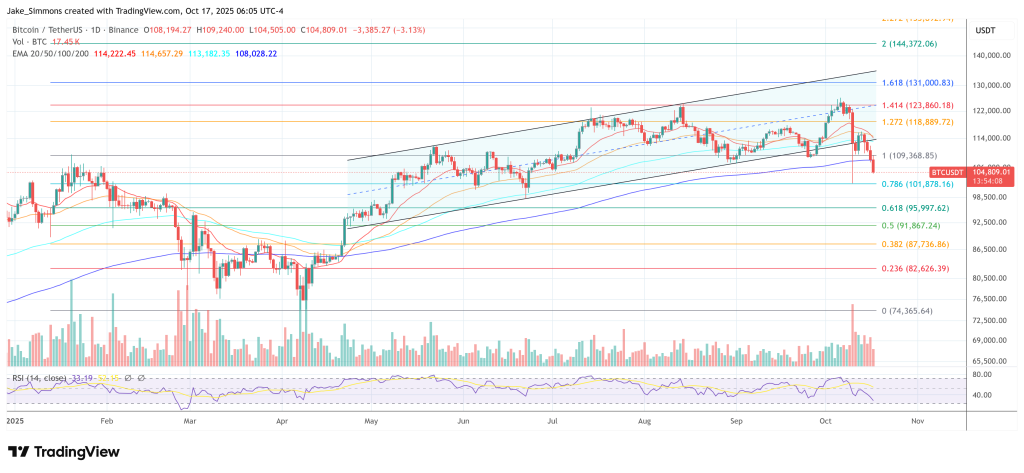
The Start Of A New Bitcoin Bear Market?
In a X post on Friday, October 17, Burniske wrote that this cycle “has been disappointing for most,” which can “paralyze action as people hope for bluer skies, or former ATHs,” and urged investors to think in linear monthly terms rather than “chart minutiae.”
He added: “MSTR is slipping, Gold is sending a warning, as are credit markets, and stocks will be the last to get the message… I want to see how $BTC responds to $100K, but will likely get interested in the market again when I see $BTC $75K or lower.” The post had 50.2K views at the time referenced.
Burniske’s remarks follow the October 10 selloff that knocked Bitcoin as low as the mid-$100Ks in intraday trade and triggered the sharpest reset of leverage ever for the crypto market. Market tone through this week underscores his “broke the bid” framing. By Friday morning in Europe, Bitcoin was changing hands below $106,000 again, leaving it roughly 15% below its month-to-date peak and dragging the total crypto market capitalization under $3.6 trillion.
The spot-ETF complex—central to this cycle’s marginal demand—mirrored the risk-off turn. Following the liquidation shock, US spot bitcoin and Ether ETFs posted combined net outflows for the week to date (Monday–Thursday). Bitcoin ETFs registered –$858.7 million, with three of four sessions in the red, while Ether ETFs were –$79.5 million, split evenly with two inflow and two outflow days.
Responses to Burniske on X captured the debate over whether October 10 marked a cyclical break or a violent, but ultimately constructive, reset. Quant and derivatives-focused trader Shanaka Anslem Perera called it a “VaR shock, not a cycle top,” arguing that “basis/funding/OI all got reset → leverage washed out, new upside will need spot demand, not perps,” and that “the marginal bid has changed: US spot ETFs + corporate/sovereign treasuries.”
Burniske replied, “Excellent breakdown, thank you for sharing.” Another commenter, Magumsy, pushed back that calling the event “breaking crypto” was “overblown,” citing “on-chain flows and institutional liquidity” as buffers; Burniske clarified that he meant it “broke a lot of peoples’, or institutions’, appetites to bid.”
Asked about altcoins if a bear market starts here, he answered bluntly: “Depends on the alt, some are bottomless — imo it’s time to consolidate into your highest conviction names + USD, or at least that’s what I’ve done.”
Whether Bitcoin needs to revisit the mid-$70Ks to entice sidelined capital is now the crux of positioning. Burniske’s tactical map—watch behavior “at $100K” and get “interested… at $75K or lower”—implies a broad re-rating of risk premia after a cycle that, in his words, “was different,” with the next bear “different too.”
At press time, Bitcoin traded at $104,809.