


CZ Liked It Twice and BonkGuy Bought In: What Is BEM?
 Blockbeats
Original title: "CZ Liked It Twice and BonkGuy Bought In: What Is BEM?"
Original author: Nicky, Foresight News
From Sept. 12 to 14, BEM, the mining reward token of the on-chain circuit design protocol TapeOut Protocol on BNB Chain, surged from $20 to a peak of $101.9, a gain of over 400%.
According to GMGN market data, as of press time, BEM is trading at around $58, with a market cap of about $10 million. The buy/sell fee is 1%, and cumulative fees have reached 60.48 BNB, worth about $3,500. Total supply is 21 million tokens, with a current supply of about 170,000 tokens. It has been listed on exchanges such as MEXC, Gate, and LBank.
This rally has brought TapeOut into the spotlight. TapeOut's founder, Blonskr, is a self-proclaimed 16-year-old high school student. According to his post on Aug. 15, he created the first real on-chain 4-bit processor, Behemoth, on BNB Chain, consisting of 2,251 NAND gates and flip-flops, with specifications comparable to the 1971 Intel 4004. The clock ticks with BNB Chain block production, at about 2.22Hz. Binance founder Changpeng Zhao commented on the post: "pretty interesting. What's the use case?"
In the early days of the project, the community had disputes about the founder's age and the project's feasibility. However, as features such as Behemoth, PoD question bank, circuit containers, and on-chain Linux demos were gradually launched, the community began to trust the founder and TapeOut.
Subsequently, Blonskr attempted to bring the semiconductor industry's "tape-out" concept (tape-out is the process of submitting chip design blueprints to a foundry to manufacture actual chip samples on silicon wafers) onto the blockchain, and built a mining coin mechanism similar to Bitcoin mining logic but with completely different on-site rules, which is the token BEM.
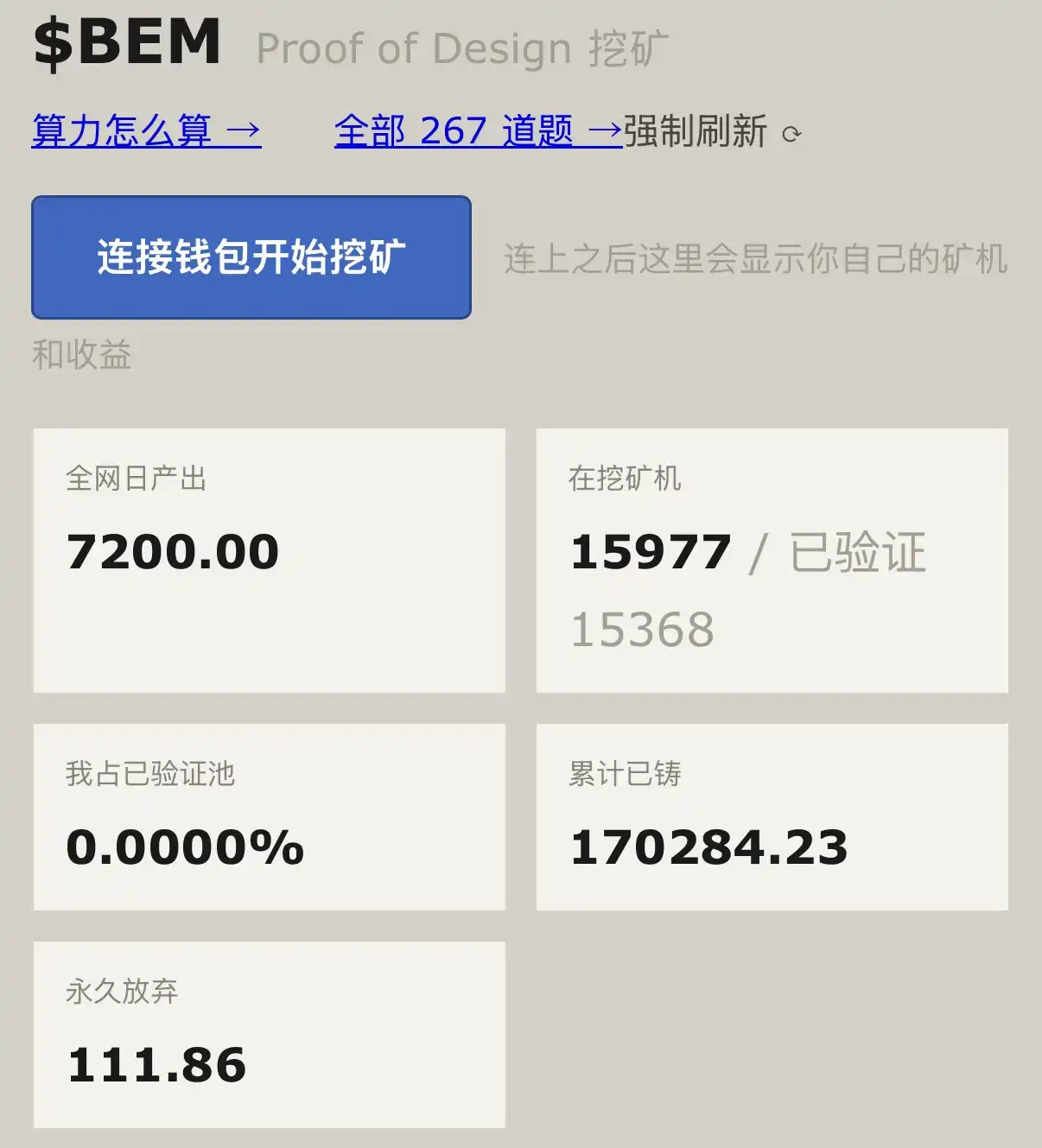
According to TapeOut's official website, BEM currently has a daily network-wide output of 7,200 tokens, worth about $417,600, with 15,977 active mining machines.
TapeOut's core idea is to break down digital circuits into basic components. NAND gates handle the most basic logic judgments, while LATCHes are used to remember a small piece of state—one is responsible for "computing," the other for "remembering." Users use these components to design circuits on a canvas, and after confirmation, the design is formally created on-chain, a process called "tape-out." Tape-out consumes the NAND, LATCH, and other components required for the design, generating circuit NFTs that can be used and transferred. Once components are consumed, they cannot be resold as original parts, so the cost is written into the circuit itself.
The mining mechanism is called "Proof of Design" (PoD). It does not use computing power as the basis for block production, but rather the quality of circuit design. Mining machines that comply with protocol rules can receive BEM according to the distribution rules of the corresponding mining pool. Current public data shows that BEM has a hard cap of 21 million tokens, halving approximately every four years, with no pre-mine and no team allocation. Additional issuance comes only from the mining contract. Currently, only circuits on the Behemoth and TapeOut processors are eligible for mining.
In the hash rate formula commonly used by the community and tool sites, a mining machine's weight basis is the actual number of NAND and LATCH consumed during tape-out. Each NAND or LATCH consumed counts as 1 point of weight, multiplied by the processor coefficient—Behemoth is 6, TapeOut is 1. Only designs that achieve the first optimal solution for a given problem receive the full design premium; copying official templates usually only yields cost recovery without premium. This means that for the same problem, consuming 3 NAND gates on Behemoth yields 6 times the weight of consuming them on TapeOut.
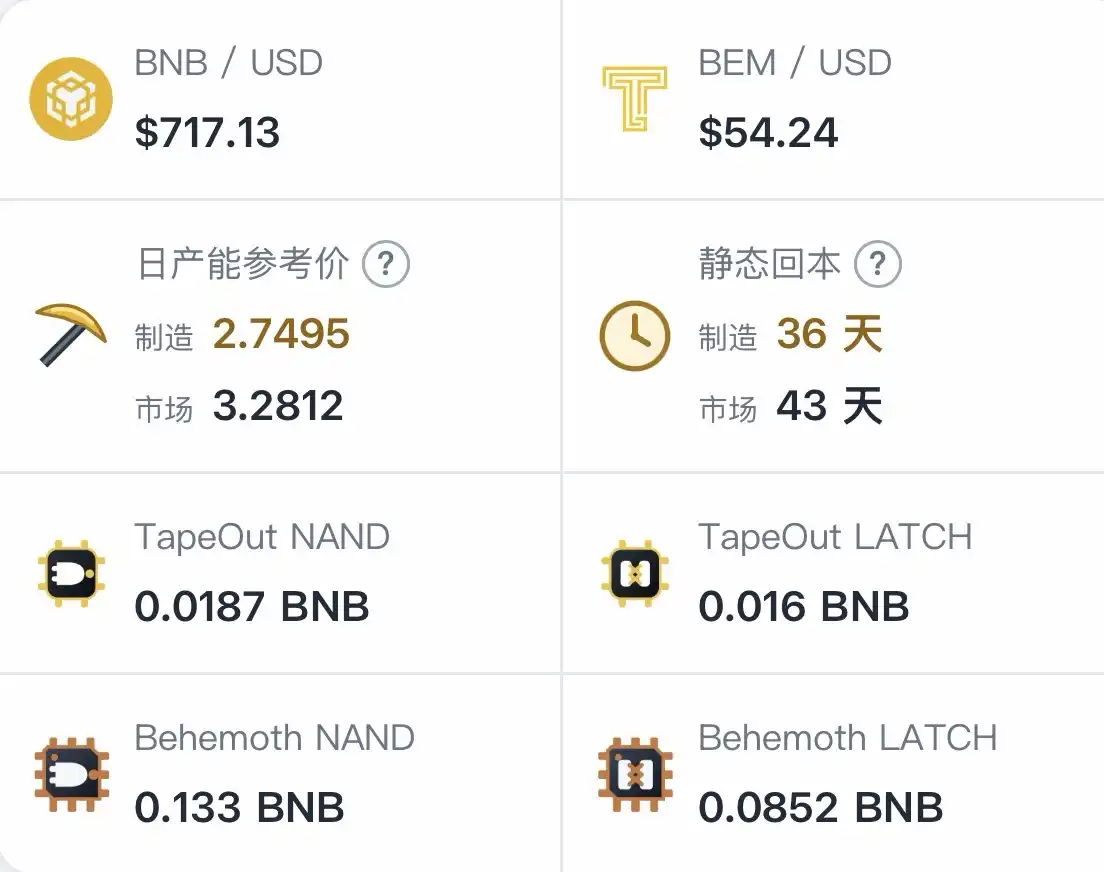
If you want to mine one BEM per day, according to TapeOutScan data, the optimal blueprint cost using transistor minting is about 2.75 BNB (about $1,970), while direct purchase on the secondary market requires 3.28 BNB (about $2,350). The corresponding static payback periods are 36 days and 43 days, respectively, and the BEM token must withstand daily output selling pressure and maintain its current price. However, if the price rises, the payback period will lengthen.
The most similar aspect of this mechanism to Bitcoin mining is the monetary policy, not the mining mechanism. Bitcoin has a cap of about 21 million coins, with early daily output of about 7,200 coins, halving approximately every four years. BEM has copied these numbers almost exactly: the same ceiling, the same initial daily output, the same four-year halving rhythm. But the on-site rules are completely different. Bitcoin is a race, producing a block about every ten minutes, with the entire reward going to the winner. Mining machines must continuously consume electricity; if shut down, no coins are produced the next day. BEM distributes rewards by share, with a fixed daily output of about 7,200 tokens. All verified mining machines share proportionally by weight, with no ongoing electricity costs. Costs are incurred only at the moment of tape-out deployment, i.e., the cost of purchasing NAND and LATCH, after which the circuit automatically produces tokens.
This difference also determines BEM's daily selling pressure structure. Bitcoin miners need to continuously pay electricity bills; when the price falls below the cost line, some miners shut down their machines, and supply automatically contracts. BEM miners' costs are sunk at tape-out deployment. As long as the circuit exists, claiming BEM daily has almost no marginal cost, so miners tend to sell continuously to recover their principal. If buying pressure is less than daily output, the price will remain under pressure.
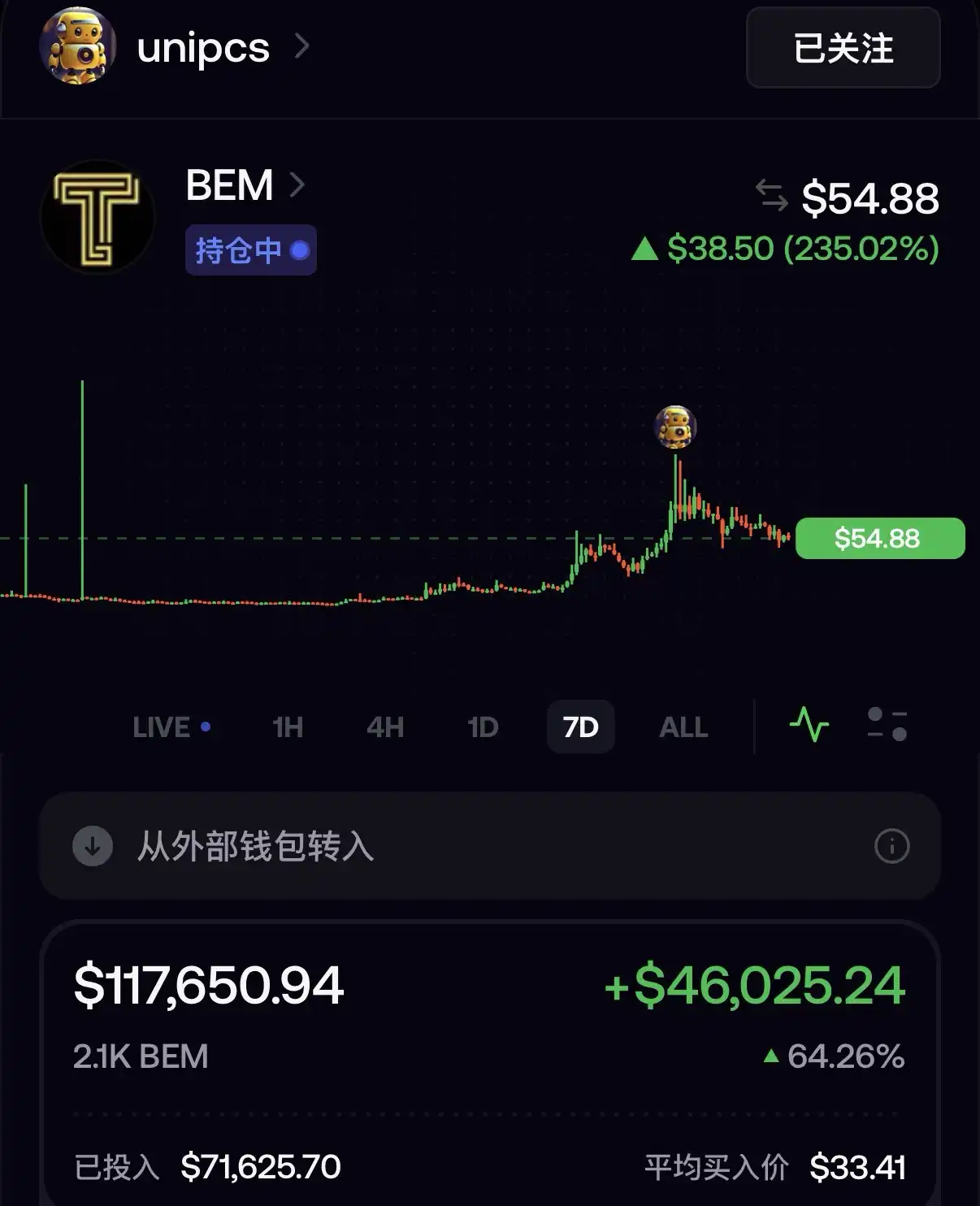
Recently, well-known trader Bonk Guy bought about $71,600 worth of BEM at $33.41, and has now made a profit of about $46,000, a return of about 64.26%. He said in his FOMO wallet: "BEM is one of the most interesting new experiments i've seen on BNB Chain in ages," and mentioned that the project was built by a 16-year-old genius and has received two interactions from CZ. He also mentioned that BEM is gaining close attention among Chinese-speaking and BNB whale communities.
On Sept. 15, CZ posted: "Would be cool to see someone make 'immortal fruit flies' on BNB Chain." Blonskr immediately quoted the tweet, encouraging all TapeOut developers to take action, and said he would devote his time to TapeOut's launch platform.
Previously, crypto blogger CUPID had published an article introducing the use of NAND and LATCH in the TapeOut ecosystem to express a simplified control model of fruit fly neural reflexes in circuit form, arguing that cyber immortality is a direction worth serious exploration.
From a broader perspective, TapeOut's innovation lies not in "another on-chain mining machine," but in breaking computation down to the most basic components, and then making these components consumable, verifiable, ownable, and composable production capital on-chain. After the circuit container feature goes live, circuits can have their own on-chain accounts, hold assets, and initiate transfers and contract operations by the current holder. When transferring a circuit NFT, the new holder also gains control of its circuit container and remaining assets. The official team has publicly demonstrated an on-chain Linux demo, where processor instructions are executed through BNB Chain transactions, and machine state is stored on-chain. The community has compiled 43 project and resource entry points, covering games, tools, circuit component research, and data dashboards.
However, BEM is still a mining coin mechanism. Daily output is about 7,200 tokens. Without stable external demand and protocol revenue, buyback and burn will be difficult to offset miner selling pressure. On Sept. 14, the BEM contract renounced all admin rights, meaning it can no longer be upgraded, paused, or have any problems or answers modified. The total supply and output curve are permanently fixed.
This content is for informational and educational purposes only and does not constitute investment advice related to BTCC. BTCC makes every effort but cannot guarantee the truthfulness, accuracy, or originality of the content above.