Central Banks, ETFs, and Options Converge: Where Does Gold Go After Breaking $4,600?
 Odaily
TL;DR
- Goldman Sachs believes fundamental gold buying is resonating with options flows, and dealer hedging could become a short-term amplifier after the price breakout.
- Goldman maintains its $4,900/oz gold forecast for end-2026, but this target does not yet factor in a surge in macro policy hedging demand, leaving room for further upside.
- Goldman's trading desk observes simultaneous accumulation by Chinese and Western macro funds, with clients betting on gold rising to $4,800–$5,500 via options and spot trades.
- The silver market has seen demand for three-month digital options with a $90 strike, but this represents client positioning, not Goldman's official target.
- Options positioning can amplify rallies and exacerbate pullbacks; if inflation reheats and rate-hike expectations rise, dealer unwinding will create additional selling pressure.
Over the past 48 hours, gold has once again become the focus of global macro trading.
After breaking through a resistance range that had held for about six months, the price climbed further above the 200-day moving average and has risen about 15% from its mid-July low, briefly approaching $4,600/oz. The forces driving this rally are also expanding from central banks and physical buying to ETFs, macro funds, and the options market.
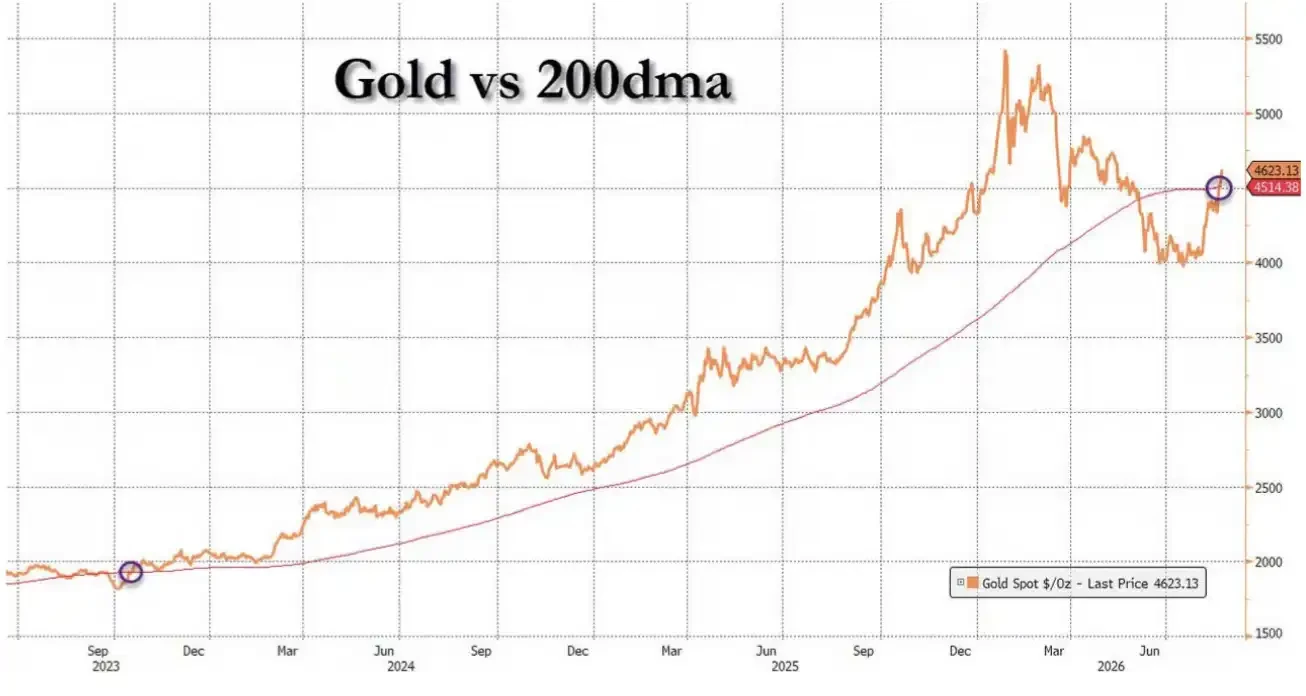
Gold breaks above prior resistance and reclaims the 200-day moving average, with prices briefly nearing $4,600/oz
ZeroHedge, citing Goldman Sachs strategists and trading desk reports, noted that demand for gold call options has risen significantly recently. Beyond central bank purchases, Chinese imports, and ETF inflows, options trading is adding a new price amplification mechanism to the gold market.
This means gold's next move may no longer be determined solely by traditional supply and demand. As prices approach dense option strike levels, dealers' passive hedging could further push prices higher; if the trend reverses, the same mechanism will amplify declines.
Call Options Heat Up, Gold Could Break $4,900
Goldman observes that investors are once again using gold call options to hedge global macro and policy risks.
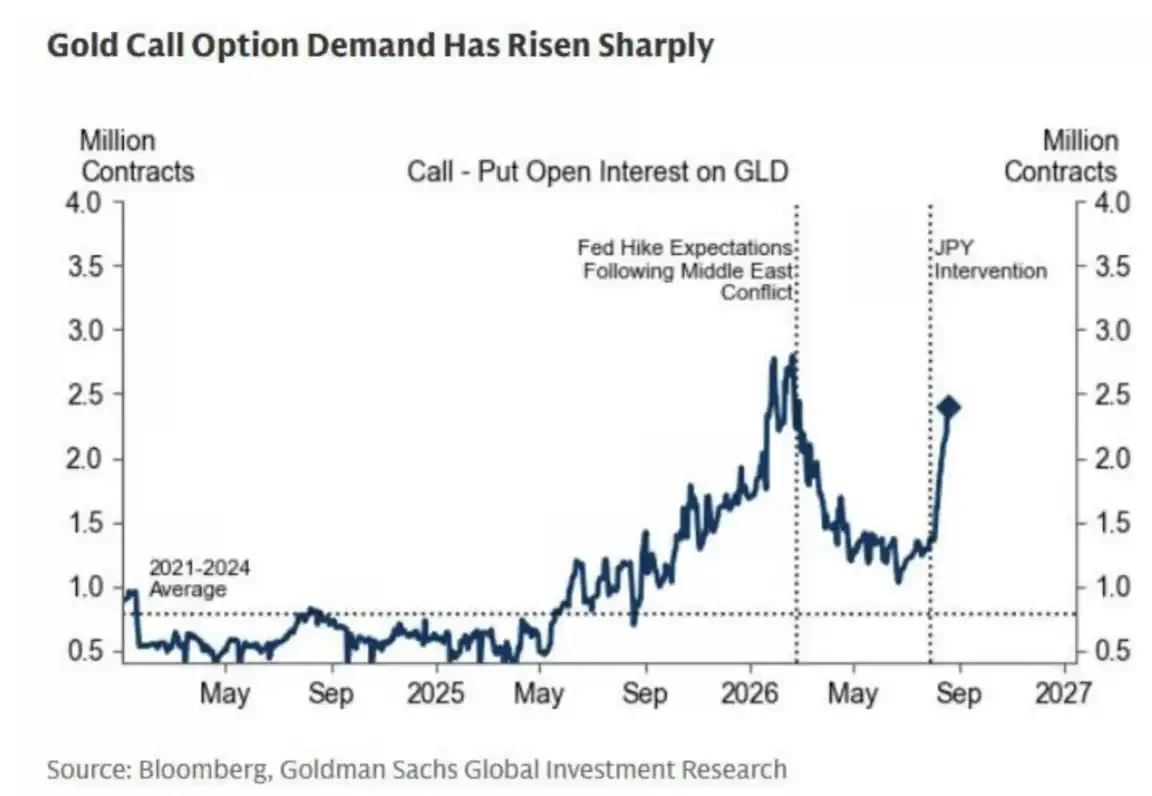
The difference between open interest in gold calls and puts is rising rapidly, indicating a clear increase in investor demand for gold call options. Source: Bloomberg, Goldman Sachs Global Investment Research.
Sellers of call options typically need to dynamically adjust their risk exposure based on gold price changes. When the price approaches key strike levels, dealers who sold options need to buy more gold or gold futures to maintain hedges. This buying is not based on new fundamental judgments, but it can create additional demand during rallies, pushing prices faster toward the next strike range.
Goldman calls it a "mechanical price amplifier." If ETF inflows continue and call option positioning remains high, gold's rise will prompt dealers to increase hedging purchases, which in turn may push prices higher, creating a short-term positive feedback loop.
However, this mechanism works both ways. When gold prices fall, dealers unwind previously established hedges, adding selling pressure to the market. Therefore, the more concentrated option positioning is, the more volatile gold may become near key price levels.
Goldman's current fair value forecast for gold at end-2026 remains $4,900/oz. This forecast is based on two assumptions: global central banks continue to maintain strong gold demand; and as the Federal Reserve keeps rates unchanged, Western private investors resume increasing gold ETF allocations.
The report notes that the Fed held rates steady in July, and with weaker US employment and CPI data, market expectations for further rate hikes have cooled. The main macro headwind that previously suppressed gold has thus diminished, and COMEX net speculative positioning and rate-sensitive ETF demand have begun to recover.
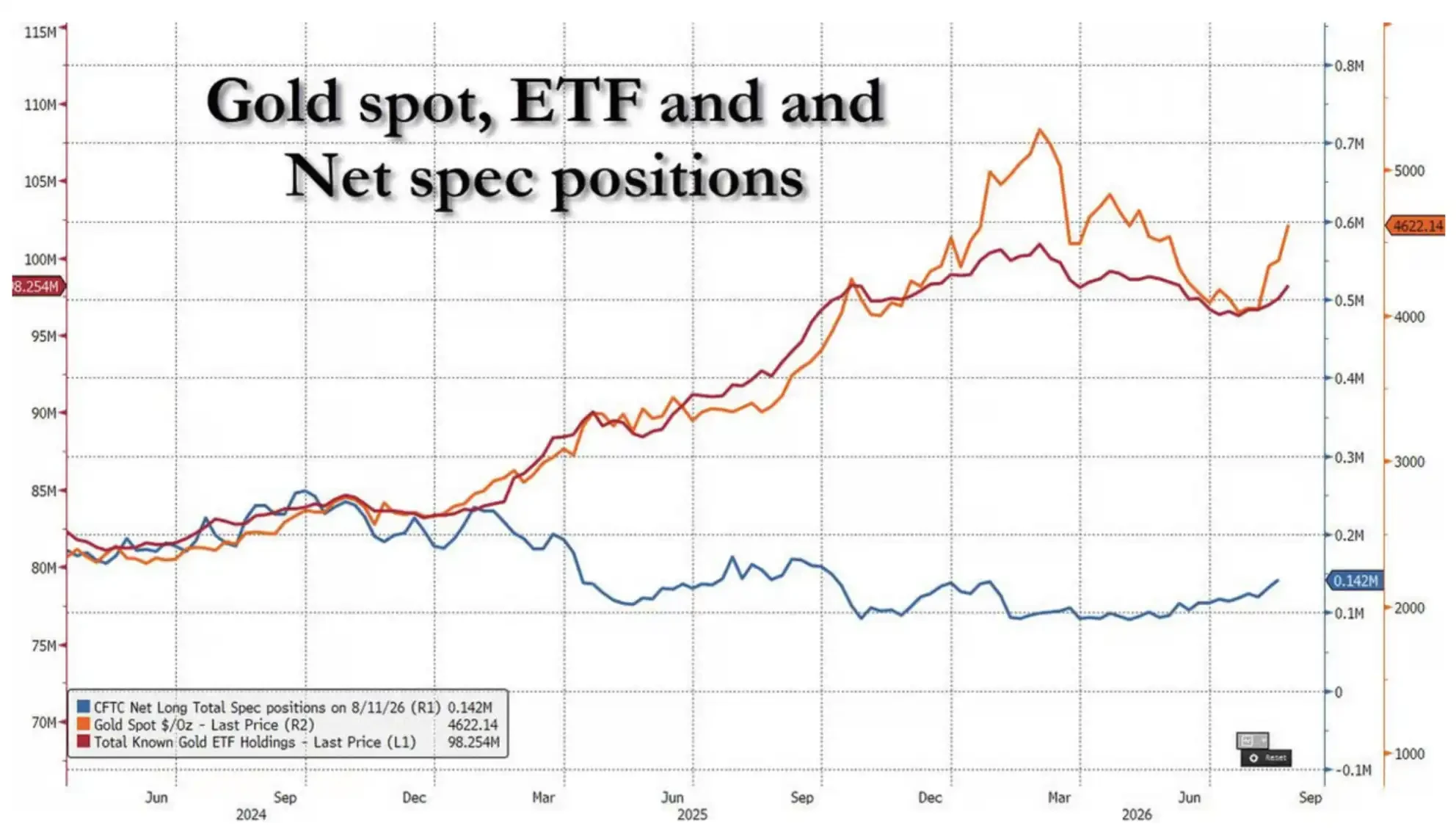
As Fed rate-hike expectations cool, gold ETF holdings and COMEX net speculative positioning begin to recover, resonating with the gold price rebound
Notably, the $4,900 forecast does not incorporate the impact of persistently rising demand for gold call options. Goldman gold analyst Lina Thomas therefore believes the current target faces "significant upside risk." If Western investment demand continues to recover and resonates with central bank buying and macro policy hedging demand, dealers' hedging behavior near key strike levels could push gold prices well above $4,900.
The flows observed by Goldman's trading desk are also more aggressive. Client trading increased significantly this week, including digital options with maturities of 3 to 6 months and direct gold purchases, with target ranges concentrated at $4,800–$5,500. The desk currently maintains a moderately high long exposure while being long volatility, skew, and directional risk.
Here a distinction is needed: $4,900 is the research team's year-end fair value forecast; $4,800–$5,500 is the client trading target observed by the trading desk and should not be viewed as Goldman officially raising its target.
China, Central Banks, and ETF Buying Provide Support
Before options flows entered, gold's bottom support came mainly from China, central banks, and ETF investors.
Goldman's trading desk said that this week both Chinese funds and Western macro funds have been continuously buying gold, and related buying accelerated further after the US Treasury expanded long-term bond buybacks. Some investors believe that the more active intervention by the US Treasury in long-term bond supply and demand may have a longer-term impact more on the dollar and gold than on Treasury yields themselves.
Trading activity in the Chinese market is particularly notable. The Shanghai market recently recorded two-day gains ranking in the top five of the past five years, but total Chinese gold positioning is still about 25% below its historical high. Goldman therefore judges that current positioning has not yet reached extremely crowded levels.
Physical imports also remain high. Data shows China's gold imports in July were 135 tons, down from 173 tons in June and slightly below the monthly average of 144 tons in the first half of 2026. However, the decline mainly came from reduced bonded zone imports, while customs-cleared imports remained basically stable.
So far this year, China's total gold imports have increased by 444 tons year-on-year, an increase of about 80%. Goldman believes this new demand is sufficient to offset the impact of the slowdown in announced central bank purchases and ETF inflows. CTA funds are also turning; Goldman's model shows trend-following strategies have covered gold shorts and begun to add long positions, with momentum indicators still positive.
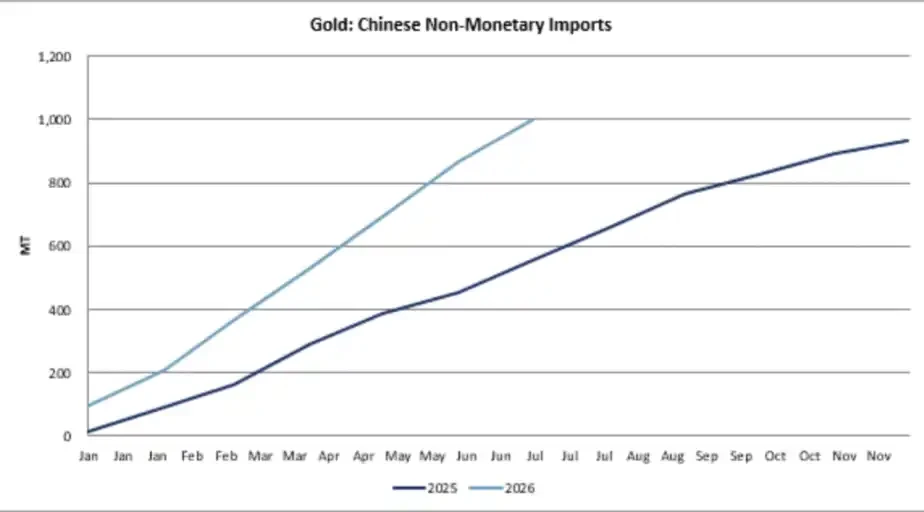
China's cumulative non-monetary gold imports in 2026 are significantly faster than the same period in 2025, with physical demand continuing to support gold prices
Central bank demand remains an important pillar of Goldman's long-term gold thesis, but official data is usually disclosed slowly and difficult to reflect actual purchases in real time.
Goldman uses UK gold exports to China as a proxy for Chinese official demand. In the second quarter of 2026, UK gold exports to China averaged 37 tons per month, significantly higher than the 15 tons per month in 2025.
Other reserve management institutions are also resuming purchases. Turkey is gradually buying back gold previously sold at the start of the conflict, with swap-adjusted holdings of about 809 tons, close to the historical high of about 822 tons. Among the 55 reserve management institutions tracked by Goldman, only Russia is currently in a net reduction state.
These data cannot fully equate to real-time net purchases by central banks, but at least indicate that the official sector's allocation trend toward gold has not yet reversed significantly.
Gold Too Expensive, Funds Start Betting on Silver Catch-Up
Gold's rapid rise has also pushed some speculative demand toward silver.
Goldman trader Adam Gillard noted that when gold prices rise to higher levels, retail investors often turn to silver, which has a lower unit price. This substitution effect may be one reason for the recent warming of silver options trading.
This week, demand emerged for three-month silver digital options with a strike price of $90/oz. A digital option is a product that pays a fixed return if the price reaches a specific level at expiration, typically used to bet on low-probability but high-convexity moves.
Therefore, "$90 silver" more accurately means that some large clients are buying short-term options with a $90 trigger price, not that Goldman predicts silver will definitely reach $90 within three months. Lower implied volatility and higher option skew make such tail bets attractive to some clients.
Compared with gold, silver lacks the structural demand from central bank purchases, and China is also a net exporter of silver. Silver's rally logic therefore relies more on gold spillover effects, retail fund rotation, and speculative positioning expansion, with higher elasticity but lower certainty.
The current gold long thesis is built on several forces: central banks continuing to buy gold, strong Chinese imports, recovering Western ETF demand, cooling Fed rate-hike expectations, and option hedging amplifying the rally. A reversal in any one of these could weaken the move.
The biggest macro risk remains a resurgence of inflation. If inflation rebounds and pushes the market to reprice Fed rate hikes, real rates and the dollar may rise, and ETF and speculative funds may also exit gold. At the same time, gold falling away from key strike ranges will prompt dealers to unwind hedges, turning the option mechanism that originally drove the rally into additional selling pressure and causing a sharper-than-usual pullback.
Gold's current change is that long-term allocation demand and short-term trading funds are beginning to point upward simultaneously. The $4,900 target corresponds to a base case of recovering central bank and ETF demand, while client trades at $4,800–$5,500 and silver $90 digital options reflect funds betting on more elastic tail scenarios.
What really needs to be watched next is whether ETF inflows can continue, whether gold can approach dense strike ranges, and whether Chinese and central bank buying can continue to absorb high prices. Options can make the move faster, but they cannot replace the real capital demand that supports the market.
This content is for informational and educational purposes only and does not constitute investment advice related to BTCC. BTCC makes every effort but cannot guarantee the truthfulness, accuracy, or originality of the content above.