Preview of Warsh's Friday Speech: What Will the Market Focus On?
 BlockbeatsAuthor: Michael J. Kramer
Original title: Kevin Warsh's Jackson Hole Speech Draws Attention to Bond Yields
Original author: Michael J. Kramer
Editor's note: According to the Federal Reserve's published schedule, Chairman Kevin Warsh will deliver his first Jackson Hole speech since taking office this Friday. Investors are watching not only whether he signals the next move in interest rates, but also whether he continues the communication approach of reducing forward guidance and letting the market form its own rate expectations.
Note: The Jackson Hole Economic Policy Symposium is hosted annually by the Federal Reserve Bank of Kansas City. It is a key conference for central bank officials to discuss economic and monetary policy, and a critical window for markets to observe Fed policy signals.
Michael J. Kramer offers a more controversial interpretation in this article: Warsh may have no intention of actively pushing down long-term rates as the Fed has done in the past, but instead wants to allow the yield curve to steepen, letting higher term premium and bond volatility tighten financial conditions. Under this framework, the Fed could suppress demand through pressure on mortgages, corporate financing costs, and equity valuations even without raising the policy rate.
This remains the author's speculation about Warsh's policy intentions, not a confirmed Fed policy arrangement. What truly deserves attention is that if the Fed reduces its management of market expectations, long-term rates may no longer be merely a passive reflection of the rate hike path, but could become an independent variable affecting financial conditions. Friday's speech will provide the first important test of this judgment.
Below is the translated original article:
In the first half of this week, market attention was mainly focused on Nvidia's earnings; after Wednesday, the focus will shift to the Jackson Hole Economic Policy Symposium.
Federal Reserve Chairman Kevin Warsh is scheduled to deliver the keynote speech on Aug. 28. This will be his first appearance at Jackson Hole since becoming chairman, and an important window for the market to observe his monetary policy framework. The schedule released by the Federal Reserve and the Kansas City Fed shows the speech will begin at 10 a.m. Eastern Time.
Investors will focus on whether Warsh has changed his stance on reducing forward guidance. Forward guidance is a policy tool through which central banks influence market expectations about the future path of interest rates through public communication. In the view of the author, Michael J. Kramer, Warsh is unlikely to change direction: the Fed will reduce its "hand-holding guidance" to the market, letting economic data and market prices play a more important pricing role.
The resulting impact may extend beyond policy communication. Kramer judges that Warsh may allow long-term yields and bond volatility to rise, thereby tightening financial conditions and reducing the need for immediate rate hikes.
Term premium returns, could the 10-year Treasury yield return to 5%?
The author observes that the term premium on U.S. Treasuries has begun to rise. The term premium is the additional return investors demand for holding long-term bonds rather than continuously rolling over short-term bonds, mainly to compensate for future interest rate, inflation, and policy uncertainty.
This article uses the ACM term premium model published by the New York Fed. ACM refers to the estimation framework established by Tobias Adrian, Richard Crump, and Emanuel Moench, used to decompose long-term Treasury yields into expected short-term rates and term premium. It should be noted that the term premium cannot be directly observed, and different models may produce different results.
According to the data cited by the author, the ACM term premium on the 10-year Treasury is about 82 basis points, still below the average of about 150 basis points in the decades before QE was implemented. If the term premium returns to this historical average, combined with the author's assumed neutral rate slightly above 4%, the 10-year Treasury yield could rise above 5%.
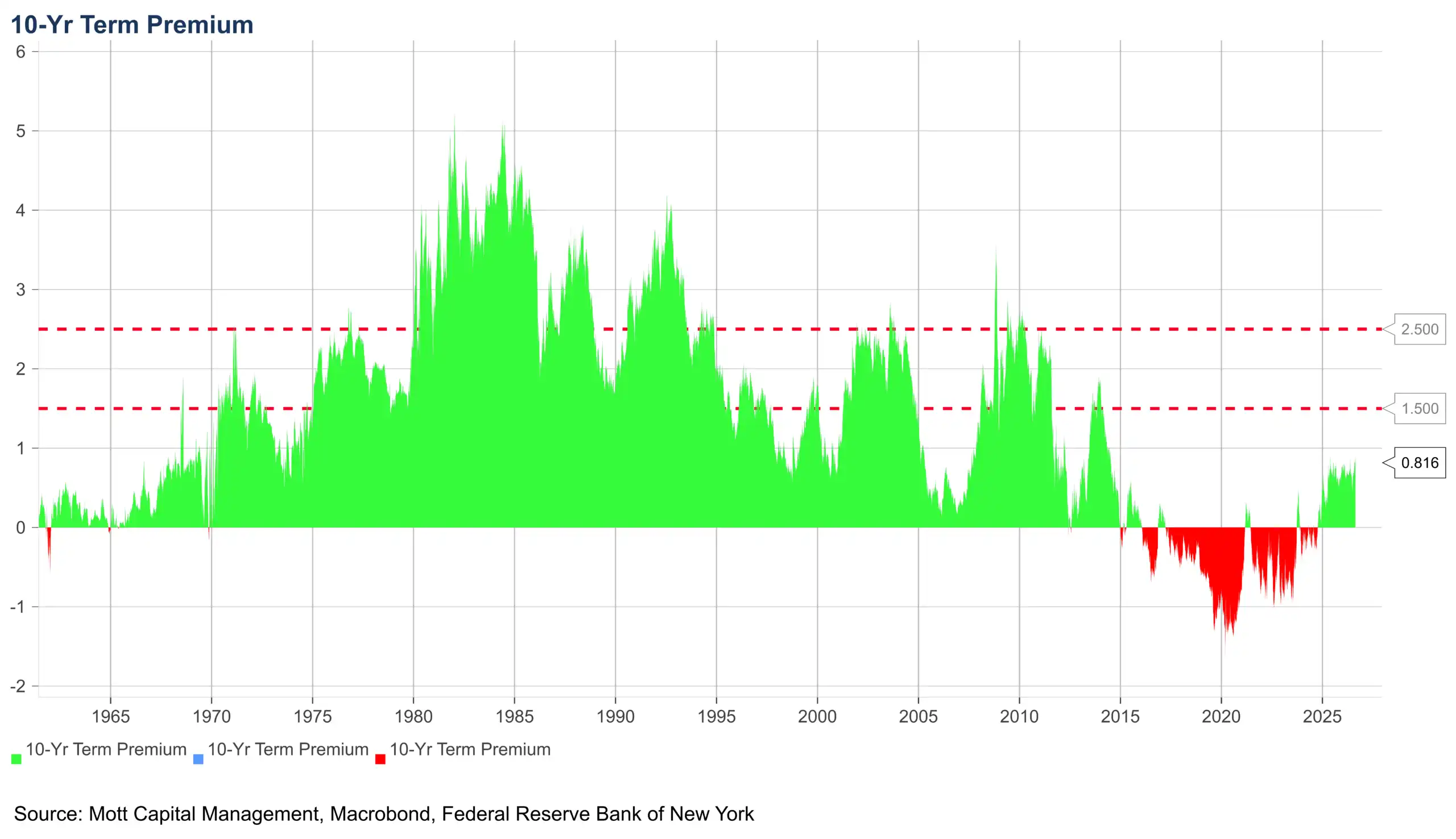
The ACM term premium on the 10-year U.S. Treasury has rebounded, but according to the author's measure, it remains below the long-term average before QE.
This calculation is closer to a scenario analysis, not a definitive forecast for the 10-year yield. It relies on two key assumptions: that the term premium continues to rise, and that the long-term neutral rate remains at a high level. If either condition changes, the result could be significantly different.
But what the author really cares about is not the specific 5% level, but the pricing logic of long-term rates: if the Fed no longer actively reduces policy uncertainty, investors may demand higher term compensation.
Bond volatility can rise without rate hikes
Reducing forward guidance could also push up implied volatility in the bond market.
Although long-term yields have risen recently, the MOVE index, which measures implied volatility in Treasury options, remains at a relatively low level. The author interprets this as the market still believing it can roughly predict the Fed's next policy path.
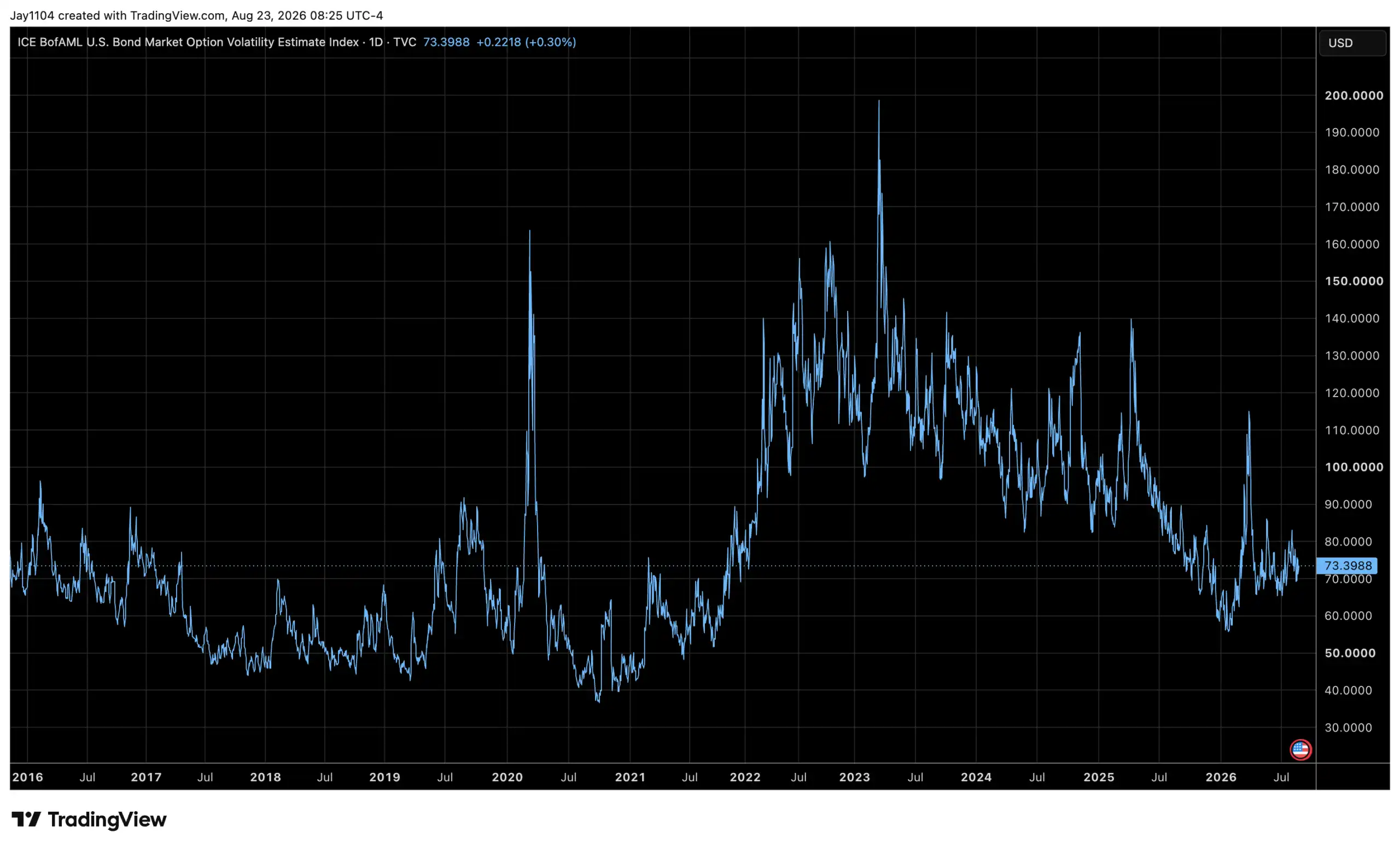
Long-term yields have risen, but implied volatility in Treasury options has not yet been significantly repriced. The author believes that reducing forward guidance could change this state.
If this certainty disappears, each policy meeting could become an "open event" again: investors cannot rule out in advance the possibility of rate hikes, cuts, or continued pauses, and bond prices will become more sensitive to economic data and policy statements. Without actually adjusting interest rates, Treasury volatility could undergo a structural repricing.
The author believes this change itself can tighten financial conditions. Higher 10-year yields will transmit to mortgage rates and corporate long-term financing costs, depressing valuations of long-duration assets such as equities; higher interest rate volatility could also widen credit spreads and raise corporate bond issuance costs.
It should be understood that the federal funds rate remains the core tool of Fed monetary policy, and it cannot be simply assumed that short-term rates are "unimportant." The author offers another layer of market interpretation: beyond the policy rate, long-term yields and bond volatility can also affect the real economy, and their transmission may be more direct.
Let the long end do the tightening, then create room for short-end rate cuts
In the policy framework Kramer envisions, the Fed may allow the yield curve to continue steepening, letting long-term rates shoulder the tightening function they have not fully played in the past.
Specifically, the Fed could reduce forward guidance and stop trying to eliminate uncertainty at every policy meeting. In an environment where supply, inflation, and fiscal risks still exist, investors will demand higher term premium, pushing long-term yields and bond volatility higher, with the market completing part of the tightening.
If this process can suppress demand and drive inflation sustainably lower, the Fed could subsequently lower short-term policy rates. At that point, the yield curve may show long-term rates remaining relatively high while short-term rates gradually decline.
In other words, the path the author envisions is not the traditional "hike first, cut later," but rather letting the long end tighten financial conditions first, then creating room for short-end rate cuts.
However, this framework carries clear risks. The rise in long-term yields is not entirely under the Fed's control. If the term premium rises too much, mortgage rates, corporate financing, and fiscal interest burdens could all come under pressure simultaneously; if the market interprets reduced communication as an unclear policy framework, rising volatility could also damage the Fed's credibility rather than help it achieve orderly tightening.
Therefore, it is still unclear whether the rise in long-term rates is a policy channel Warsh wants to use, or additional compensation the market demands for inflation, fiscal, and policy uncertainty.
Japan's rate normalization adds pressure to global long-term bonds
In addition to U.S. policy changes, the author also views Japan as another driver of global interest rate increases.
According to the Bank of Japan's latest policy, the target for the uncollateralized overnight call rate is currently about 1%. Meanwhile, Japan's 10-year breakeven inflation rate has approached 2%. The breakeven inflation rate is the difference between yields on nominal government bonds and inflation-linked bonds of the same maturity, typically seen as the market's estimate of future inflation, but it also includes liquidity and risk premiums.
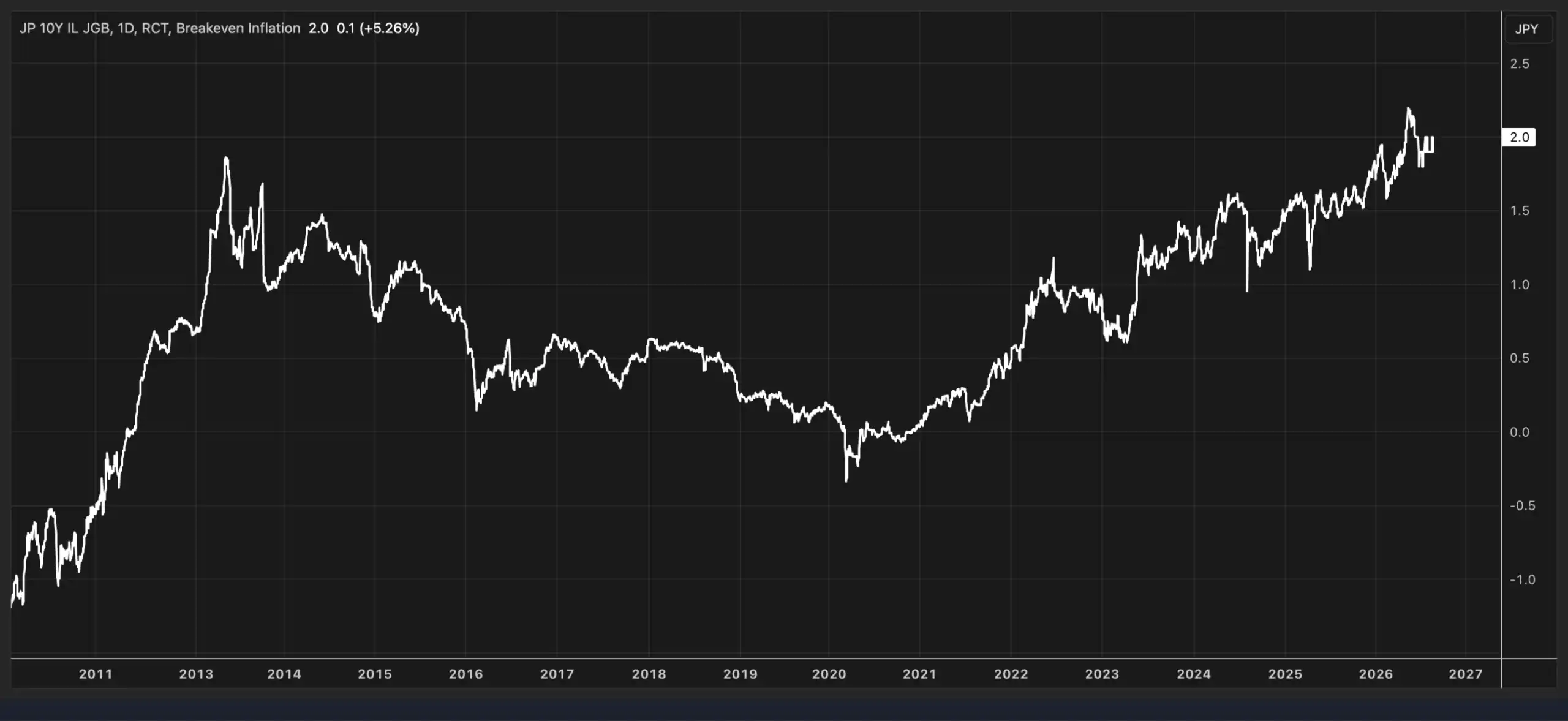
Japan's 10-year breakeven inflation rate has risen to about 2%, and market expectations for further monetary policy normalization by the Bank of Japan have heated up accordingly.
The author believes that the rebound in Japan's inflation expectations means the market is preparing for further monetary policy normalization by the Bank of Japan. According to the TONA futures pricing he cites, the market-implied rates are about 1.19% in September, 1.41% in December, and 1.6% in March of the following year. These figures reflect market pricing at the time of publication and will continue to change with economic data and policy expectations; they do not represent a confirmed rate hike path by the Bank of Japan.
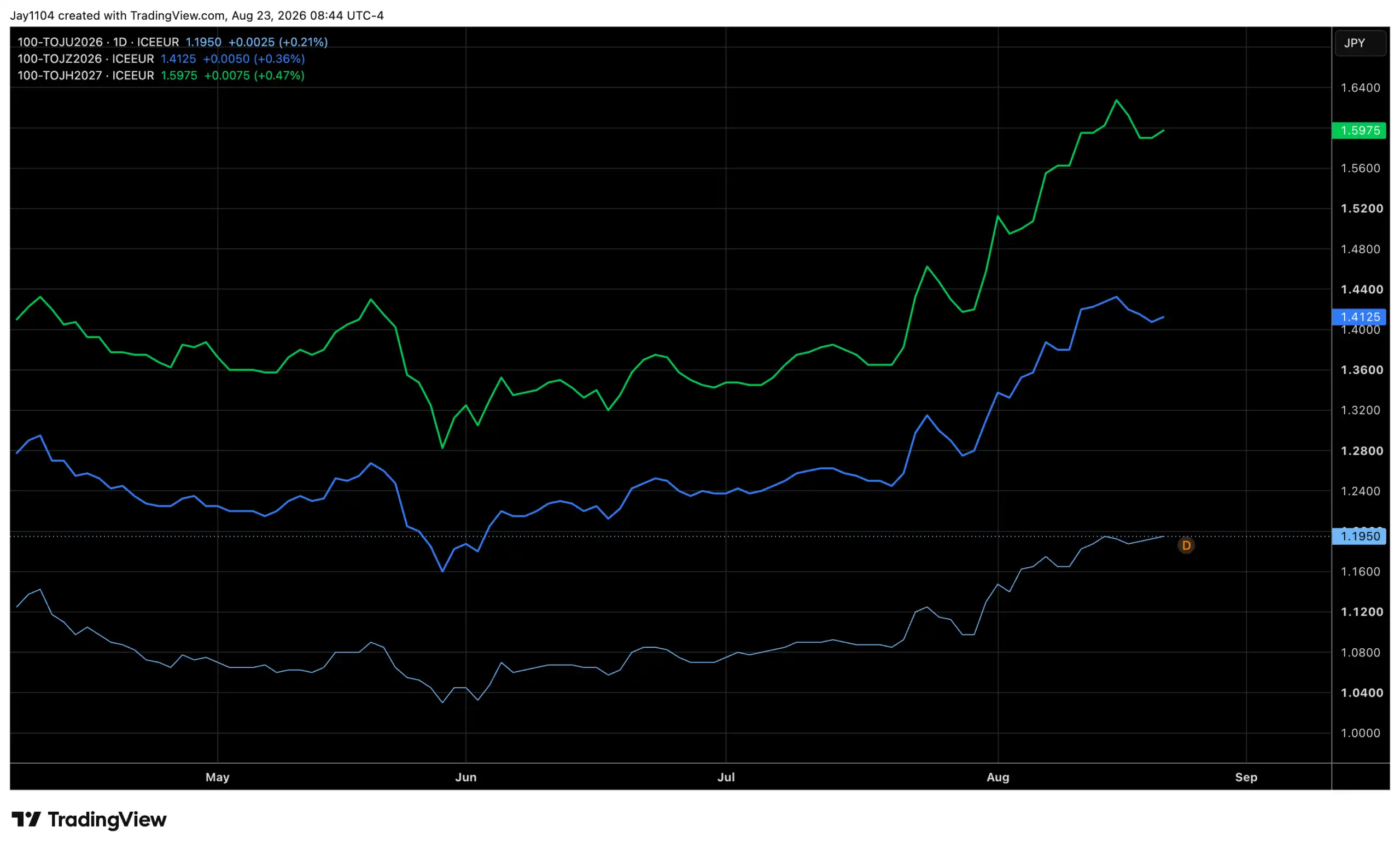
TONA futures pricing at the time of publication shows the market is pricing in the possibility of further increases in Japan's short-term rates. Futures prices will change with data and policy expectations and do not represent a confirmed rate hike path by the Bank of Japan.
If Japanese interest rates continue to rise, global demand for low-yield foreign bonds may weaken marginally, and global long-term rates will face more upward pressure. In this environment, even if Warsh does not send a clear rate hike signal, the long end of U.S. Treasuries may not easily fall back.
What really needs to be observed on Friday is how Warsh describes the rise in long-term yields: will he view it as having already done part of the Fed's tightening, or will he see higher term premium as bringing uncontrollable financial risks? Will he continue to reduce forward guidance, and will he explain how the Fed wants the market to understand its monetary policy reaction function?
Only when these questions are answered more clearly can we judge whether "letting the long end do the Fed's tightening" is a policy framework Warsh might adopt, or a story the market has filled in on its own based on his silence.
[Original link]
This content is for informational and educational purposes only and does not constitute investment advice related to BTCC. BTCC makes every effort but cannot guarantee the truthfulness, accuracy, or originality of the content above.