


A relatively objective analysis of Coinbase
 chaincatcher
Author: Zhao Haibei
introduce
1/ Despite declining market share, bloated management, and weak product strength, we readily conclude that Coinbase is not a good company. The price difference between Robinhood and Coinbase over the past few months further confirms this view. However, this information is more or less already reflected in Coinbase's current stock price. No matter how good a company is, we cannot obtain excess returns from "excellence" itself, because the reasons for its excellence are beyond our control. The process of buying a company and paying the corresponding price will erase excess returns at the company level, and this is also true for poorly performing companies.
2/ Cryptocurrencies are currently in a four-year bear market cycle. Looking ahead to the next year or two, Coinbase's price is likely to be higher than it is now. Therefore, discussing whether or not to buy Coinbase is not very meaningful. In my opinion, the essence of the Coinbase problem lies in opportunity cost (relative to other crypto assets, such as Bitcoin). In the following sections, I will analyze this as objectively as possible.
Basic facts
1/ Following Coinbase's release of its Q2 earnings report, the binary risk of renewing the contract with Circle has been eliminated. The contract will automatically renew for three years unless otherwise modified.
2/ In Coinbase's revenue structure, non-trading revenue can be further divided into: stablecoins + other businesses. Other businesses include: blockchain staking + subscriptions + cryptocurrency holding income + interest income. In fact, this portion of revenue is highly correlated with the cryptocurrency cycle itself and cannot be simply understood as non-cyclical revenue. I categorize it as trading-related business.
An arithmetic problem
Coinbase's stablecoin revenue for the second quarter was $292 million, with $28 million coming from the company's own USDC balance. Total USDC revenue for the second quarter was approximately $320 million. Trading revenue for the same period was $599 million, bringing total revenue to $1.22 billion.
In the second quarter, USDC's average market capitalization was approximately $77 billion, with Coinbase's products accounting for 26% and Circle's platform averaging 19.5% daily. According to the agreement, Coinbase received approximately 50% of USDC's overall economic benefits over the past year.
While Circle's stablecoin issuance revenue includes long-term options like Arc and CPN, Coinbase's role and influence as a distribution partner cannot be ignored. We can roughly estimate that the two can offset each other, at a ratio of approximately 1:1. Therefore, of Coinbase's $38.5 billion market capitalization, approximately $15 billion comes from stablecoin business, while the remaining $23.5 billion comes from trading, staking, subscriptions, lending, and other non-USDC businesses.
Based on second-quarter annualized data, Coinbase's stablecoin business was approximately 11.7 times its total revenue, or approximately 18.7 times after deducting approximately $11.9 million in USDC rewards; its non-USDC business was approximately 6.5 times its revenue (the TTM revenue valuation of the non-USDC business was approximately 5 times its price-to-sales ratio).
Therefore, the question boils down to: Is it worthwhile to trade non-stablecoins at a P/E ratio of 6.5 (compared to Bitcoin)? For comparison, our opportunity cost could be directly buying Circle (long stablecoin gains) + Bitcoin (long cryptocurrency market trading-related gains).
First, let's quote a typical viewpoint: based on historical data, Coinbase has never outperformed BTC over the years, so I might as well just buy BTC directly.
This logic has two flaws:
1/ Poor past performance does not guarantee a poor future performance. Using historical prices to predict future prices is not fundamentally different from technical analysis; however, technical analysis reduces sensitivity to subtle changes.
2/ Poor past performance does not preclude the existence of excess returns in specific periods. Historically, many companies have underperformed Bitcoin, but this does not mean that these companies lacked trading opportunities.
Let's first review Coinbase's historical performance relative to BTC:
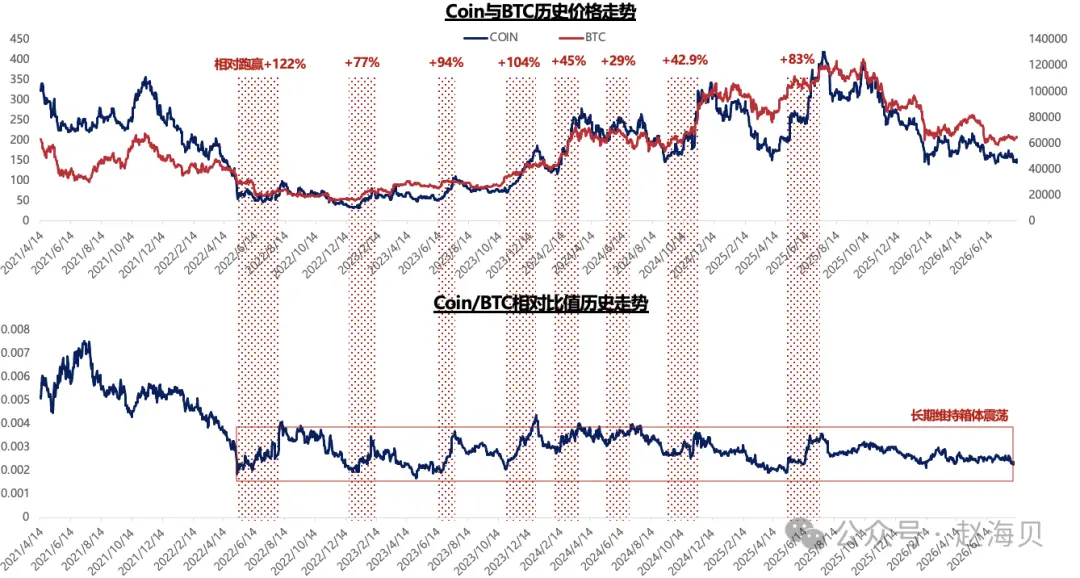
Putting aside the short-term overvaluation after its IPO, Coinbase has outperformed Bitcoin in excess returns eight times in its history.
First excess return: May 2022 to August 2022 (+122%)
On May 11, following the release of its earnings report, market panic regarding bankruptcy risk intensified, with COIN falling approximately 21.6% against BTC that day. In June, an 18% reduction in fixed costs and BlackRock's decision to use the Coinbase Prime platform mitigated the bankruptcy risk—a classic turnaround strategy.
Second excess return: December 2022 to February 2023 (+77.1%)
The FTX crisis led COIN into bankruptcy proceedings, and it bottomed out at the end of December. In January, 950 employees were laid off and quarterly expenses were cut by 25%, causing COIN to rise 11.4% relative to BTC that day. In February, a class-action lawsuit against the securities firm was dismissed, causing COIN's relative price to rise 25.2% in a single day, thus mitigating legal risks.
Third excess return: June 2023 - July 2023 (+94.2%)
On June 6, the U.S. Securities and Exchange Commission (SEC) sued Coinbase, causing COIN to fall 16.9% against BTC that day. Subsequently, companies such as BlackRock chose Coinbase as their custody and monitoring platform in their spot ETF applications. In July, Ripple won its case, driving COIN to rise 20.3% against BTC in a single day, with regulatory easing boosting market confidence.
Fourth excess return: October 2023 to December 2023 (+104.2%)
The likelihood of approval for a spot Bitcoin ETF is rapidly increasing, directly benefiting Coinbase due to its role in custody, Prime services, and monitoring. Meanwhile, Binance's plea bargain and substantial settlement further enhance Coinbase's listing and compliance premium in the US, with ETF expectations and an improved competitive landscape jointly driving this growth.
Fifth excess return: February 2024 to March 2024 (+45.9%)
Following the approval of the spot Bitcoin ETF, the market initially worried that the ETF would divert a significant portion of Coinbase's retail trading volume. However, in February, Coinbase announced its first quarterly profit since 2021, with trading revenue rebounding and expenses declining. The day after the earnings release, Coinbase's price against Bitcoin rose 8.3%, and market expectations shifted from "ETFs replacing exchanges" to "ETFs expanding the size, trading volume, and institutional revenue of crypto assets."
Sixth largest excess return: May 2024 - July 2024 (+29.3%)
The passage of the FIT21 bill in the House of Representatives, the rise in the spot Ethereum ETF price, the integration of Stripe with Base and USDC, and the selection of Coinbase Prime by the U.S. Marshals Service have further solidified Coinbase's position in compliance infrastructure. However, during this period, Coinbase only rose by 12.3%, while Bitcoin fell by 13.2%, reflecting regulatory trends.
Seventh excess return: 2024/10--2024/11 (+42.9%)
On October 31, COIN's earnings report fell short of expectations, causing its price to drop 12.7% relative to BTC, hitting a low. On November 6, after Trump won the election, COIN's price rose 31.1%, while BTC rose approximately 9%, resulting in a single-day increase of 20.3%. Market focus is on the shift in enforcement by the U.S. Securities and Exchange Commission (SEC), the advancement of cryptocurrency legislation, and the easing of restrictions on staking and token listings, all reflecting regulatory trends.
Eighth largest excess return: May 2025 to July 2025 (+83.8%)
Following the release of its May earnings report, market expectations for a slowdown in trading revenue plummeted. Subsequently, Coinbase was included in the S&P 500 index, and the day after the announcement, its stock price rose 22.5% relative to Bitcoin. In June, the Senate passed the Genius Act, and Coinbase's stock price again surged 16.1% in a single day, reflecting regulatory trends. Simultaneously, Circle's IPO made explosive progress, driving a parallel rise in Coinbase's price.
Interestingly, cryptocurrency stocks are commonly perceived as leveraged Bitcoin. However, backtesting results show this is not the case. In bear markets, Coinbase's stock outperformed Bitcoin in certain phases (3 out of 8), while in bull markets, it frequently underperformed. Based on this logic, it's easy to see that Coinbase's excess returns stemmed more from regulatory trends in specific phases (regulatory events were the primary driver in 6 out of 8 phases).
In the long run, the relative prices of Coinbase and Bitcoin typically exhibit a range-bound trading pattern. Given that market expectations for Clarity have fallen short of expectations, Coinbase, currently at the bottom of this range, presents an ideal target for strategic maneuvering to address regulatory events.
But what specific structural changes are involved?
One of my respected teachers once said that the essence of cryptocurrency is to attract retail investors to participate in PVP games through PVE narratives.
I believe that PVE narrative is also a reason, the fundamental reason being the surplus of funds, which means that capital leads the narrative, and the narrative follows.
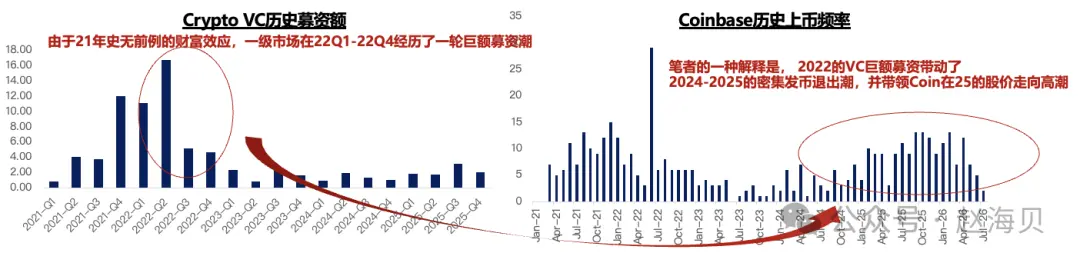
As shown in the figure, driven by the unprecedented wealth effect in 2021, the cryptocurrency primary market experienced a large-scale financing wave from the first to the fourth quarter of 2022, which was directly reflected in the concentrated wave of token exits in 2024-2025, resulting in COIN's transaction-related revenue reaching its peak in 2024-2025.
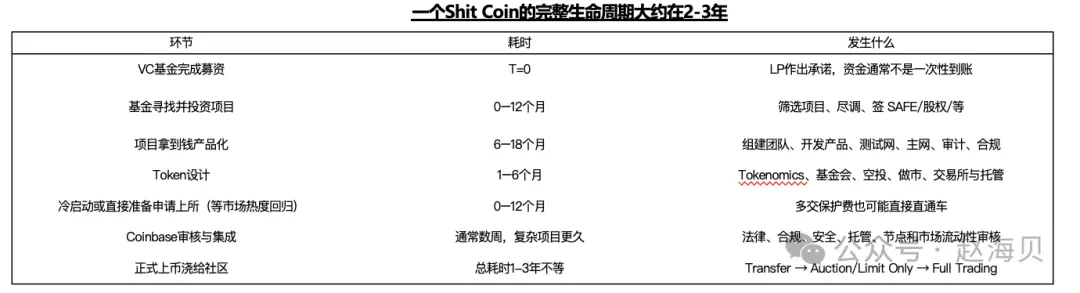
This also means that if we speculate that the amount raised in 2024-2025 may not be enough to support the next Shitcoin Summer round, this will directly affect Coinbase's main revenue in the next round.
What other structural changes are there?
If we observe the trend of Coinbase's non-stablecoin revenue, we will find that by the first to third quarters of 2025, its revenue will be significantly decoupled from the price of Bitcoin:
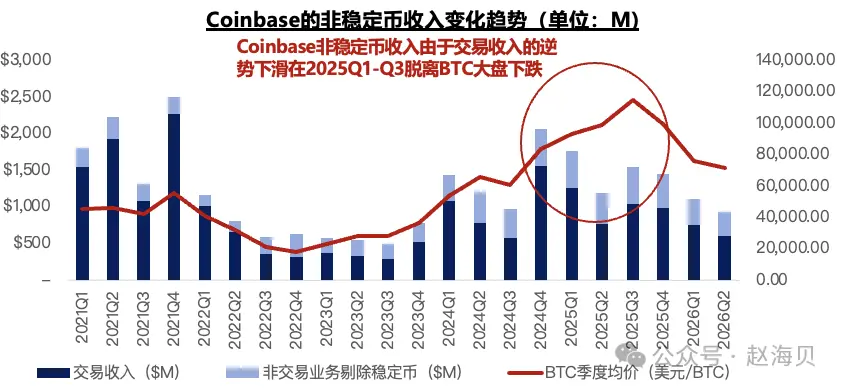
The reason is that altcoins, low retail trading volume, and insufficient volatility result in Coinbase's revenue elasticity being weaker than Bitcoin's. If we look at the total market capitalization of crypto assets outside the top ten (i.e., the altcoin market), we find that it is highly correlated with Coinbase's non-stablecoin revenue:
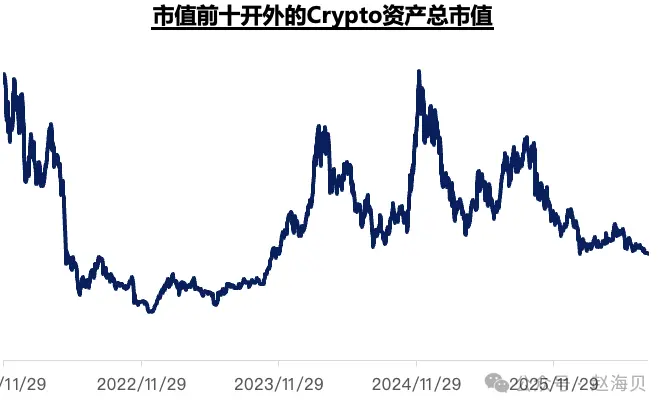
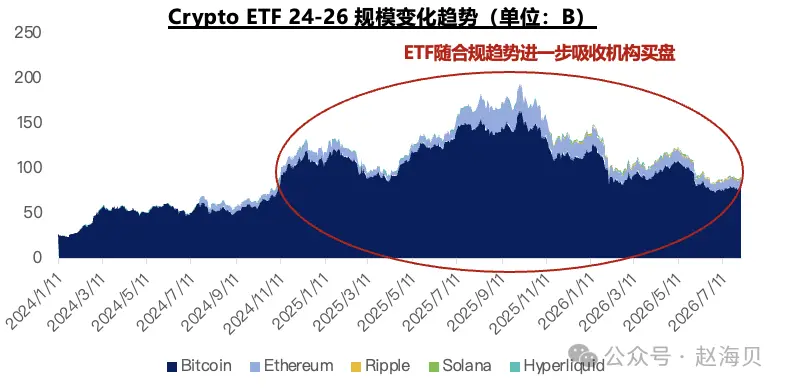
So why is the correlation between mainstream cryptocurrencies like BTC/ETH lower than that of other cryptocurrencies? The core reason is that the increasing clarity of regulatory policies has reduced the scarcity of compliant trading channels. Coinbase's previously high retail spot profits, gained through licenses, fiat currency trading, and security guarantees, are gradually being eroded by institutional trading such as ETFs.
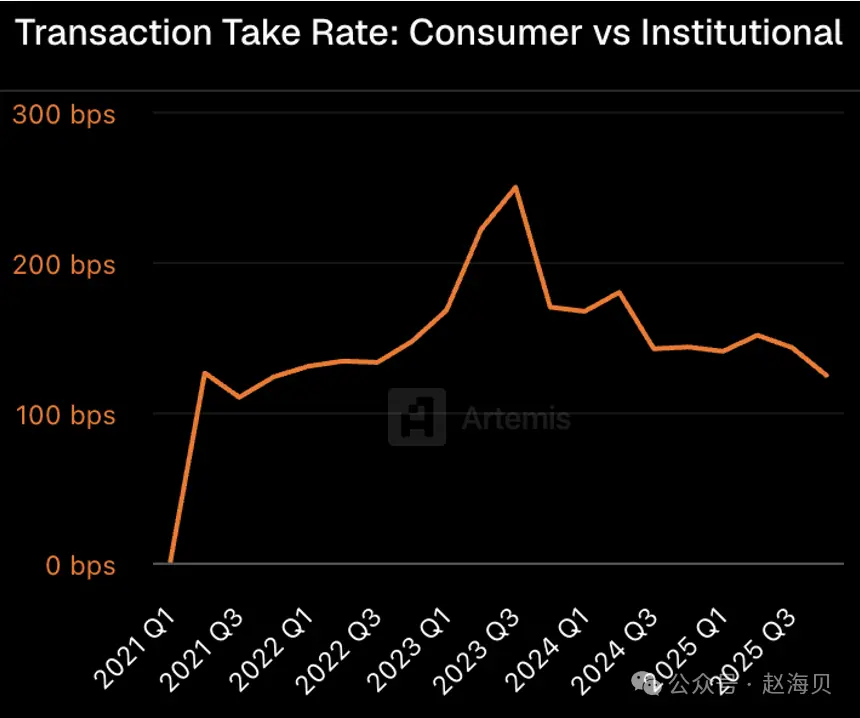
Similarly, influenced by the differentiation strategies of competitors like Robinhood, Coinbase's transaction fees have also shown a significant downward trend.
Above, we discussed two structural issues related to trading revenue: 1/ The end of the altcoin summer narrowed the market space for the next bull market; 2/ Increased competition led to a decline in Coinbase's market share. Based on this, I believe we can at least conclude that Coinbase does not have long-term (more than four years) holding value.
Strategy
1/ Currently, the market generally believes that Clarity is unlikely to be approved within a year. If you have unique insights into Clarity and other compliance events, Coinbase at its current price level (with lower non-trading revenue) can be a relatively safe tool to express your views. Compared to Circle, Coinbase is less sensitive to channel sharing and interest rates. If Clarity is approved, both could see significant gains in the short term (you can refer to the recent price action after Clarity's hints, but due to space limitations, I will not elaborate further here).
2/ Compared to the Circle + BTC = 1:1 combination, Coinbase can be seen as a tool for long-term growth in altcoin trading volume during a bull market. However, in the long run, the altcoin market is likely to underperform Bitcoin (due to slower fundraising), and Coinbase's market share is a given. Therefore, it can be inferred that Coinbase's long-term performance is likely to be inferior to the Circle + BTC = 1:1 combination.
3/ Although the Coin/BTC ratio has been fluctuating within a range for a long time, this does not mean that you should hold Coin. Coin's unit returns are more volatile, and its risk-reward ratio will inherently lead to its underperformance compared to BTC in the long run.
This content is for informational and educational purposes only and does not constitute investment advice related to BTCC. BTCC makes every effort but cannot guarantee the truthfulness, accuracy, or originality of the content above.