Crypto Wallet
Custodial vs Non-Custodial Wallet: What’s the Real Difference?

In this guide, I’ll break down the differences, using verified data from reputable industry sources, and help you decide which one fits your needs.
Table of Contents
- What Is a Crypto Wallet?
- What Is a Custodial Wallet?
- What Is a Non-Custodial Wallet?
- Custodial vs Non-Custodial Wallet: Side-by-Side Comparison
- Who Prefers Self-Custody?
- Pros & Cons of Custodial Wallets
- Custodial vs Non-Custodial Wallet: FAQs
- Conclusion
- References
- How to Trade Crypto on BTCC?
- BTCC FAQs
What Is a Crypto Wallet?
You might think of a cryptocurrency wallet as a key to your digital possessions.
It can be seen in this way:
- The blockchain is a giant public record.
- To access the little “box” included within that record, you’ll need your wallet, which serves as your personal key.
- Assets reside on the blockchain, not in the wallet.
- Keys are the only items kept in the wallet.
What Is a Custodial Wallet?
A custodial wallet is when a company (like an exchange) holds your private keys for you.
In other words, you can get to your money, but they hold the key.
Famous examples:
•Exchanges (BTCC, Coinbase, Binance)
What Is a Non-Custodial Wallet?
Examples:
•MetaMask
•Ledger
•Phantom
People who want full control, on-chain users, DeFi enthusiasts.
/ You can claim a welcome reward of up to 10,055 USDT🎁\
Custodial vs Non-Custodial Wallet: Side-by-Side Comparison
| Feature | Custodial Wallet | Non-Custodial Wallet |
|---|---|---|
| You own the private keys? | No | Yes |
| Recovery options | Email/password reset | Lose phrase = lost forever |
| Security control | Medium (shared responsibility) | High (fully your responsibility) |
| Ease of use | Very beginner-friendly | More technical |
| DeFi usage | Limited | Full access |
| Risk of hacks | Platform-level risks | User-level risks |
| Fees | Often lower | Sometimes higher (gas fees) |
Who Prefers Self-Custody?
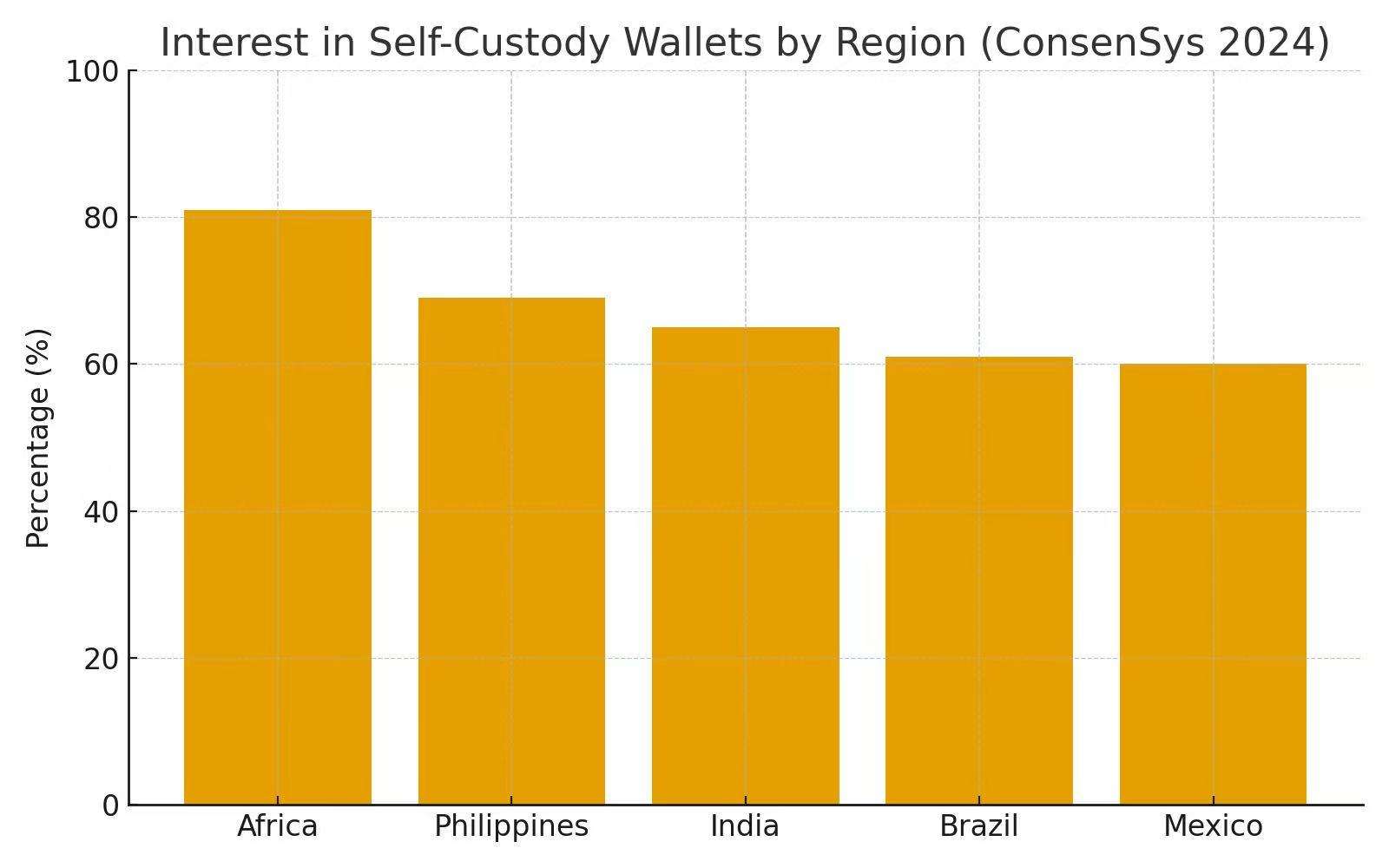
According to the ConsenSys Global Web3 User Study (2024), interest in self-custody wallets is highest in:
•Africa – 81%
•Philippines – 69%
•India – 65%
•Brazil – 61%
Pros & Cons of Custodial Wallets
Pros
- Suitable for newcomers
- You can get your account back
- Trading on exchanges is quick
- Easier to grasp
Cons
- The keys are not yours.
- Withdrawals can be frozen by the platform.
- Exchange hacking pose a threat.
Pros & Cons of Non-Custodial Wallets
Pros
- Acquiring totally
- Endless use of DeFi
- There is absolutely no danger to any irrelevant parties
- Greater exclusivity
Cons
- The loss of a seed phrase is irreversible.
- May be too much for newcomers to handle
- Costs associated with gas
- Needs routines for individual safety
Which One Should You Choose?
Here’s the honest answer:
- Starting with custodial is a safer and easier option for newcomers.
- To store your funds for the long term and use DeFi, after you have mastered the fundamentals, add a non-custodial wallet.
- Many advanced users use both:
- Custodial → trading
- Non-custodial → long-term holding
Start Trading Safely on BTCC
- Ultra-fast deposits & withdrawals
- 13+ years of exchange security
- User-friendly mobile app
- Futures trading with industry-leading liquidity
/ You can claim a welcome reward of up to 10,055 USDT🎁\
Custodial vs Non-Custodial Wallet: FAQs
It’s “safer” only if you manage your seed phrase correctly.
Conclusion
The question isn’t whether a custodial or non-custodial wallet is “better”; rather, you should consider your present abilities and future objectives while making your decision.
Want things to be easy? Join the custodial officers.
Desire total command? Leave the penal system.
Do you value adaptability and security equally? Make use of both.
No matter what you decide, be well-informed at all times and never give out your recovery phrases or private keys.
Disclaimer
References
For more detailed market analysis, strategies, and educational resources, visit BTCC Academy and stay ahead of the curve in the rapidly evolving crypto space.
How to Trade Crypto on BTCC?
This brief instruction will assist you in registering for and trading on the BTCC exchange.
Step 1: Register an account
The first step is to hit the “Sign Up” button on the BTCC website or app. Your email address and a strong password are all you need. After completing that, look for a verification email in your inbox. To activate your account, click the link in the email.

Step 2: Finish the KYC
The Know Your Customer (KYC) procedure is the next step after your account is operational. The main goal of this stage is to maintain compliance and security. You must upload identification, such as a passport or driver’s license. You’ll receive a confirmation email as soon as your documents are validated, so don’t worry—it’s a quick process.

Step 3. Deposit Funds
After that, adding money to your account is simple. BTCC provides a range of payment options, such as credit cards and bank transfers. To get your money into your trading account, simply choose what works best for you, enter the amount, and then follow the instructions.
- Fiat Deposit. Buy USDT using Visa/Mastercard (KYC required).
- Crypto Deposit. Transfer crypto from another platform or wallet.
Step 4. Start Trading
If you wish to follow profitable traders, you might go for copy trading, futures, or spot trading. After choosing your order type and the cryptocurrency you wish to trade, press the buy or sell button. Managing your portfolio and keeping track of your trades is made simple by the user-friendly interface.

Look more for details: How to Trade Crypto Futures Contracts on BTCC
BTCC FAQs
Is BTCC safe?
Based on its track record since 2011, BTCC has established itself as a secure cryptocurrency exchange. There have been no reports of fraudulent activity involving user accounts or the platform’s infrastructure. By enforcing mandatory know-your-customer (KYC) and anti-money laundering (AML) procedures, the cryptocurrency trading platform gives consumers greater security. For operations like withdrawals, it also provides extra security features like two-factor authentication (2FA).
Is KYC Necessary for BTCC?
Indeed. Before using BTCC goods, users must finish the Know Your Customer (KYC) process. A facial recognition scan and legitimate identification documents must be submitted for this process. Usually, it is finished in a few minutes. This procedure has the benefit of strengthening the security of the exchange and satisfying legal requirements.
Because their accounts will have a lower daily withdrawal limit, those who do not finish their KYC are unable to make deposits. It should be noted that those who present a legitimate ID without a facial recognition scan will likewise have restricted withdrawal options.
Is There a Mobile App for BTCC?
Indeed. For users of iOS and Android, BTCC has a mobile app. The exchange’s website offers the mobile app for download. Since both the web version and the mobile app have the same features and capabilities, they are comparable.
Will I Have to Pay BTCC Trading Fees?
Indeed. BTCC levies a fee for trade, just like a lot of other centralised exchanges. Each user’s VIP level, which is unlocked according to their available money, determines the different costs. The BTCC website provides information on the charge rates.
Can I Access BTCC From the U.S?
You can, indeed. According to its website, BTCC has obtained a crypto license from the US Financial Crimes Enforcement Network (FinCEN), which enables the cryptocurrency exchange to provide its services to investors who are headquartered in the US.
According to BTCC’s User Agreement document, its goods are not allowed to be used in nations and organisations that have been sanctioned by the United States or other nations where it has a licence.
Hot Topic:
- Best Free Crypto Sign-Up Bonuses in 2025: Ultimate Guide for Traders & Investors
- How to Get Free $10 Crypto No Deposit Bonus 2025
- 5 Best Free Bitcoin Cloud Mining Sites & Apps in 2025
- Nvidia (NVDA) Stock Price Forecast 2025–2028 | AI Infrastructure Growth Outlook for Investors
- Compare Gold Prices in India and USA | Gold Rate Today
BTCC Guide:
- How to Trade Crypto Futures Contracts on BTCC
- How to Buy and Deposit Crypto on BTCC?
- What is Crypto Futures Trading – Beginner’s Guide
- What is Leverage in Cryptocurrency? How Can I Trade at 100X Leverage?
Crypto Buying Guides:
- How To Buy Bitcoin (BTC)
- How To Buy Picoin
- How To Buy Ethereum (ETH)
- How To Buy Dogecoin (DOGE)
- How To Buy Pepe Coin (PEPE)
- How To Buy Ripple (XRP)
Crypto Prediction:
- Ethereum (ETH) Price Prediction 2025, 2026, 2030 — Will ETH Reach $10,000?
- Ethereum Price Prediction 2025, 2026, 2030: How High Can ETH Go in 2024?
- Bitcoin (BTC) Price Prediction 2025, 2026, 2030 — Is BTC a Good Investment?
- Ripple (XRP) Price Prediction 2025 ,2026, 2030 — Will XRP Reach $1 After SEC Lawsuit?
- Pi Coin Price Prediction 2025,2026,2030 — Is Pi Coin a Good Buy?
- Pepe (PEPE) Price Prediction 2025, 2026, 2030 – Will PEPE Reach $1
Please be aware that all investments involve risk, including the potential loss of part or all of your invested capital. Past performance is not indicative of future results. You should ensure that you fully understand the risks involved and consider seeking independent professional advice suited to your individual circumstances before making any decision.
For any inquiries or feedback regarding this article, please contact us at: [email protected]