


Wang Chun Slams Zcash as Undeserving, Can ZEC's Epic Pump Last?
 BlockbeatsAuthor: Azuma
Original title: "Wang Chun Recounts Zcash's Dark History, Slams ZEC as 'Undeserving'"
Original author: Azuma, Odaily News
Zcash (ZEC) is in the midst of an epic pump.
ZEC officially broke through the $1,000 mark on Sep. 6, reaching a high of $1,256.92. As of 14:00 today, it has pulled back slightly but is still quoted at $1,128.05. If calculated from the low of $251.39 in early June this year when the Orchard vulnerability was unfolding, ZEC's maximum gain is approaching 400%.
However, while ZEC is surging in the secondary market, not everyone is buying it in the court of public opinion.
Wang Chun Slams Zcash
At noon today, Bitcoin veteran and F2Pool co-founder Wang Chun (@satofishi) posted multiple tweets, digging up Zcash's dark history and bluntly stating that "blocking this team was one of the most correct decisions I've ever made."
· Odaily note: Wang Chun is now better known as "the first astronaut slated to fly to Mars." In May this year, SpaceX officially announced that Wang Chun will ride Starship on one of the first crewed interplanetary Mars missions, a two-year deep-space flight that will leave the Earth-Moon system, fly by Mars (without landing), and return to Earth.
First, at 12:52, Wang Chun retweeted a post from six years ago criticizing the Zcash team for not understanding daylight saving time, questioning the team's professionalism.
"Six years ago, a member of the Zcash team emailed me and kept confusing EST (Eastern Standard Time) with EDT (Eastern Daylight Time). Communication broke down completely, and I blocked the entire company. Looking back six years later, it's still one of the most correct decisions I've ever made. Remember the BlockFi incident? They were supposed to send users $701.4, but instead transferred 701.4 bitcoins. Someone who can't tell EDT from EST would probably also mix up BTC and USD."
Then at 13:17, Wang Chun commented on ZEC again, this time with more aggressive language, arguing that ZEC is "undeserving of its position."
"Zcash's recent rally is purely narrative-driven. A large market cap doesn't mean a token deserves its current position; being next to Solana and Hyperliquid on the market cap rankings doesn't mean Zcash can do what those two have done."
"Its launch was unfair from the start. In the first four years, 20% of every block reward was deducted as the 'Founders' Reward.' This money went to founders, employees, advisors, and early investors. The total accumulated to 2.1 million ZEC, 10% of the 21 million total supply cap. Bitcoin only rewards miners, while Zcash also has to support a company and its backers. When the first cut was supposed to end, another similar 20% cut came back under the name of a 'development fund.' A token that writes self-enrichment clauses directly into its block rewards has no right to be packaged as a clean, neutral currency."
"This cut didn't buy a real economic ecosystem. Privacy is its marketing selling point, but using privacy features is optional. For exchanges and simple wallets, transparent addresses are always the path of least resistance. For most of Zcash's history, the vast majority of tokens have been exposed in the open. 'Optional privacy' is just a marketing gimmick; 'privacy by default' is the underlying protocol. Meanwhile, team governance has been mired in board infighting: Electric Coin Company (ECC), the Foundation, Bootstrap, brand ownership, wallet ownership, and who gets a piece of the pie. In January 2026, the entire ECC team left and claimed they were pushed out. This isn't a minor detail; it's the project's real operating ecosystem. A core team that can't even coexist under one roof with its own nonprofit board is by no means 'decentralized'—its top-level architecture has collapsed."
"Next is the security mess the market is now trying to gloss over. In May 2026, a critical vulnerability in the Orchard pool was disclosed. It had been lurking for about four years. In theory, it could mint fake ZEC out of thin air without leaving clear on-chain traces. And because the pool is private, no one can prove whether fake coins were ever minted. The 'Ironwood' upgrade in July closed the old pool and forced tokens to migrate through a checkpoint. That's cleaning up a mess, not a reason to be in the top ten by market cap. A currency that cannot verify its private supply like Bitcoin and had to undergo an emergency fix after a four-year vulnerability is hardly 'hard money.'"
"The conclusion is obvious: an unfair launch, team cuts disproportionate to product strength, years of top-level infighting, and a massive hole lurking in the privacy pool for four years—these are not the report card of a top-ten network, but the true portrait of a story coin kept alive by narratives. You may dislike Solana and Hyperliquid for your own reasons, but they at least carry real application demand; what Zcash carries is nothing more than an exchange listing and a short squeeze. The two are fundamentally different. Confusing them is as absurd as sending 701.4 of the wrong asset in a transfer, or treating EST (Eastern Standard Time) and EDT (Eastern Daylight Time) as the same time."
Recounting the Dark History
In short, aside from the timezone professionalism issue, Wang Chun mentioned four controversies about Zcash in his tweets.
The 20% "Insider Treatment"
The earliest criticism of Zcash was its launch mechanism, which is completely different from Bitcoin's. After the mainnet launch in 2016, 20% of every block reward in the first four years did not go to miners but was distributed as the "Founders' Reward" to founders, early employees, advisors, investors, and related parties such as Electric Coin Company (ECC). This portion ultimately accumulated to about 2.1 million ZEC, 10% of the total supply cap.
More notably, after the Founders' Reward expired in 2020, the 20% block reward cut did not completely disappear. The Zcash community introduced a new Dev Fund through ZIP 1014, continuing to allocate 20% of block subsidies to Bootstrap, the Zcash Foundation, and Major Grants from 2020 to 2024.
Although the use of funds and governance differ from the original Founders' Reward, critics argue that Zcash still has a long-standing "developer cut" mechanism distinct from Bitcoin.
A "Privacy Coin" That Allows You Not to Be Private
The second controversy stems from Zcash's core product positioning—privacy.
Zcash does not force all transactions to be private; it supports both shielded (private) transactions and transparent transactions. Users can choose whether to use privacy features depending on wallet and exchange support; some wallets or exchanges still only support transparent transactions. Zcash's official documentation explicitly reminds users that to keep transaction and financial history private, they need to use wallets or services with shielded transactions enabled by default.
This creates a controversial product positioning—Zcash does have unique privacy technology, but privacy is not a mandatory protocol-level property. For users, not using privacy features is often more convenient; for exchanges and wallets, transparent addresses are easier to support and regulate.
Wang Chun's "optional privacy" criticism is not denying Zcash's privacy technology, but questioning whether Zcash can justify today's valuation with the "privacy coin" narrative when a large number of transactions on the network can still be conducted publicly.
Core Team Publicly Fights, Ends Up Disbanding
If the first two issues are part of Zcash's historical design, the ECC turmoil that erupted earlier this year directly exposed governance conflicts.
In January 2026, the entire team of Zcash's core development company Electric Coin Company (ECC) left collectively. ECC CEO Josh Swihart said at the time that the team was forced out due to serious disagreements with the board of Bootstrap, the nonprofit that governs ECC; Bootstrap attributed the conflict to governance arrangements and nonprofit legal constraints.
The turmoil did not halt Zcash—the former ECC team subsequently founded a new company to continue developing Zcash, and at the end of February, Bootstrap announced that both parties had reached a resolution: ECC would gradually wind down operations and transfer relevant technical assets.
But from an outside perspective, a project whose core development team publicly clashes with its governance body and ultimately "walks out en masse" hardly fits the image of a highly decentralized, maturely governed protocol. This became one of Wang Chun's key arguments for questioning Zcash's "undeserved position."
The Orchard Vulnerability Lurking for Four Years
What truly tested Zcash's "hard money" narrative was the Orchard vulnerability disclosed in May this year.
On May 29, security researcher Taylor Hornby discovered a critical vulnerability in the zero-knowledge proof circuit of the Orchard privacy pool. According to Zcash's disclosure, the vulnerability could theoretically allow an attacker to mint unlimited fake ZEC without detection. More troublingly, because Orchard itself has privacy properties, even after the vulnerability was fixed, it is cryptographically impossible to prove whether anyone exploited it to mint fake coins during the vulnerable period.
Zcash quickly took emergency measures, temporarily shutting down Orchard-related operations and re-enabling the fixed circuit through the NU6.2 upgrade; the entire emergency fix was completed within days.
The problem is that for an asset built on scarcity, privacy, and a "digital cash" narrative, "theoretically unlimited minting, and no way to prove afterward whether it happened" is itself an extremely serious trust issue. This was the direct cause of ZEC being dumped to around $250 in early June this year, and it is the project's most difficult-to-avoid "dark history."
Another Big Player Is Aggressively Shorting
Besides Wang Chun's comments, another big player is expressing bearishness on ZEC with real money.
Garrett Jin, known as the "1011 insider whale proxy," is currently the largest on-chain ZEC short. This morning, Garrett Jin closed a Bitcoin long position with a notional value of $106.18 million and continued to add to his ZEC short.
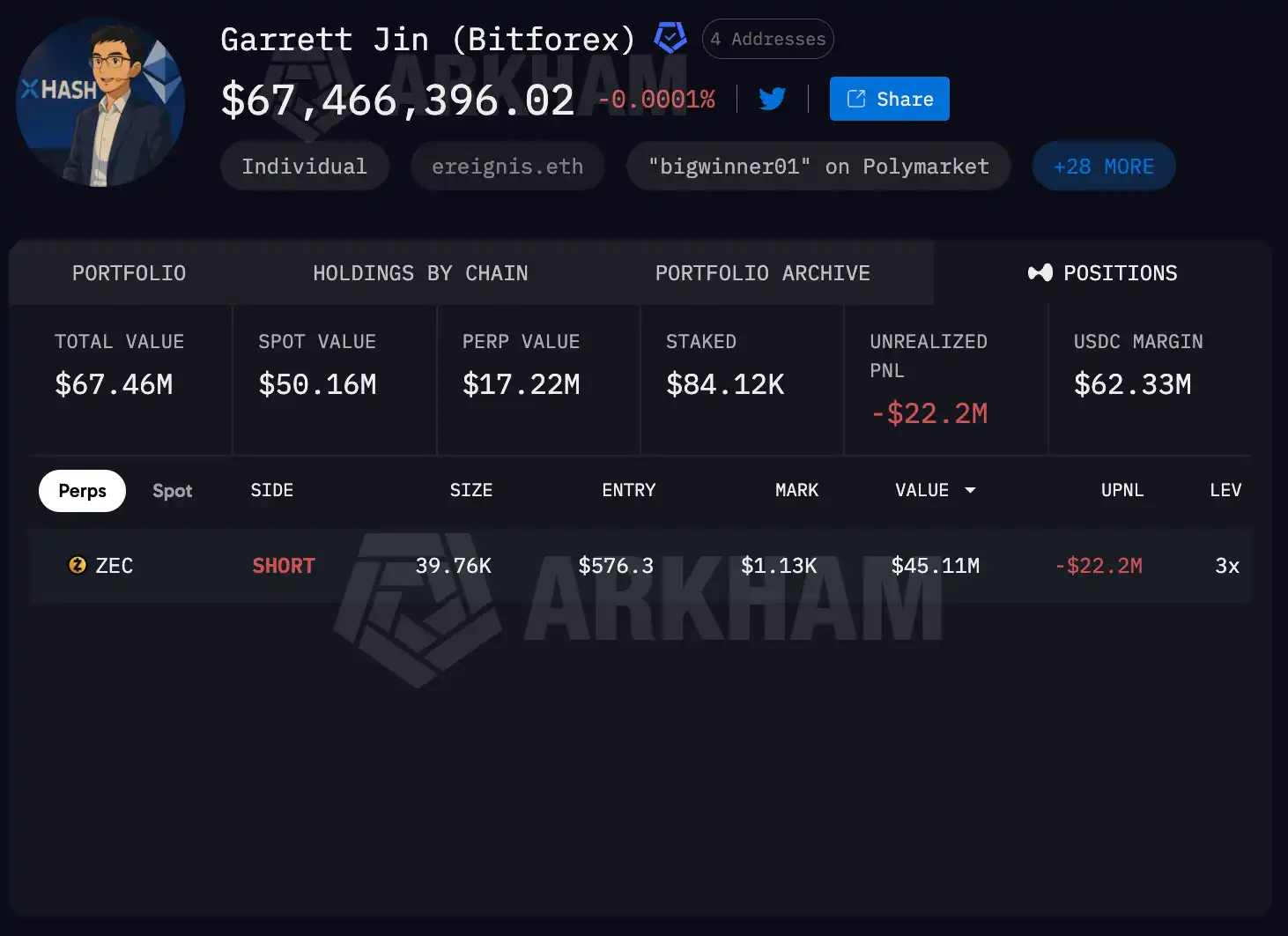
Currently, Garrett Jin is shorting $45.11 million worth of ZEC with 3x leverage at an average entry price of $576.3, still showing an unrealized loss of $22.2 million—but Garrett Jin seems extremely determined, having added to his short position multiple times as ZEC's price continued to rise.
How Long Can ZEC Keep Rising?
Of course, neither Wang Chun nor Garrett Jin can determine ZEC's price solely through bearish views or shorting. In fact, rising from $250 to over $1,200, ZEC has proven that the return of the privacy narrative, capital chasing, and short squeezes are fully capable of overwhelming fundamentals in the short term. As long as market sentiment continues to heat up, ZEC could certainly push higher.
But the question is, after this nearly 5x rally, it is hard to explain the current price with "undervaluation." When the short squeeze gradually ends (perhaps with another squeeze on Garrett Jin?), profit-taking pressure will grow, and the market will eventually return to fundamentals: besides the privacy narrative, what else can Zcash offer to support a higher valuation? The launch mechanism, optional privacy, governance disputes, and the Orchard vulnerability mentioned earlier have not disappeared just because the price went up.
Therefore, rather than predicting whether ZEC's next stop is $1,500 or $2,000, it may be more worth observing how much premium the market is willing to leave for ZEC after hot money recedes and shorts are no longer forced to cover. That will determine whether this surge is a revaluation of a veteran privacy coin or a super rally driven by narrative and liquidity.
This content is for informational and educational purposes only and does not constitute investment advice related to BTCC. BTCC makes every effort but cannot guarantee the truthfulness, accuracy, or originality of the content above.