


PONS Surges Nearly 20x: How It Powers Half of Robinhood Chain's Revenue
 chaincatcher
Author: Zhou, ChainCatcher
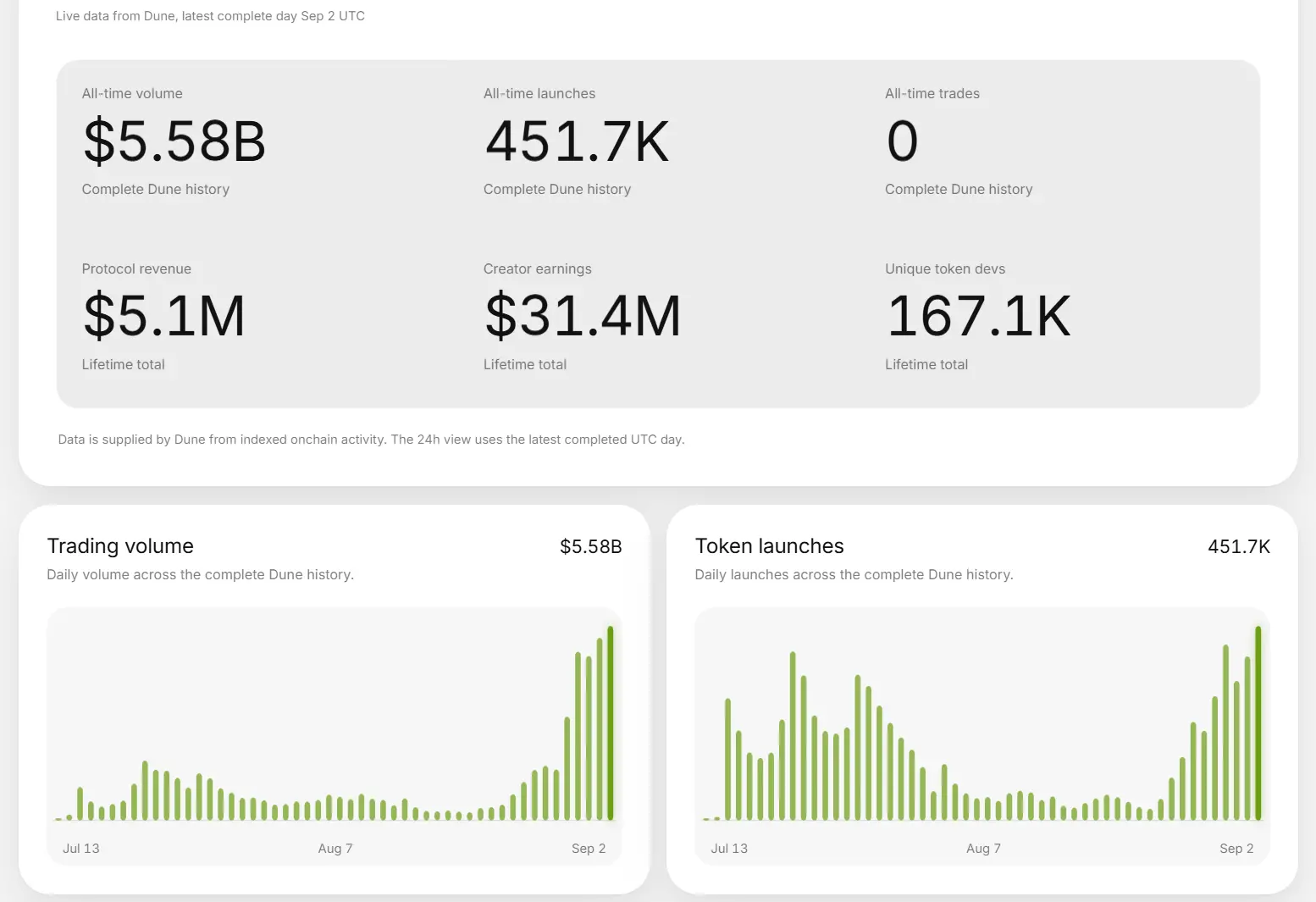
Market discussion around Robinhood Chain has been heating up recently, and Pons is an unavoidable topic. Latest data shows Pons' cumulative trading volume has surpassed $5 billion, with over 63% of Robinhood Chain Launchpad's trading volume during the same period executed through Pons.
Over the past month, the PONS token price has risen roughly 20x. On Sept. 2, PONS was listed on Binance Alpha, and its market cap has now exceeded $500 million, with a 24-hour gain of over 40%.
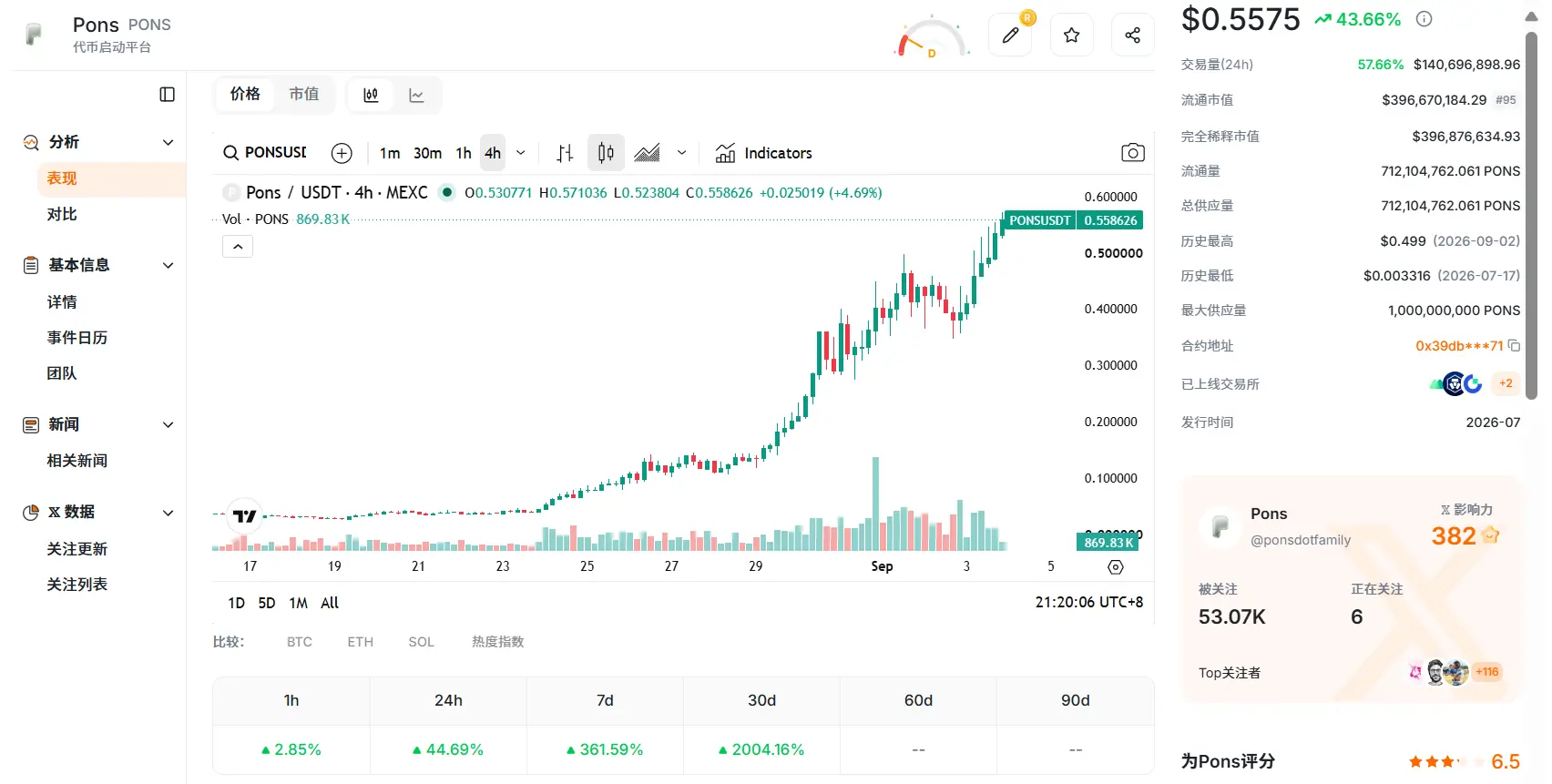
Pons is a token launch platform built on Robinhood Chain. In less than two months since launch, it has become the most active application on this new public chain, with token creators collectively earning over $28.7 million in trading fee revenue share.
A team that was virtually unknown has secured a leading position in the sector within two months. This is the story of Pons, and a key clue to understanding Robinhood Chain's early ecosystem.
From Taking Over Noxa's Traffic to Entering Pools.trade
Robinhood Chain officially launched its mainnet on July 1. Initially, the sector leader was the launch platform Noxa.
However, Noxa suspended new token launches in mid-July, and traffic quickly shifted to the fledgling Pons. Within a single week, Pons completed over 66,000 token launches, with cumulative platform trading volume exceeding $380 million and a market share above 50% for several consecutive days.
WLFI advisor Ogle publicly disclosed his holdings on Robinhood Chain, with PONS as his second-largest position after Lighter (his PONS holdings are now worth approximately $5.4 million).
In late July, Robinhood co-founder and CEO Vlad Tenev followed Pons founder Ozzy on Twitter, and PONS' market cap briefly soared to $39 million.
In early August, the competitive landscape shifted. Uniswap's launch platform pools.trade went live on Robinhood Chain on Aug. 5, creating 10,506 tokens on its first day, surpassing Pons' 7,210 during the same period. Uniswap itself is the underlying liquidity pool infrastructure that Pons relies on, and the official entry into a similar product intensified competition across the sector.
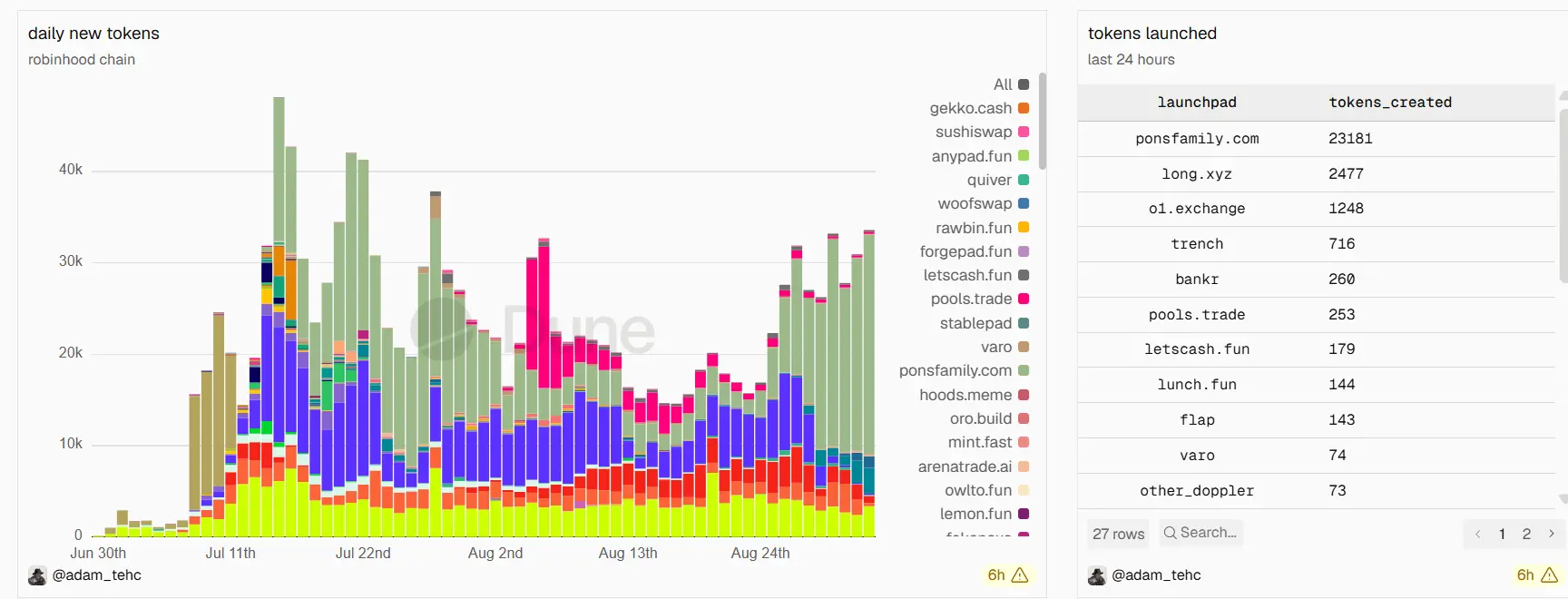
Pons' daily token launches also fell from a peak of over 20,000 in mid-July to a low of just over 1,000 in mid-August. It wasn't until around Aug. 24 that Pons' daily token launches began to rebound, with trading volume and PONS price rising almost in tandem, returning to over 20,000 by the end of August and setting a new high. During the same period, Pons was also advancing mechanism upgrades.
As of now, the Pons team has not publicly disclosed a complete list of members. The founder's Twitter handle is MEADGod (Ozzy), and the bio mentions RootsFi.
Reportedly, in May 2025, he introduced RootsFi on the Berachain governance forum under the same identity, positioning it as a native lending protocol centered on the stablecoin MEAD. RootsFi later underwent a transformation, and its official website now positions it as a payment network.
Mechanism Upgraded to V2, RWA Share Only 5%
Pons' initial model was very simple: after a token was created, it went directly into a Uniswap V3 liquidity pool, with no bonding curve and no subsequent migration, trading in the same pool from the very first second.
The creation fee was fixed at 0.0005 ETH, and the trading fee was 1%, with 70% going to the creator and 30% to the protocol. Tokens issued earlier retain the old ratio of 90% to the creator and 10% to the protocol. Of the protocol's share, 80% will be used to buy back and burn PONS via TWAP.
The new V2 version switches to an ETH-denominated bonding curve. Tokens automatically graduate after selling out on the curve, with liquidity permanently locked into Uniswap V4 positions, and creators can no longer withdraw. The pricing asset has also expanded from ETH alone to other platform-approved tokens, including stablecoins and some tokenized stocks.
This mechanism pushes the launch process and anti-sniping design a step further. The specific incremental benefits remain to be seen, but the product has indeed iterated to a new generation.
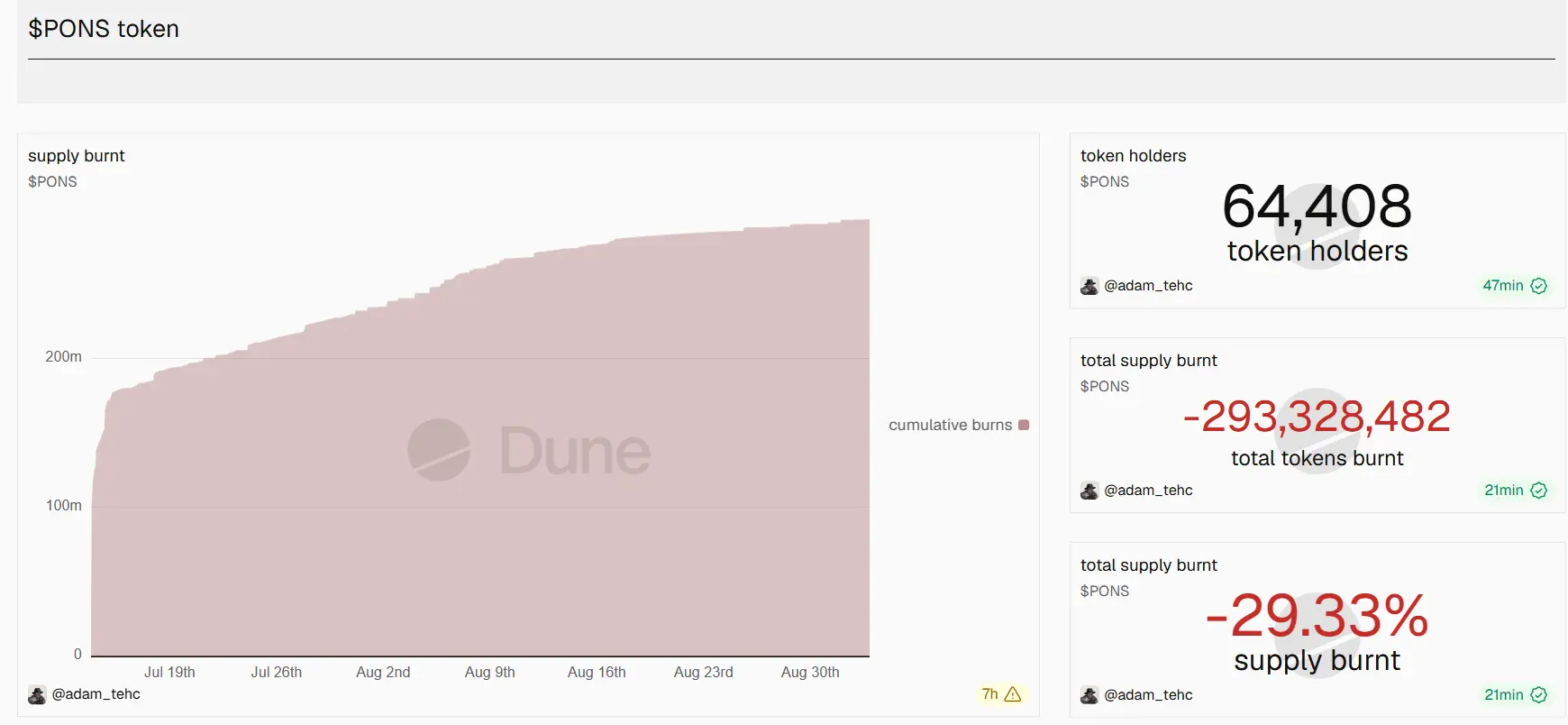
As of early September, PONS has cumulatively burned 293 million tokens, accounting for 29.33% of the maximum supply, with over 62,000 holding addresses. At the platform level, nearly 600,000 tokens have been issued, with over 150,000 unique creators, and cumulative protocol revenue of approximately $4.97 million.
Looking across the entire Robinhood Chain launch platform sector, according to Dune dashboard data, since July, Pons ranks first in token issuance volume, on-chain trading volume, and number of traders, with its trading volume accounting for more than half of the total across major launch platforms.
Additionally, the combination of stocks and memes is becoming a larger trend on Robinhood Chain. KOL Dayu believes that once stock tokens are tokenized on-chain at scale, the first issue to solve is actually liquidity; with thousands of stocks, each one needs someone to create a pool, and there is no standard answer for how large a pool should be.
Memes offer a low-cost solution; once a meme coin tied to a stock takes off, the corresponding liquidity pool grows naturally with trading, without the need for dedicated pool creation. Conversely, stocks provide memes with a real-world value anchor and narrative.
In his view, this complementarity is the core logic behind the flourishing of stocks and memes on Robinhood Chain, rather than just a narrative gimmick.
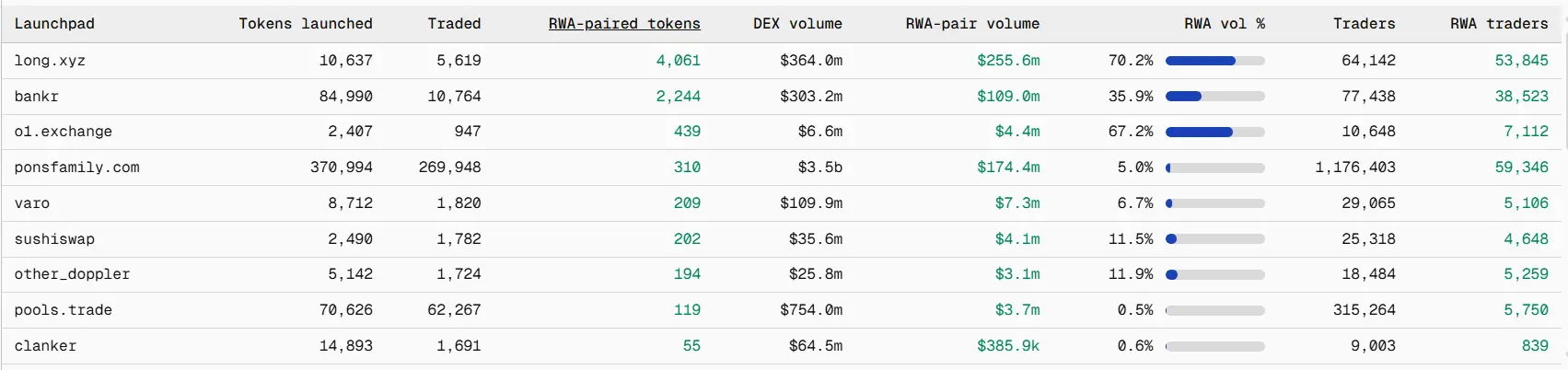
Pons is also attempting to incorporate stock token trading into its system. Currently, this segment accounts for about 5% of the platform's total volume, corresponding to a cumulative trading volume of approximately $174 million, with 310 stock token trading pairs. However, this is not Pons' main battlefield; on the same chain, long.xyz, o1.exchange, and bankr have RWA shares of 70.2%, 67.2%, and 35.9% respectively, all far higher than Pons.
Powering Half of Robinhood Chain's Revenue?
Robinhood Chain has been live for only two months, yet its revenue has already surpassed Ethereum, BSC, Solana, and Base.
As of Sept. 3, Robinhood Chain's 24-hour DEX trading volume was approximately $1.85 billion, second only to Solana and ahead of Ethereum mainnet, BSC, and Base.
During the same period, the chain generated approximately $4.45 million in fees, three times the combined total of Solana, Ethereum, BSC, and Base, with on-chain revenue of approximately $4.01 million, nearly 14 times the combined total of these four chains.
In DeFiLlama's revenue rankings, by protocol revenue, Pons ranks ninth as a single application. On-chain data analytics platform Bubblemaps reported that PONS generates approximately $4.73 million in daily fee revenue, surpassing the combined total of Hyperliquid, Polymarket, and Fomo at the application level.
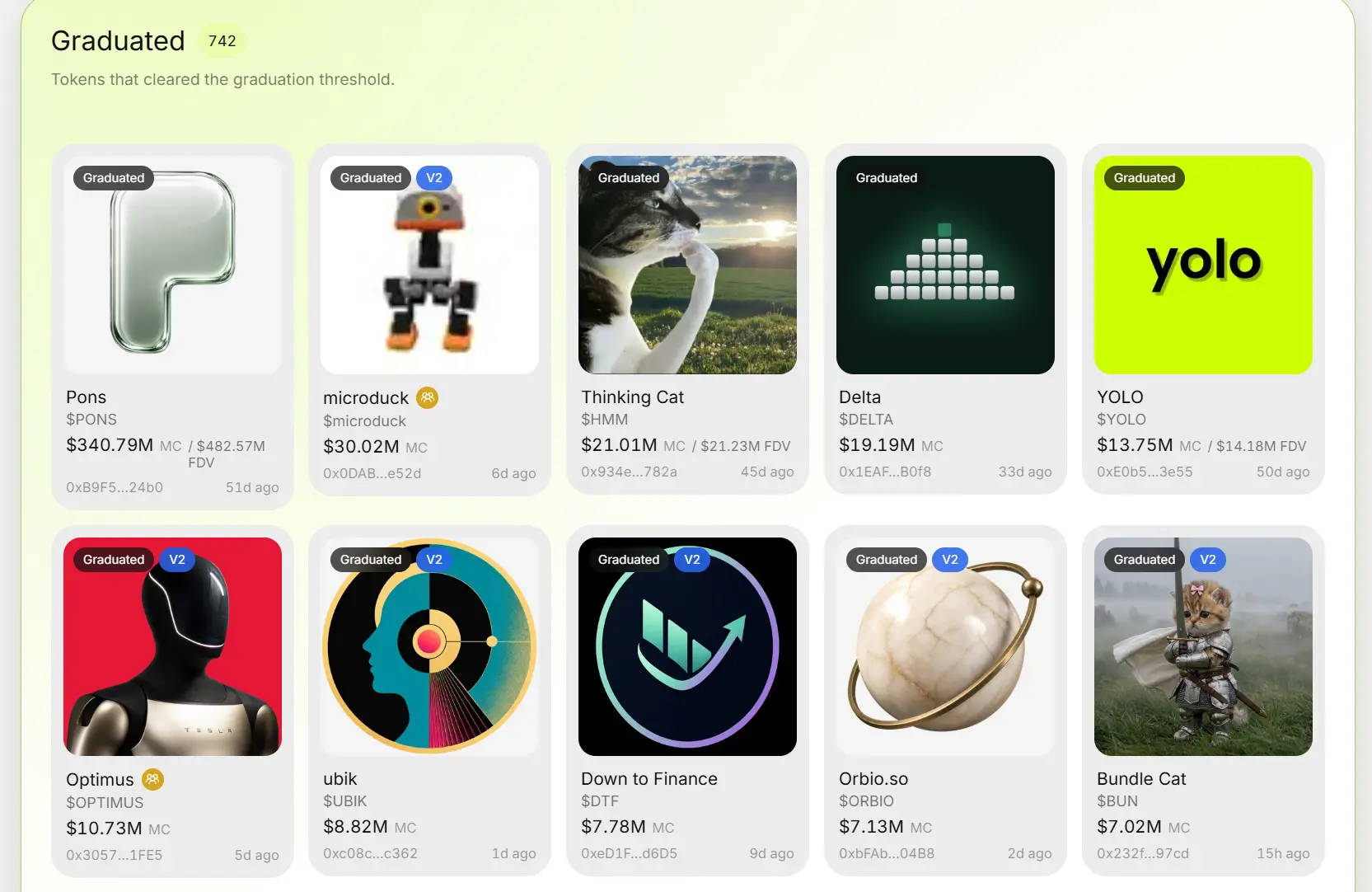
In terms of graduation rate, July statistics showed Pons cumulatively issued approximately 67,000 tokens, of which 529 reached the graduation threshold, a ratio of less than 0.8%. By early September, the official website showed a cumulative total of 742 graduated tokens, while cumulative issuance had risen to nearly 600,000, lowering the graduation rate to approximately 0.11%.
KOL 0xLoki cautioned that newly issued tokens and projects that have not yet taken off carry the highest risk, and investors in meme coin liquidity pools should be prepared for their value to go to zero at any time. On the same launch platform, many long-tail tokens have highly concentrated holdings, with some projects having over 80% of chips concentrated in a few addresses; once these whales sell, the price structure will be difficult to sustain.
Furthermore, it is worth noting that Robinhood Chain has provided users with a 90-day zero gas fee policy since the mainnet launch, which is set to expire at the end of September. The current daily issuance density of 20,000 tokens is largely built on the near-zero cost of token creation; whether this pace can be maintained after the subsidy ends remains unknown.
Trader Timo compared Pons' revenue performance to Virtual's historical peak, arguing that such growth is difficult to sustain long-term, and raised questions about whether the buyback ratio can truly be executed, how long revenue can last, and whether liquidity is sufficient.
KOL Lanhu pointed out that Pons' strategy is to bring Pump.fun to Robinhood Chain; the playbook is not new, and while traffic and attention are present, how long they can last is unknown. Others have noted that they have seen many projects that copy the Pump model and switch chains; switching chains does not solve the fundamental problem, and most end up with only a wave of market hype.
Pons may have proven Robinhood Chain's success, but whether it can ultimately become a platform that sustainably generates wealth effects remains unanswered by the market.
This content is for informational and educational purposes only and does not constitute investment advice related to BTCC. BTCC makes every effort but cannot guarantee the truthfulness, accuracy, or originality of the content above.