


Solana's First Binding Vote: Deflation Doubles, Burn Proposal Fails
 OdailyAuthor: jk
Original | Odaily News (@OdailyChina)
Author | jk
On Aug. 27–28, 2026, the Solana network completed its first truly binding on-chain governance vote, marking a formal shift from "off-chain signaling by validators" to "stake-weighted on-chain voting."
This was the first time institutional investors, publicly traded companies, and ordinary staking delegates faced off in the same voting process. Two of the three proposals passed by a wide margin, while the fee reform proposal aimed at increasing SOL burns fell short of the two-thirds approval threshold.
What Were the Three Proposals?
The vote took place under Solana's newly launched SGP (Solana Governance Proposal) framework, which went live on July 1, 2026, replacing the previous informal, validator-only off-chain signaling mechanism. The biggest change in the new framework is the introduction of "delegator override": even if tokens are delegated to a validator for staking, the actual token holder can override that validator's vote, thereby mitigating the long-standing misalignment between validators and ordinary token holders.
The three proposals on the table were:
SGP-0001, the "Solana Constitution," established the basic rules of the entire governance framework, including quorum (one-third of staked supply participating) and approval threshold (two-thirds majority). This proposal ultimately passed with about 86% support, about 2% opposition, and about 12% abstention.
SGP-0002, "Double Deflation" (corresponding to technical proposal SIMD-0550), increased Solana's annual deflation rate from 15% to 30%, moving the timeline for reaching the 1.5% terminal inflation rate from around 2032 to around 2029, and is expected to reduce total SOL issuance by about 18.9 million tokens over the next six years.
The passage of this proposal was dramatic: about 70 minutes before the vote closed, the largest validator under crypto exchange Kraken temporarily flipped its position on about 8.9 million SOL from support to opposition, putting the proposal behind by about 58 million SOL. But at the last moment, Kraken flipped about 8.1 million SOL back to support, and Galaxy, an institutional investor, also shifted from abstention to support in the final minutes. Additionally, stakers represented by the Jito staking pool overrode some delegated positions. SGP-0002 ultimately passed with exactly 67.00% support, just about 0.33 percentage points above the two-thirds threshold—a nail-biter.
SGP-0003, the "Resource and Access Fee Proposal" (corresponding to technical proposal SIMD-0553), failed to pass. Final tallies showed 53.90% support, 18.92% opposition, and a high 27.18% abstention. Although participation met the quorum requirement, support fell far short of the two-thirds line.
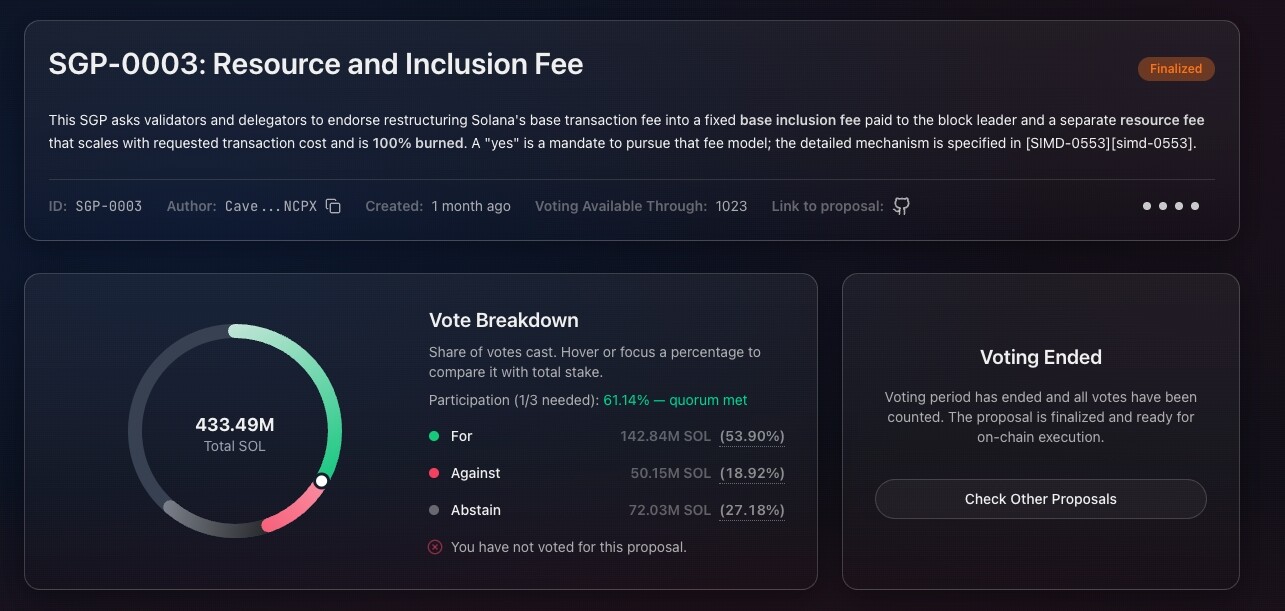
SGP-0003 failed to pass, source: Solana
What Did the Failed Burn Proposal Actually Propose?
The failed SGP-0003 was not, as some outside reports suggested, a proposal to "burn treasury funds" or "burn MEV revenue." It targeted the network's most basic transaction fee structure. Currently, every signature on every transaction on Solana pays a flat fee of 5,000 lamports, half of which is burned and half goes to the validator that produced the block.
SGP-0003 proposed splitting this fee into two parts: a fixed "access fee" of 2,500 lamports paid entirely to the block producer, and a "resource fee" priced dynamically based on the actual computational resources consumed by the transaction, which would be fully burned and not distributed to any party.
The intent was to make heavy users who consume more on-chain computational resources bear higher costs, while keeping more value within the protocol through burning rather than flowing to block producers. According to analysis firm 21Shares, if implemented, daily SOL burns would jump from about 648 tokens to between 7,500 and 9,000 tokens, equivalent to nearly a 14-fold increase in daily burn value at then-current prices.
However, even at the upper estimate, this burn volume would still be far below the current daily issuance of about 60,000 tokens, so the proposal would not immediately make SOL deflationary—it would only significantly intensify deflationary pressure.
Deflation Favors Price Increases—Why Did It Fail?
Looking closely at why SGP-0003 failed, opposition votes were not the main cause; the decisive factor was the high 27.18% abstention rate.
Under the counting rules established by the Solana Constitution, abstentions count toward the participation needed to meet quorum but are also included in the denominator of the support rate calculation. This means the more abstentions there are, the higher the effective threshold for passage becomes. SGP-0003's abstention rate was significantly higher than the other two proposals, and the collective abstention of large validators effectively determined the outcome.
Some calculations show that if abstentions were excluded from the denominator, SGP-0003's "decisive stake" support rate would have been about 74%, enough to pass. This discrepancy later sparked a public dispute over the interpretation of counting rules: Michael Hubbard, CEO of SOL Strategies, publicly stated that the constitutional text differed from the calculation method described in some pre-vote communication materials, and that under the rules participants were originally told, the proposal should have been considered passed. He also admitted that, despite his procedural objections, he personally believed the proposal's failure might have been the better outcome.
According to reports citing on-chain data from some channels, decentralized exchange protocol Jupiter, lending protocol Drift, publicly traded company Forward Industries, and staking service provider Anagram Staking are believed to have voted against; staking service provider Everstake is believed to have abstained; while staking service providers Figment, Staking Facilities, P2P.org, as well as Helius, OtterSec, Solana Compass, Blueshift, Temporal, and others that had already expressed support during the earlier signaling phase, along with DeFi Development Corp (DFDV), the first U.S.-listed SOL treasury company, are believed to have voted in favor.
Nasdaq-Listed Company Publicly Opposed, but Most Ecosystem Projects Supported
The most notable aspect of this vote was the public stance of Nasdaq-listed The Solana Company (ticker: HSDT). The Philadelphia-based digital asset treasury company, which operates institutional-grade validator services in the Asia-Pacific region, announced its position days before the vote: support for the constitution proposal, opposition to both the deflation and burn proposals.
Chairman and CEO Joseph Chee said that based on the company's communications with various institutional investors, issuance rate itself is rarely seen as a barrier to institutional entry into crypto; what truly deters institutions is whether network economic parameters can remain stable and reliable over multi-year cycles. In his view, adjusting the network's two most core and stable economic parameters (issuance rate and fee structure) simultaneously in the first formal voting cycle, right after the governance framework launched, was too risky and could actually slow institutional adoption.
On the deflation proposal, Chee specifically noted that staking yield is, for many SOL holders, equivalent to a financial statement line item that needs to be forecast, disclosed, and audited—it can even be considered part of operating cash flow—and the company did not want to see this previously certain, predictable issuance schedule reopened for discussion. On the burn proposal, he was even more direct: the current transaction fee is a known fixed constant, allowing financial institutions using Solana to budget in advance; turning transaction costs into a variable before the ecosystem has fully adapted would effectively shift the risk of cost estimation onto end users and operators.
According to financial data disclosed by media, staking rewards from the company's SOL holdings accounted for as much as 99.4% of its total second-quarter revenue; the company earned over 30,000 SOL from staking during the quarter and chose to auto-restake, but due to impairment charges from the decline in SOL's price, it still recorded a net loss of about $30 million.
Solana co-founder Anatoly Yakovenko publicly supported the general direction of the proposals, interpreting a yes vote as an authorization of the direction, with specific technical implementation details to be refined in subsequent technical proposals. However, he also admitted that SGP-0003 "packaged a bit too much at once," and preferred to split it into several simpler, more focused independent proposals for separate votes in the future—for example, separating the replacement of the fixed signature fee from the specific determination of the variable fee rate.
Austin Federa, co-founder of decentralized infrastructure project DoubleZero and former Solana Foundation member, cited data showing that the application layer of the Solana ecosystem captures about 93% of the total value generated on-chain, while the base network layer itself receives only the remaining 7%. In his view, a mechanism proportional to computational resource consumption, with the resource portion fully burned, could redirect more value that currently flows to the application layer or block producers back into the protocol itself.
The vote also rarely exposed a divergence in stance among digital asset treasury (DAT) companies within the Solana ecosystem—companies that typically hold and stake large amounts of SOL as part of their corporate balance sheets and should be most sensitive to changes in network economic parameters. DeFi Development Corp clearly supported both economic proposals; The Solana Company clearly opposed them; Michael Hubbard, CEO of SOL Strategies, another Nasdaq-listed infrastructure and treasury company, publicly called the deflation proposal "premature" and raised procedural objections to the burn proposal's vote counting; and Forward Industries, whose notable institutional shareholders include Multicoin Capital, Galaxy Digital, and Jump Crypto, reportedly also voted against the burn proposal.
After the Vote, SOL Posted Its First Monthly Gain in a Long Time
The governance vote coincided with SOL's price emerging from a slump. Market data shows that on Aug. 27, the day of the vote, SOL briefly hit a high of $110.38, its strongest price performance since late January of that year, and ultimately closed near $106 at the end of August, a monthly gain of about 46%, ending a ten-month losing streak and recording a long-awaited monthly green candle.
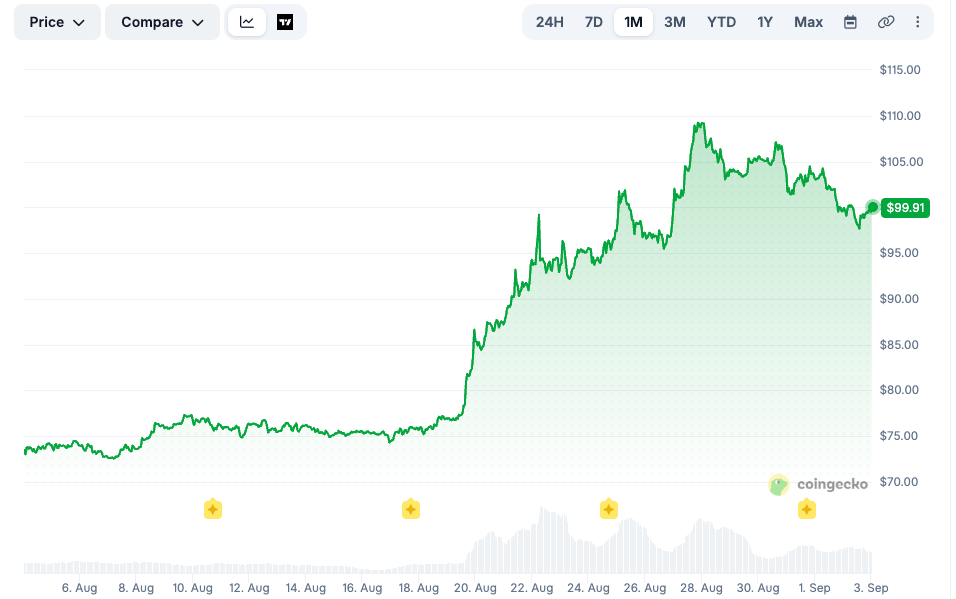
Solana monthly trend, source: Coingecko
The rally was also supported by strong inflows into exchange-traded funds (ETFs), with cumulative net inflows into SOL-related ETFs reaching about $1.322 billion and total assets under management for the category reaching about $1.49 billion. On Aug. 27 alone, net inflows hit $60.91 million, the third-highest single-day inflow for the category since its launch. Of that day's inflows, asset manager Bitwise's SOL ETF product captured about 66%, pushing its assets under management past the $1 billion mark with about 9.3 million SOL held; its largest disclosed institutional holder is Goldman Sachs.
Will the Failed Burn Proposal Return to the Table?
Despite this failure, statements from various parties suggest that the burn proposal being resubmitted in a revised form and put to another vote is almost a certainty, though no formal re-vote timeline has been announced as of now.
As mentioned earlier, Yakovenko has explicitly called for splitting the original proposal into several simpler independent proposals; and The Solana Company, representing the opposition, has clearly stated that as long as the new version retains a fixed fee floor, the company is willing to reconsider its position. It is understood that the technical proposal corresponding to the burn plan, SIMD-0553, had actually already passed technical review by core development team Anza and the alternative validator client team Firedancer, meaning that once the proposal is re-authorized at the governance level, technical implementation could theoretically proceed quite quickly.
In other words, we may soon see a Solana with significantly intensified deflation.
This content is for informational and educational purposes only and does not constitute investment advice related to BTCC. BTCC makes every effort but cannot guarantee the truthfulness, accuracy, or originality of the content above.