GSK’s Political Gambit and U.S. Pipeline Push: Pharma Giant’s Bold Play for Market Dominance

GlaxoSmithKline doubles down on Washington influence and American drug pipeline to reclaim pharma throne.
POLITICAL CALCULATIONS
GSK's lobbying machine kicks into high gear—betting regulatory favors will grease their comeback wheels. The company's positioning itself at the intersection of healthcare policy and profit margins.
AMERICAN DREAMS
The U.S. pipeline becomes GSK's secret weapon. New drug approvals and strategic acquisitions target the world's most lucrative healthcare market. They're playing for keeps in the prescription drug big leagues.
PHARMA WARS
Competitors watch nervously as GSK leverages political connections and pipeline momentum. The move signals a return to aggressive market positioning—because in pharma, sometimes the best medicine is a well-timed regulatory advantage.
Wall Street analysts nod approvingly while quietly calculating how many insulin pens equal one congressional hearing. The real prescription? Always follow the money.
Elevate Your Investing Strategy:
- Take advantage of TipRanks Premium at 50% off! Unlock powerful investing tools, advanced data, and expert analyst insights to help you invest with confidence.
GSK marketed Leucovorin under its brand name “Wellcovorin” from 1983 to 1997. In an eyebrow-raising moment, Leucovorin has now been reapproved by the U.S. Food and Drug Administration (FDA), spurred by White House pressure to find treatments for autism. Though the drug has shown limited benefit in rare metabolic disorders, its broader use in autism remains unproven and highly controversial—mainly because of who is promoting it the most: the TRUMP administration. Yet the timing of the approval—announced just before a joint event featuring Trump and Robert F. Kennedy Jr. on autism—highlights how political positioning may carry as much weight as clinical data.
The pursuit of reliable respirators and a viable vaccine during the COVID pandemic should remind investors how rapidly policymakers can MOVE under the appropriate circumstances. As Donald Trump and RFK Jr. prepare a war on autism in the political limelight, GSK managers can be forgiven for thinking they’ve hit two birds without throwing a stone. A dusty old drug is suddenly being reawakened without a dollar being spent, while free publicity is set to follow it all the way to the pharmacy shelves.
Rangebound GSK Stock Despite Sturdy Results
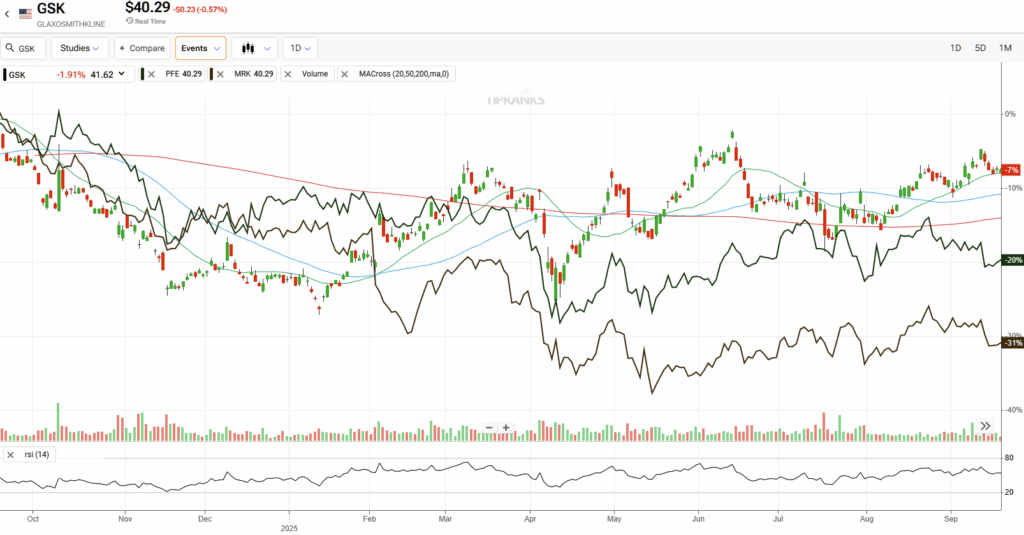
Despite its strong string of quarterly results, GFKS stock has been stuck in a $30-$40 range since 2022. Bears argue that without the stock’s hefty 4.06% dividend yield, which more than doubles the sector average, many investors WOULD have sold up by now.

Third-quarter results highlighted steady growth across all three of its Core businesses, with group sales up by 6% and core operating profit increasing by 12%. CEO Emma Walmsley pointed to the “remarkable start” of Shingrix, GSK’s shingles vaccine, which has already seen nearly 7 million doses administered globally.
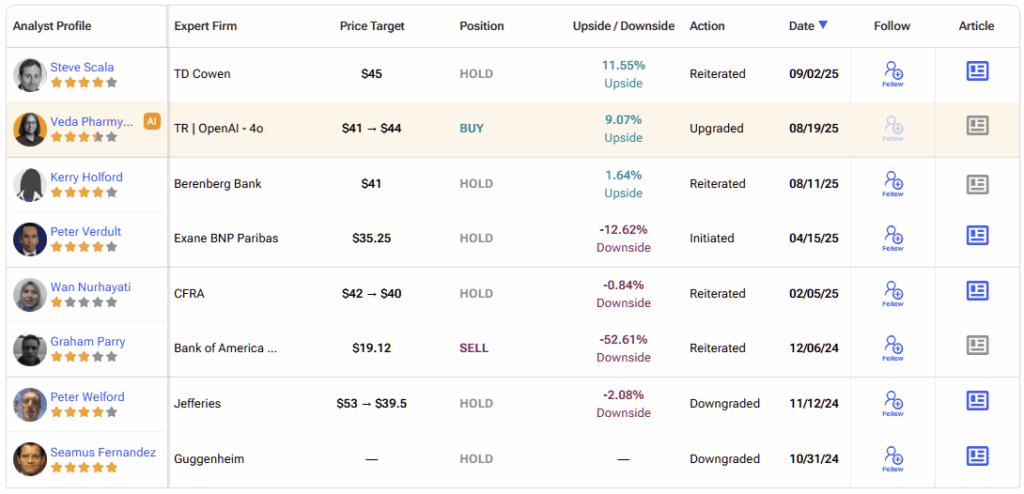
Wall Street analysts are convinced, though. While newer respiratory therapies posted gains, legacy blockbusters like Advair/Seretide continued to decline, and questions linger about whether GSK’s pipeline can truly reinvigorate its pharmaceutical division. “Confidence is still fairly thin on the ground,” warned Hargreaves Lansdown analyst Charlie Huggins. A snapshot of analyst opinion indicates most analysts remain on the fence regarding GSK.
GSK Pumps Up Its Pipeline
Amid these challenges, GSK is stepping up its bets on growth. Earlier this month, the company unveiled a $30 billion, five-year plan to bolster research and manufacturing in the U.S. The investment includes a $1.2 billion factory in Pennsylvania dedicated to respiratory and cancer drugs, as well as funding for AI-driven drug discovery and expanded clinical trial networks. GSK said the initiative would “bridge R&D and manufacturing across both the U.S. and UK,” thereby strengthening its transatlantic footprint.
The skeptics will likely say the move, timed with U.S. President Donald Trump’s state visit to Britain, underscores GSK’s strategy of leveraging political relationships as much as scientific breakthroughs. Meanwhile, the cynics will say that the approval of Leucovorin was sanctioned by Trump himself and arranged well in advance of this week’s shindig at the UN.
Leucovorin remains the latest, and possibly greatest, sentiment driver for GSK. So too for Donald Trump and RFK Jr. Could GSK’s dusty old drug become the autism-defeater the early HYPE points to? Probably not, and seasoned biotech investors will know better than to pin their hopes on a wonderdrug. Many have come and lost their shirts doing that.
For GSK, the autism drug is unlikely to become a multibillion-dollar franchise on par with Shingrix. However, it represents something else: a chance to surf the opportunistic wave of political momentum and reframe the company as central to a hot-topic health issue. PR specialists take note. Even better if the incumbent President does early marketing through regular commentary as he achieves lofty political goals. By aligning with Washington’s priorities and expanding its U.S. footprint, GSK aims not only to drive market growth via political favor but also to regain its own relevance. Ultimately, it may be politics rather than science that delivers GSK’s next breakthrough.
