SiriusXM vs. Spotify: Which Streaming Giant Dominates Your 2025 Portfolio?

Streaming wars hit Wall Street—and your portfolio's about to pick a side.
Audio Titans Clash
SiriusXM's satellite empire faces off against Spotify's global audio dominance. One leverages exclusive content and automotive partnerships, the other rules playlists and podcast ecosystems. Both chase the same ears—but only one deserves your capital.
Subscriber Math vs. Market Momentum
Satellite radio's recurring revenue model battles music streaming's growth trajectory. Analysts scrutinize churn rates against user acquisition costs. Meanwhile, advertising dollars pivot toward digital—leaving traditional radio scrambling.
The Bottom Line
Forget nostalgia—this fight's about future cash flows. One stock offers stability, the other growth potential. Choose wrong, and your portfolio sings the blues. Choose right? You might just afford that premium subscription yourself. (Wall Street bankers will still take their cut either way—some things never change.)

Image source: Getty Images.
Growth favors Spotify
Spotify features a free, ad-supported option as well as a subscription, ad-free tier for its customers to choose between. The vast majority of Spotify's revenue comes from its subscription customers, even though 62% of its monthly average users are on the free, ad-supported tier. In the most recent quarter, Spotify grew its total monthly average users by 11%. It ended the quarter with 276 million premium (paid) subscribers, up 12 year over year.
Other than free trials, there is no free subscription option for SiriusXM, and it ended its most recent quarter with 33 million paid subscribers. Not only does SiriusXM have a fraction of the subscribers of Spotify, but they're also declining, with a Q2 year-over-year growth decline of 1%.
Where future growth will come from is also less clear with SiriusXM. Many customers subscribe after purchasing a new car that comes with a trial SiriusXM subscription. This ties SiriusXM's growth to auto sales to a certain degree. With no such limit on Spotify, it's easy to see how it WOULD have a clearer path to future growth.
The bottom line favors SiriusXM
Despite the more impressive growth profile for Spotify, the bottom line tells a different story. SiriusXM is consistently profitable (except for its Q3 of 2024) while Spotify is still struggling to generate consistent profits.
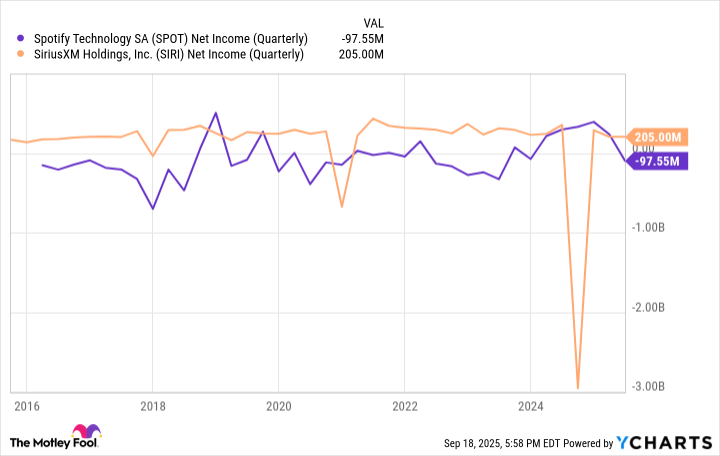
SPOT Net Income (Quarterly) data by YCharts
This consistent profitability for SiriusXM has also allowed it to be more shareholder-friendly than Spotify. Over the last 10 years, SiriusXM has reduced its share count by almost 36% and the company pays a dividend that currently yields 4.7%.
With interest rates falling, and predicted to continue to fall, SiriusXM's dividend yield is even more attractive. Combine that with the share buybacks, and the stock becomes more interesting than at first glance.
Growth is expensive
There's no doubt that Spotify has a more attractive growth profile than SiriusXM. However, investors pay for that growth in the stock's valuation. SiriusXM currently trades for 0.9 times sales, while Spotify investors will pay 8 times sales for shares today.
Not only is SiriusXM cheaper than Spotify, it's NEAR its cheapest point in the last 10 years. That's the reason for the attractive dividend yield. There may not be exciting growth to look forward to, but the company is profitable and generates positive free cash flow. Its total return profile makes it worth considering.
On the other hand, Spotify is nearly the most expensive it has been over the past 10 years. With no capital return to shareholders to speak of, investors need to rely on continued strong growth to see an investment from today pay off.
So, which is the best stock? It might come down to what investors are looking for. Spotify offers higher upside, but more risk from today's price. SiriusXM is cheap and offers stability with its dividend, allowing it to serve a different role in a well-diversified portfolio.
