Could IonQ Outperform Nvidia in the Next Decade? Here’s Why Quantum Computing Might Just Shock the Market

Quantum Leap or Quantum Hype? IonQ's Bold Challenge to Nvidia's AI Throne
The Quantum Disruption Play
While Nvidia dominates classical computing, IonQ's quantum processors operate in an entirely different realm—where qubits bypass binary limitations and solve problems in minutes that would take classical supercomputers millennia. No silicon, no Moore's Law constraints, just pure quantum advantage.
The Investment Calculus
Quantum computing isn't another GPU cycle—it's a paradigm shift. Institutional money's already placing bets on quantum outperforming traditional AI hardware within the decade. Wall Street's still pricing this like it's science fiction while the tech's already running in production environments.
The Reality Check
Sure, quantum's volatile—qubits decohere, error rates challenge scalability, and the technology's still in its infancy. But remember when people said Bitcoin would never surpass $100? Technological revolutions tend to sneak up while traditional finance is still calculating risk-adjusted returns on spreadsheet models from 1995.
One thing's certain: in the high-stakes race between quantum and classical computing, betting against technological disruption has historically been the riskiest move of all—just ask any hedge fund that shorted Tesla at $30.

Image source: Getty Images.
Quantum stocks have gotten buzzy this year, and stocks like(IONQ 5.39%) have surged. As you can see from the chart below, IonQ and its peers have skyrocketed over the last year in a rally that began last December with's announcement of a breakthrough with its Willow quantum chip.
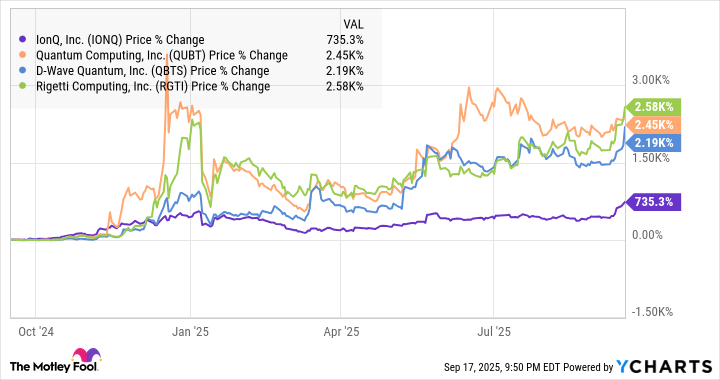
IONQ data by YCharts
IonQ is the biggest of the four pure-play quantum stocks, now trading at a market cap of $19.4 billion. Though the company still has very little revenue, it's been building significant momentum and showing more evidence that it and quantum computing more generally can go mainstream. Let's take a closer look at where IonQ stands today and where it could go in the next decade.
IonQ today
IonQ reported $20.7 million in revenue in the second quarter, up 82% from the quarter a year ago. That's still tiny for a company with a market cap of nearly $20 billion, but there are signs of a bright future for IonQ.
In the second quarter, the company said a collaborative research program between it,,Web Services (AWS), and Nvidia achieved more than 20 times improvement in end-to-end time-to-solution using a quantum-accelerated computational chemistry workflow for drug discovery. That's strong evidence of the potential of the technology.
The company also forged partnerships around the world in the second quarter, including in South Korea, Japan, and Sweden, and announced an expansion in the Asia-Pacific region in collaboration with Emergence Quantum, an Australian company.
Finally, IonQ has been growing through a string of acquisitions, beefing up its capabilities in quantum computing. Those include Lightsynq and Capella in the second quarter, and Oxford Ionics and Vector Atomic, which hasn't closed yet, in September.
Just on Wednesday, the company signed a memorandum of understanding with the U.S. Department of Energy to advance quantum technologies in space, showing the federal government is getting more involved in quantum.
Will it beat Nvidia over the next decade?
There's a TON of uncertainty in quantum computing over the next decade. The technology seems promising, but IonQ's growth forecast still seems relatively modest as it expects full-year revenue of $82 million to $100 million. It could still be several years before it reaches $1 billion.
Comparing IonQ's prospects to Nvidia's is difficult because Nvidia is at a much different stage of its life cycle. As the most valuable company in the world, the ceiling for Nvidia's growth is much lower than IonQ. At a price-to-earnings ratio of roughly 40, a 10x for Nvidia over the next decade WOULD mean reaching $40 trillion in market cap and $1 trillion in profit if it maintained its valuation.
Currently, there aren't any companies with $1 trillion in revenue, let alone $1 trillion in profit, and the's current market cap is about $55 trillion. Looking at it that way, a 10x return for Nvidia will be difficult, if not unrealistic, over the next decade.
With greater upside potential and the potential disruption from quantum computing, IonQ could outperform Nvidia, but it's much riskier than the AI leader.
For tech-minded growth investors, owning both stocks might be the best approach. It will also give you exposure to the top names in AI and quantum computing.
