Nvidia’s $5 Billion Lifeline to Intel: Tech Titans Forge Unlikely Alliance

Silicon Valley's fiercest rivals just became strange bedfellows. Nvidia—the AI chip behemoth—is throwing Intel a $5 billion lifeline in a move that's reshaping the semiconductor landscape.
Behind the handshake deal
This isn't charity. Nvidia needs Intel's manufacturing muscle to keep pace with insatiable AI demand. The cash infusion secures priority access to Intel's cutting-edge fabs—a strategic hedge against TSMC's dominance. Smart play? Or desperate times?
The fine print investors missed
That $5 billion doesn't buy equity. It's essentially prepayment for wafer capacity—locking in rates before the next supply crunch. Wall Street's calling it visionary. Cynics see it as Nvidia paying protection money to avoid production bottlenecks. Because nothing says 'innovation' like paying your competitor to do their job better.
Semiconductor cold war heats up
This alliance redraws battle lines. AMD suddenly looks isolated. TSMC's monopoly faces its first real challenge. And Intel? They get cash plus credibility—their turnaround just got real momentum.
The verdict: temporary truce or permanent realignment? Only the next chip cycle will tell. But for now, the chip wars just got a $5 billion ceasefire—and Wall Street's already pricing in the peace dividend.
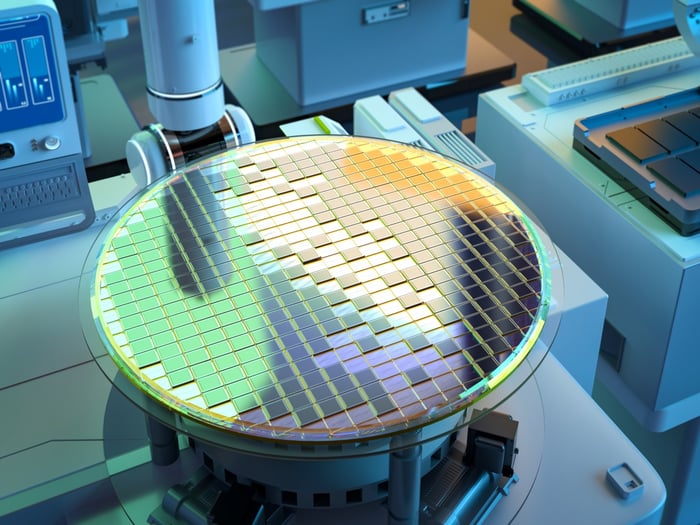
Image source: Getty Images.
A game-changing deal
Artificial intelligence (AI) chip leader Nvidia has agreed to a deal with Intel that will see both companies jointly develop multiple generations of data center and PC products. For the data center, custom x86 chips will be used by Nvidia and sold to other customers. In the PC market, Intel's CPU technology will be combined with Nvidia GPU chiplets to create system-on-chips that will be offered to external customers.
This announcement comes on the heels of Intel's push into custom silicon. Earlier this month, Intel disclosed that it was creating a new group that WOULD design custom semiconductor chips for external customers. Nvidia appears to be the first such customer.
Importantly, Intel will also manufacture these custom Nvidia chips. The company didn't disclose timelines, process nodes, or much other information, but the announcement noted that Intel would both "design and manufacture" custom data center and client CPUs integrating Nvidia technology. Intel desperately needed a major external foundry customer, and now it has one.
Intel also desperately needs capital to fund its foundry business, and the other part of the deal with Nvidia provides just that. Nvidia will invest $5 billion in Intel, buying shares at $23.28 a pop. Intel didn't disclose the planned use of this capital injection, but the company certainly needs cash to scale up its latest process nodes.
Cash infusions are adding up
Nvidia's $5 billion investment adds to Intel's haul over the past month. In August, Intel reached a deal for the U.S. government to invest $8.9 billion in the company. Some of the funding came from previous grants under the U.S. CHIPS and Science Act, which had not yet been paid, although those grants originally had conditions that were then dropped as part of the deal. Intel confirmed that it had received a $5.7 billion payment from the U.S. government in late August related to the deal.
Intel also received a $2 billion investment fromin August, announced a few days before the deal with the U.S. government. The Softbank investment, the Nvidia investment, and the payment from the U.S. government add up to a $12.7 billion cash infusion. Intel also recently closed on its sale of a majority stake in Altera, which brought in an additional $3.3 billion. All told, that's around $16 billion in cash, before any taxes related to the Altera sale.
These cash infusions give Intel some breathing room, and the collaboration with Nvidia provides an enormous vote of confidence for Intel's custom silicon business and its foundry business. While Intel's turnaround will still be a slow process, things are clearly looking up for the struggling chip company.
