Has Joby Aviation’s Stock Already Peaked? Here’s What the Charts Won’t Tell You

Joby's high-flying ambitions meet Wall Street's harsh realities—gravity always wins.
The Hype vs The Hard Numbers
Electric vertical takeoff sounds revolutionary until you realize most investors can't tell a rotor from a rotisserie chicken. The stock's recent volatility isn't just market noise—it's the sound of speculative bubbles testing their limits.
Regulatory Headwinds or Tailwinds?
FAA certification processes move slower than traffic on the 405 during rush hour. Every delay chips away at that first-mover advantage Wall Street priced in years ago.
The Cash Burn Conundrum
Developing flying taxis isn't cheap—unless you're printing money in your basement. Joby's runway length matters more than its aircraft's when quarterly reports hit.
Short-term traders already took their profits. Long-term believers? They're either visionaries or bagholders—history will decide which. In aviation terms: this stock either reaches cruising altitude or needs emergency landing protocols. Either way, fasten your seatbelts.
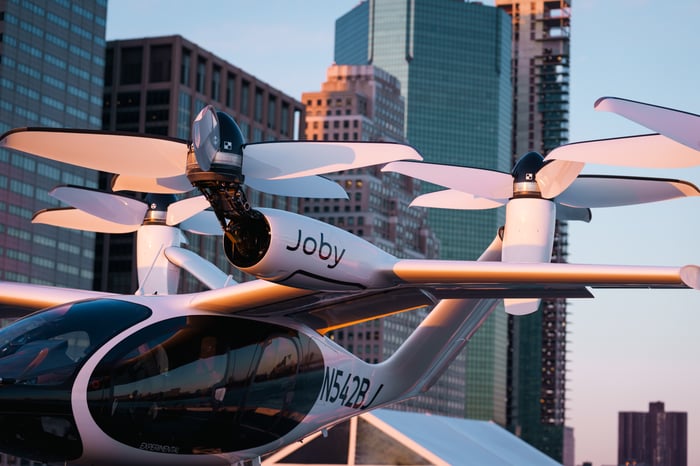
A Joby eVTOL. Image source: Joby Aviation.
Joby has been busy
Founded in 2009, Joby Aviation is developing an eVTOL air taxi with an expected range of 100 miles on a single charge. The company says it's more than halfway through the most rigorous stage of the Federal Aviation Administration (FAA) certification process, which is the approval of the aircraft design. Joby expects FAA pilots to begin conducting test flights with the aircraft next year.
The past few months have brought a flurry of activity. This summer, a Joby electric aircraft completed 21 test flights in Dubai in the United Arab Emirates, where the company has secured exclusive rights to operate air taxis until 2030.
Earlier this month, Joby showcased its Superpilot autonomous flight software in a successful demonstration for the U.S. Air Force. Joby also acquired the passenger service of Blade Air Mobility, which offers helicopter and seaplane flights in New York City and Europe.
Joby sees three paths to commercialization
Management has outlined three potential paths to bringing its products and services to market: owning and operating an air taxi service, direct sales to defense and commercial customers, and regional partnerships.
Its acquisition of Blade Air Mobility fast-tracks its path to having an electric air taxi service. Blade transported more than 50,000 passengers last year and has a loyal customer base.
Once Joby gains FAA certification, it plans to add eVTOL service to Blade's existing routes. CEO JoeBen Bevirt said the acquisition "gives us a defensible first-mover advantage and creates a competitive edge that will be difficult to replicate."
On the direct-sales front, the company has discussed several tantalizing opportunities. With the Defense Department requesting $9.4 billion for autonomous aircraft in its fiscal 2026 budget, Joby is working withto develop a gas turbine hybrid VTOL aircraft for low-altitude missions.
Meanwhile, Joby is exploring a distribution agreement with a Saudi Arabian family-owned conglomerate, Abdul Latif Jameel, that could generate up to $1 billion in sales of its aircraft and services.
Lastly, Joby and the Japanese airline ANA Holdings plan to launch a joint venture that will deploy more than 100 Joby aircraft across Japan. In my opinion, the company deserves an "A" for its new business development efforts.
Growing pains
While the future looks promising, Joby's second-quarter financials were a reminder that it's a pre-revenue start-up. Its net loss ballooned from $123.3 million in the year-ago quarter to $324.7 million in the second quarter.
The run-up in the stock price during the quarter was a major factor in the larger reported loss, because it increased the accounting value of certain financial obligations. The net loss per share came in at $0.41, which was significantly worse than the average analyst estimate, which called for a per-share loss of $0.19.
The financial picture isn't all doom and gloom. The company ended the quarter with $991 million in cash and short-term investments, buoyed by a $250 million investment fromand a $41 million at-the-market stock offering. Based on previous announcements, Toyota plans to invest another $250 million via purchases of common stock.
For the year, management expects to burn through $500 million to $540 million in cash. The company's strong balance sheet gives it some cushion heading into 2026. But as it gets deeper into the FAA certification process, and potentially starts full-scale production, its cash burn likely will intensify.
Did you miss out on Joby Aviation?
When you're evaluating a stock -- especially for a business with no revenue history -- it's helpful to get a sense of the company's total addressable market (TAM). One of the most optimistic forecasts I've seen comes from Grand View Research, which sees the global urban air mobility market growing from $3.6 billion in 2023 to $29.2 billion by 2030.
McKinsey & Company is even more enthusiastic, predicting that by the end of the decade, the leading air mobility providers could have bigger fleets and offer more flights per day than the world's largest airlines. But a lot needs to happen between now and then for that to become a reality.
The industry will need takeoff and landing sites, ground operations, and network logistics that support a high-volume cadence of short-duration, on-demand flights -- not to mention many pilots.
With so much still up in the air (no pun intended), Joby Aviation is a speculative investment. But there's a lot to like here. One thing that stands out is the company's focus on building a strong pipeline of business so it's ready to start as soon as it earns FAA approval. And management has some strong allies, most notably Toyota. If its eVTOL aircraft catches on, I could see that relationship blossoming into something more formal.
While I don't think Joby Aviation stock has peaked, you should brace for plenty of turbulence if you're thinking of starting a position.
