What You Don’t Know About Rocket Lab Could Make You Rich

Rocket Lab's stealth ascent in the space race just hit escape velocity—while Wall Street was busy watching SpaceX.
The Electron's Secret Sauce
Their 3D-printed Rutherford engines cut production costs by 80% compared to traditional manufacturing. Carbon-composite tanks slash weight while maintaining structural integrity—every gram saved means more payload revenue.
Launch Frequency Game-Changer
They've achieved 24-hour turnaround between missions. That's not just impressive—it's industry-disrupting. While old-space contractors drown in paperwork, Rocket Lab executes.
The Neutron Factor
Their upcoming medium-lift vehicle bypasses the smallsat niche entirely. Reusable first stage, 8-ton payload capacity, and human-rated design from day one. They're not playing for singles—they're going for the grand slam.
Revenue Streams You Missed
Space systems division already contributes 30% of revenue. Satellite components, flight software, and mission control solutions—they monetize every layer of the space ecosystem.
Meanwhile, traditional aerospace stocks still trade like it's 1985—all P/E ratios and dividend yields while the future literally launches over their heads.
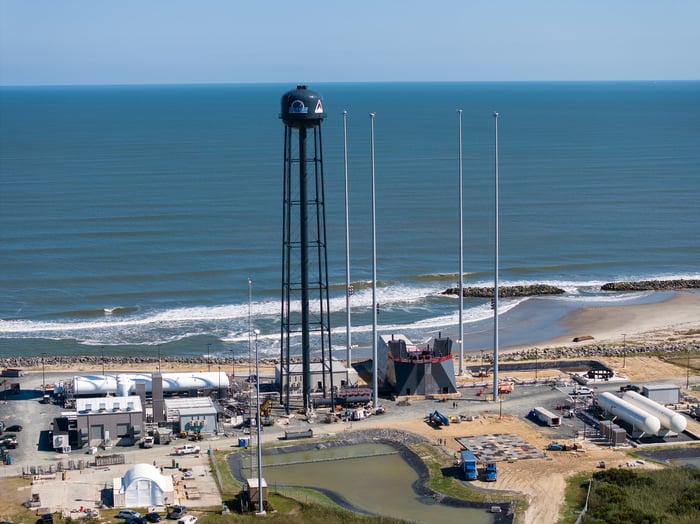
Image source: Rocket Lab.
It was only hours after the festivities ended, however, that I got to what was -- for me, as an investor -- the real highlight of the event.
Safely back at my house on nearby Chincoteague Island, reclined in my blue upholstered rocker, I leafed through Rocket Lab's 62-page promotional brochure explaining how LC-3 and Neutron will help transform Rocket Lab into an "end-to-end space company," selling everything from spacecraft components and software to complete spacecraft to the payloads they carry, launching all of the above into orbit -- then recovering the rocket to start the process all over again.
What I found in there was surprising.
Rocket Lab is about more than just rockets
Like the name suggests, Rocket Lab is first and most obviously a rocket stock. The company's famed Electron small rocket is already the second-most-often-launched rocket in the United States after SpaceX's Falcon 9. Rocket Lab's new Neutron rocket, which will launch out of LC-3, has a fighting chance of becoming the nation's third-most-often-launched rocket (although ULA's Vulcan and Blue Origin's New Glenn will contest it for that title).
Now, I knew all this already. I also knew that Rocket Lab was about more than just rockets, boasting a supplemental "space systems" division that's growing just as fast as the "launch services" business, and indeed, already larger than launch in terms of revenue.
What I didn't realize, however, is just how variegated Rocket Lab's space systems business has grown in recent years.
Rocket Lab spacecraft
Rocket Lab's actual rockets and rocket engines consume just 10 of the brochure's 62 pages, with the balance devoted to describing the company's multiple non-rocket products. These include five separate models of spacecraft:
Photon
Arguably Rocket Lab's first spacecraft, Photon is a satellite derived from the company's "Kick Stage" spacecraft that delivers payloads to final orbital insertion.
Pioneer
Capable of steering itself for atmospheric reentry, Pioneer spacecraft are used to return Varda Space Industries' space pharmaceutical experiments to Earth.
Explorer
Designed for DEEP space interplanetary missions, Explorer spacecraft will be used on the upcoming ESCAPADE mission to Mars.
Lightning
Designed for "high reliability, high power," Lightning spacecraft will be used in Rocket Lab's biggest contract ever, its $515 million assignment to build a missile detection system for the Space Force.
Flatellite
Also a new invention, like its name implies, Flatellite is designed for easy stacking within a rocket fairing for deployment to FORM orbital constellations of satellites, such as for communications.
Rocket Lab rocket parts
In addition to building its own satellites, Rocket Lab also supplies parts to other companies that want to build their own satellites.
What's a "satellite part," you ask? Well, it could be anything from solar panels to power the satellite, to radios that let them communicate, to star trackers that tell the satellite where it is, to reaction wheels that help orient a satellite in the direction where it wants to go.
Rocket Lab also builds infrared and electro-optical systems that let a satellite "see" (and take pictures of targets on Earth) separation systems for breaking off rocket "stages" during launch, and dispensing systems to unloading payloads once in orbit -- and software for controlling all of the above.
Rocket Lab devotes roughly half the company's promotional brochure to its rocket parts business, making it resemble a celestial Harbor Freight catalog. But there's good reason for this.
Rocket Lab's most important business
I mentioned earlier that Rocket Lab's space systems business, which includes both its spacecraft and its satellite parts, is the company's biggest business. At $310 million in 2024 sales, it's actually more than twice as big as the launch services business.
But space systems is also Rocket Lab's most profitable division. In 2024, S&P Global Market Intelligence data show that launch services briefly caught up to space systems in profitability, earning a 27.5% gross profit margin. In 2025, however, space systems began pulling away again, generating gross profit margins of 32.5% -- 650 basis points more than launch services, where the gross margin retreated to 26%.
Factor in a higher growth rate (35% in H1 2025, to launch services' 32%), and it seems Rocket Lab's growing the most profitable side of its business faster than its less profitable division. If Rocket Lab succeeds in hitting analysts' target to turn generally accepted accounting principles (GAAP)-profitable in 2027, Neutron may be part of that accomplishment.
But space systems will be an even bigger part.
