Elon Musk Predicts 80% of Tesla’s Value Will Come From This AI Business—Not Robotaxi—and Jensen Huang Sees Trillion-Dollar Potential

Elon Musk just dropped a bombshell: 80% of Tesla's future valuation hinges on an AI venture that isn't the much-hyped Robotaxi project. Nvidia CEO Jensen Huang backs the vision, suggesting it could grow into a trillion-dollar market.
Why This AI Play Stands Out
While everyone fixates on self-driving cars, Musk points to a less flashy but potentially more lucrative AI application. It cuts through the noise of autonomous vehicle hype and taps into scalable, enterprise-grade technology.
Huang's Trillion-Dollar Endorsement
Jensen Huang, never one for modest projections, aligns with Musk's outlook. He sees the same AI segment reaching valuations that would make even the most bullish Wall Street analyst blush—assuming they look up from their quarterly earnings reports.
The Real Story Behind the Numbers
Forget Robotaxi. This is about AI infrastructure, data processing, or neural network training—the unsexy backbone of the AI revolution. It's the kind of business that prints money while tech bloggers chase shiny objects.
A Reality Check for Tesla Bulls
Musk's projection shifts the narrative from car manufacturing to tech dominance. If he's right, Tesla transforms into an AI powerhouse overnight. If he's wrong? Well, it wouldn't be the first time a CEO overpromised on AI.
Why are humanoid robots important in the broader AI narrative?
In recent years, much of the progress in artificial intelligence has come from the development of large language models (LLMs) capable of generating detailed, context-rich answers to user queries. While these systems have boosted efficiencies across certain workflows, they remain fundamentally reactive -- waiting for prompts before offering value.
This limitation highlights why humanoid robotics is such an ambitious frontier. Unlike traditional industrial robots, humanoid robots are built with arms, legs, and advanced dexterity, enabling them to perform human-level tasks in real-world environments.
In many ways, humanoid robotics represent the closest manifestation of achieving generalized intelligence -- AI that doesn't just respond but actively engages with the physical world.
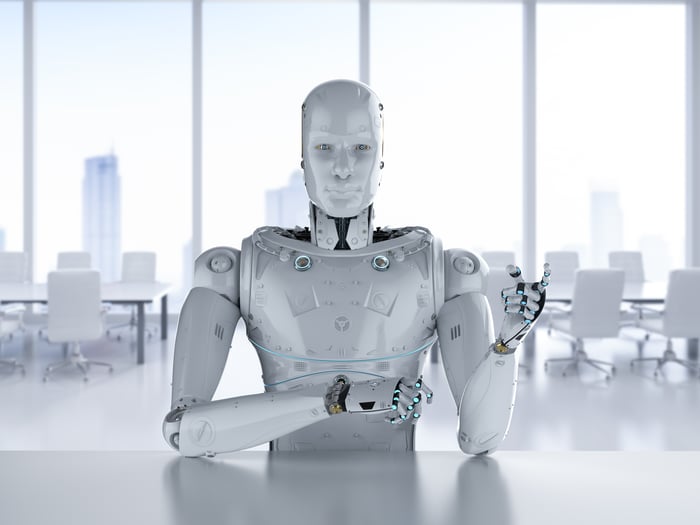
Image source: Getty Images.
What companies does Tesla Optimus compete with?
Thanks in part to Musk's star power, Optimus has become an increasingly recognized prototype in the humanoid robot landscape. However, Tesla is far from alone in pursuing this technology.
Boston Dynamics -- backed by Hyundai -- continues to show off mobility and agility capabilities through its humanoid robot platform, Atlas.
Meanwhile, Figure AI -- a start-up backed by AI heavyweights such as, Nvidia, OpenAI, and Jeff Bezos -- is building a competing humanoid system with an initial focus on manufacturing and logistics applications.
Could Optimus really account for 80% of Tesla's future value?
Today, Tesla's revenue and profitability are largely driven by its EV and energy-storage businesses. Optimus introduces an entirely new frontier: labor automation. Designed as a general-purpose worker, Optimus has the potential to support manufacturing and production on factory floors while also handling routine tasks in household settings.
The implications are twofold. Internally, deploying Optimus in its gigafactories could yield significant labor efficiencies -- lowering operating costs and expanding profit margins as vehicle production scales. Externally, commercialization unlocks the doors to penetrating new markets such as logistics, retail, and healthcare -- all areas where reliable labor needs are rising.
Unlike vehicles, which remain commoditized products subject to cyclical demand, Optimus could become a recurring, mission-critical asset for businesses seeking to offset labor shortages or inflationary costs. If successful, this WOULD provide Tesla with a much-needed durable growth engine beyond its legacy auto and energy solutions.
This is why Musk contends that Optimus could ultimately become Tesla's largest business. Recurring demand and the high-margin nature of robotics have the potential to dwarf even the most optimistic scenarios for Tesla's car business, which will always face shifting consumer preferences and intense competition from other automakers.
If Tesla executes on its robotics pursuit, the upside could be enormous, potentially reaching $10 trillion, according to Musk. With that said, Optimus should still be viewed largely as a moonshot. The product remains years away from global adoption and is unlikely to MOVE the financial needle for Tesla anytime soon.
