Tesla’s Optimus AI Bet: Is the Robot Future Worth 80% of Its Valuation?

Elon Musk bets the farm on silicon shoulders—Optimus now carries 80% of Tesla's market cap.
The Humanoid Gambit
Tesla's valuation hinges on robots that don't exist yet—classic Wall Street alchemy meets West Coast optimism. Investors cheer while engineers scramble to turn renderings into reality.
Hardware Hurdles
Optimus prototypes still stumble through basic tasks. Each clumsy step costs millions in R&D—funding that could've launched three new EV models. Meanwhile, Boston Dynamics bots backflip without breaking a sweat.
Software Sovereignty
AI brains need exponential processing power. Tesla's Dojo supercomputer burns cash faster than Bitcoin miners in 2021. Training datasets remain mostly theoretical—like valuing a startup on PowerPoint slides.
Market Mirage
Even if Optimus works, who buys humanoids at scale? Factories retool for specialized bots, not jack-of-all-trades androids. Consumer demand remains science fiction—unless your dream is a $200k保姆 that might glitch and serve your cat instead of coffee.
Financial Fantasy
Wall Street prices in perfection while ignoring physics. Tesla's 80% robot premium assumes flawless execution—a gamble that makes crypto leverage look conservative. When the music stops, shareholders will learn robots don't care about earnings calls.
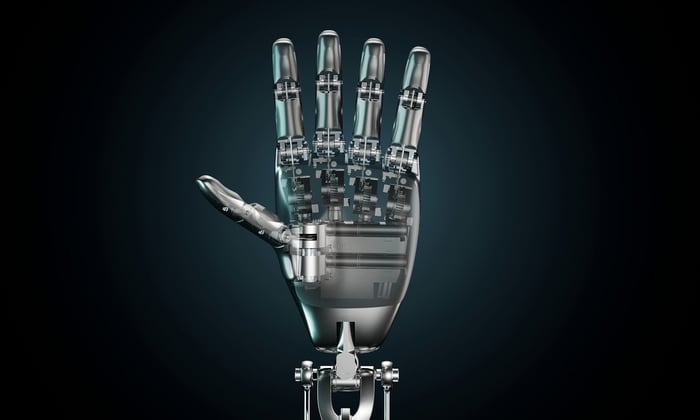
Image source: Tesla.
Far-fetched? Not necessarily.
Tesla's market cap stood at a little over $1 trillion as of the market close on Sept. 8. It's reasonable to assume that Musk's post on X was intended to imply that the EV component of Tesla's valuation WOULD rise rather than decline in the future. Therefore, for his prediction to come true, the company's Optimus robot business would have to be worth at least $4 trillion at some point, and perhaps significantly more.
Is this far-fetched? Not necessarily. At least, it isn't if you believe projections from two Wall Street analysts.(MS 1.27%) thinks the humanoid robot market could top $5 trillion in the future.'s (C -0.08%) Wenyan Fei estimates the market could reach $7 trillion.
Tesla's price-to-sales (P/S) ratio currently stands at 13.3. Using that multiple, its Optimus unit would need to generate annual sales in the ballpark of $301 billion to be worth $4 trillion. That represents 6% of the total market projected by Morgan Stanley and only 4.3% of the market projected by Citi.
Granted, a P/S ratio of 13.3 is exceptionally high. If we use the average P/S multiple of 4.6 for the technology hardware industry, Optimus' annual sales would need to be around $870 billion for the business to be valued at $4 trillion. Still, that's only 17.4% and 12.4% of the total markets estimated by Morgan Stanley and Citi, respectively.
How long might it take?
Some might scoff at estimates that Tesla's total addressable market for humanoid robots could be $5 trillion or more. However, consider the potential uses for these robots: manufacturing, caring for the elderly, household chores, security, and more. If the technology fulfills its potential, I don't think Morgan Stanley's and Citi's estimates are unrealistic.
But how long might it take for the humanoid robot market to reach those levels? That's the rub. Both Wall Street companies' projections are for 2050 -- 25 years from now.
Musk said in Tesla's latest quarterly earnings call in July 2025, "We will scale Optimus production as fast as possible and try to get to a million units a year as quickly as possible. We think we can get there in less than five years." Later in the call, he upped his estimate a bit to around 1.2 million units per year, saying: "I would be surprised if at the end of five years, sixty months from now, if we are not roughly making a hundred thousand Optimus robots a month in sixty months. I would be shocked."
The outspoken CEO has said in the past that Tesla hopes to sell its Optimus robots for between $20,000 and $30,000. If we use the midpoint of that range, the company could potentially generate around $30 billion in revenue from Optimus early in the next decade (assuming Musk's volume prediction is right). At Tesla's current P/S multiple, that translates to a valuation for the Optimus business of close to $400 billion -- roughly 40% of the company's current market cap.
A few potential obstacles
However, Musk could be wrong about having Optimus become such a huge part of Tesla's valuation. Some of his past predictions proved to be overly optimistic.
Importantly, Tesla isn't the only company developing humanoid robots. Some might even argue that it isn't the best in the group. For example, Chinese robot makers Unitree and X-Humanoid were the biggest winners at the World Humanoid Robot Games in August. It's not a certainty that Tesla will dominate the humanoid robotics market.
Musk's Optimus prediction could also fall flat for a positive reason. Cathie Wood's Ark Invest thinks the robotaxi market could reach $10 trillion by 2030, with Tesla being a huge winner. If Wood and her team are correct, Optimus might have a difficult climb to account for 80% of Tesla's valuation because of the company's robotaxi success.
Still, I wouldn't dismiss the prospects for Optimus. Tesla just might one day be viewed more as a robotics stock than an EV stock.
