Prediction: Why Joby Aviation Will Absolutely Crush the Market by 2026

Joby Aviation's electric vertical takeoff aircraft just rewrote the rulebook on urban mobility—and traditional finance is scrambling to catch up.
The Sky's New Disruptor
Forget incremental gains. Joby's eVTOL technology doesn't just improve transportation—it obliterates congestion, bypasses infrastructure limitations, and cuts commute times from hours to minutes. This isn't evolution; it's revolution.
Market Domination by 2026
While legacy automakers talk electrification, Joby executes aerial transformation. Regulatory approvals are accelerating, manufacturing scales rapidly, and urban air mobility shifts from concept to commercial reality. The first-mover advantage here isn't just measurable—it's monumental.
Financial Gravity Defied
Wall Street analysts still value Joby like another automotive stock—missing the entire point. This isn't a car company; it's the foundation of the third dimension of transportation. Their spreadsheet models can't capture market creation, only market share. How very 20th century of them.
The runway clears, the engines spin silent, and the entire transportation sector braces for impact. The sky's about to become the most valuable real estate on Earth.
2026: The year Joby Aviation puts passengers into the air?
For those who have been watching the Joby story closely, the biggest hurdle is still regulatory. The company has built and flown aircraft, but it can't carry paying passengers until it clears the certification process of the Federal Aviation Administration (FAA). To date, no eVTOL company has been cleared to fly passengers commercially.
But Joby is making real progress. By the end of the second quarter, management said it had completed about 70% of stage four of the certification process, while the FAA was more than 50% through with its portion. That doesn't mean it's 70% closer to putting paying passengers into the air -- it still needs to clear stage five, as well as obtain a Production Certificate.
But it does mean the company has cleared a large chunk of the technical work that stands between testing prototypes and selling tickets for flights.
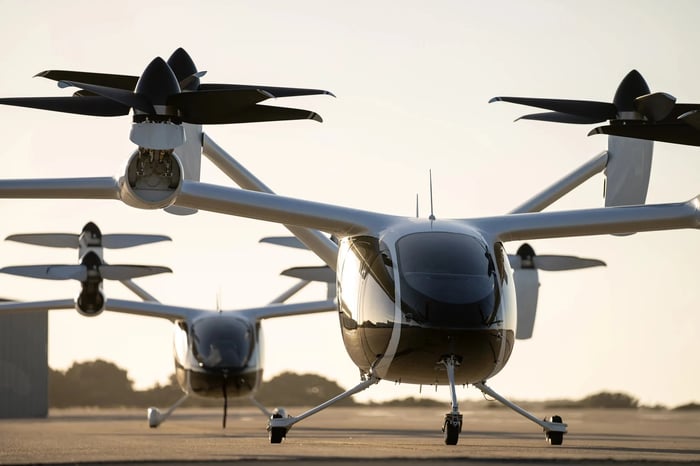
Joby eVTOLs. Image source: Joby Aviation.
At the same time, it's making progress overseas. In Dubai, in the United Arab Emirates, Joby completed 21 piloted test flights this summer in temperatures that neared 110 degrees. The company sees itself on schedule to finish its "vertiport" at the Dubai International Airport in early 2026 and recently reaffirmed a commitment to fly commercial passengers in that same year.
In the U.S., Joby is also making strategic moves. Early in August, it partnered with aerospace and defense specialistto start developing a gas turbine hybrid craft for defense purposes. Test flights are expected this fall, with demonstrations targeted for 2026.
All of this is setting Joby up for what looks to be a breakout 2026. Going from a pre-revenue company to one that's flying passengers commercially overseas could give the stock a modest valuation boost, especially if FAA certification for U.S. flights is nearly in its grip. It could be the year in which Joby finally proves a decades-long thesis: That it can fly customers safely, and at scale, under real-world conditions.
Cash burn could clip Joby's wings
Although the company is making progress to get FAA certification, it's not there yet. And although it has strategic partnership with blue chip manufacturing and aviation giants -- like and-- its cash situation could become a problem if it doesn't start making money soon.
The company currently sits on about $991 million in cash. At its current burn rate (about $500 million over the trailing 12 months), that gives it less than a couple of years before it will need an injection of new cash, if nothing comes sooner.
The company also has a rich valuation. With a market capitalization of about $11 billion, and a full-year revenue estimate of roughly $232,000, Joby's price-to-sales (P/S) multiple is absurdly in the tens of thousands. A lot of expectation is already priced in; expect this stock to be volatile on the heels of any good (or bad) news.
Still, the market hasn't seen a truly disruptive industrial stock sinceand Joby has the know-how and backing to change how we taxi around cities. Aggressive growth-stock investors have much to love about Joby. More-cautious investors, however, might want to put their money in a different stock or an industrial exchange-traded fund (ETF).
