Apple Stock in 3 Years: Where Will It Land?

Apple's trillion-dollar trajectory faces its ultimate test—innovation or stagnation?
The iPhone Empire's Next Act
Three years out, Apple's fate hinges on moving beyond smartphone dependency. Wearables, services, and that elusive "next big thing" must deliver—not just promise. Wall Street's patience for incremental updates wears thinner than the latest MacBook Air.
Services: The Growth Engine or Cash Cow?
Subscription revenue keeps climbing, but can it offset hardware saturation? The App Store, Apple Music, and iCloud face regulatory heat and competition. Margins look juicy—until they don't.
China Syndrome and Supply Chain Gambles
Geopolitical tensions and manufacturing diversification remain wild cards. Betting against Tim Cook's operational genius has been a loser's game—but past performance doesn't guarantee future results (as the finance bots love to parrot).
The AI and AR Play: Vision Pro or Vision Problems?
Apple's mixed-reality push needs to evolve from luxury curiosity to mainstream must-have. If anyone can monetize the metaverse, it's them—but that's a big if.
Bottom line: Apple either reinvents itself again or becomes the world's most valuable nostalgia act. Because nothing says innovation like another color option for the iPhone.
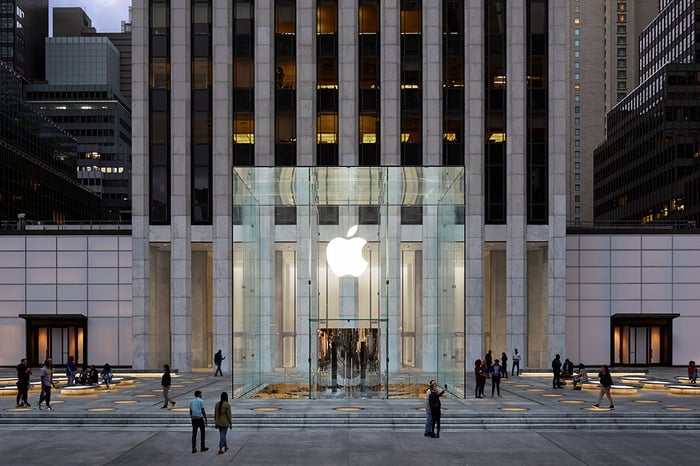
Image source: Apple.
(BRK.A -1.28%) (BRK.B -1.40%), which still holds Apple as its top stock, even sold about 57% of its shares over the past two years. Those red flags suggest that Apple's stock is running out of steam, but will it bounce back and head higher over the next three years?
What happened to Apple over the past few years?
In the first nine months of fiscal 2025 (which ends this September), Apple still generated 51% of its net sales from the iPhone. Another 26% came from its services segment, which houses its App Store, iCloud, and various subscription-based services. The remaining 23% came from its Macs, iPads, wearables, accessories, and other products.
Apple relies heavily on the growth of its services segment, which now hosts over 1 billion paid subscriptions, to offset its slower sales of iPhones and other hardware devices. Here's how those two Core businesses fared over the past few years.
|
iPhone sales growth (YOY) |
7% |
(2%) |
0% |
4% |
|
Services sales growth (YOY) |
14% |
9% |
13% |
13% |
|
Total sales growth (YOY) |
8% |
(3%) |
2% |
6% |
Data source: Apple. YOY = Year over year.
In fiscal 2022, Apple's iPhone sales accelerated as the pandemic lockdowns passed, its supply chains normalized, and it satisfied that pent-up demand for new phones. But in fiscal 2023 and fiscal 2024, its iPhone sales stalled out again as it lapped that temporary growth spurt, it faced tougher competitors in China, and the 5G upgrade cycle cooled off. A lack of meaningful upgrades also prevented many iPhone users from replacing their aging devices.
In fiscal 2025, Apple's iPhone sales warmed up again. The iPhone 16 experienced a strong launch driven by the robust demand for its top-tier Pro models, while the threat of higher tariffs against China drove many consumers to upgrade their devices before those rates kicked in. It also cut its prices in China to benefit from a 15% subsidy on purchases of smartphones, tablets, and smartwatches under 6,000 yuan ($840), and it reached more cost-conscious consumers with the lower-end iPhone 16e. Its iPhone sales grew by the double digits across its top emerging markets -- including India, the Middle East, South Asia, and Brazil -- and offset its slower sales in its mature markets.
As Apple's iPhone sales rose again, it locked more users into its services. That strategy should continue to drive its long-term growth and widen its moat against other tech companies -- even if its Apple Intelligence efforts aren't turning as many heads as OpenAI's ChatGPT or's (GOOG 1.04%) (GOOGL 1.13%) Google Gemini. It should also buy it more time to develop new hardware products or refine its existing ones (like the disappointing Vision Pro headset) to gradually reduce its dependence on the iPhone. Apple ended its latest quarter with $133 billion in cash and marketable securities, which gives it plenty of room for more buybacks, dividend hikes, or ecosystem-expanding acquisitions. It bought back 7% of its shares over the past three years, and it's raised its dividend annually for 12 consecutive years.
What will happen to Apple over the next three years?
From fiscal 2024 to fiscal 2027, analysts expect Apple's revenue and earnings per share (EPS) to increase at a compound annual growth rate (CAGR) of 6% and 13%, respectively. A lot of that growth should be driven by its upcoming iPhones. The latest rumors suggest it will overhaul its entire design with the iPhone 17 this year -- and follow it up with foldable or curved iPhones in 2026 and 2027. Those dramatic changes might drive more of its users to upgrade their older iPhones.
Its other potential catalysts include a more affordable Vision Pro, new smart home and wearable products, and upgrades to its AI ecosystem. It should also continue to develop more first-party chips to reduce its dependence on third-party chipmakers like(QCOM 0.01%).
Assuming Apple meets those estimates, grows its EPS another 10% in fiscal 2028, and still trades at 32 times earnings, then its stock could rise about 30% to $308 over the next three years. That WOULD be a healthy gain that could at least match the S&P 500 -- which has delivered an average annual return of about 10% since its inception -- but it might not impress investors who expected bigger life-changing gains.
