5 Must-Buy Quantum Computing Stocks for September 2025

Quantum leaps ahead—these five stocks are positioning themselves to dominate the next computing revolution.
Riding the Quantum Wave
Forget traditional computing—quantum processors handle problems that would make supercomputers sweat. These companies aren't just researching; they're delivering actual hardware and software solutions right now.
The Hardware Heavyweights
Two players lead in quantum hardware development—scaling qubit counts while reducing error rates. Their systems already outperform classical computers on specific tasks, attracting government and enterprise contracts.
Software & Security Plays
Three other companies focus on quantum algorithms and encryption—because what good is a quantum computer without programs to run? They're developing applications for drug discovery, financial modeling, and cybersecurity.
Timing the Market
September brings seasonal momentum for tech stocks—institutional investors rebalance portfolios after summer lulls. Quantum computing plays offer growth potential that makes A.I. stocks look... well, classical.
Bottom line: Quantum computing moves fast—these five stocks won't stay at current valuations for long. Just remember—every 'next big thing' creates winners and losers. Choose wisely unless you enjoy funding someone else's yacht party.
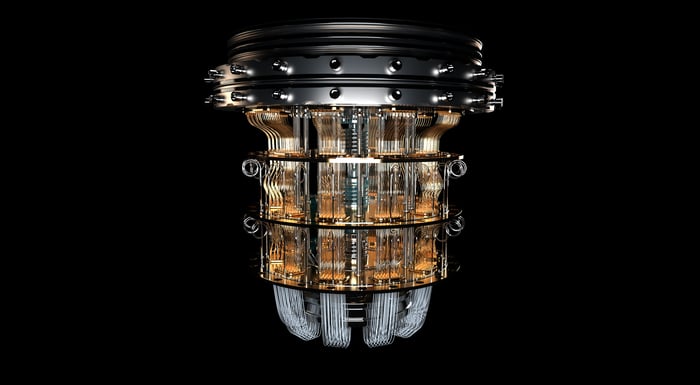
Image source: Getty Images.
Pure plays: IonQ and D-Wave Quantum
Companies of all sizes are vying for supremacy in the field of quantum computing. The ones with the most upside are those that have no other business besides quantum computing. It's an all-or-nothing bet for these companies, and they're fighting for their lives to produce a successful business. These companies are high-risk investments, but that's precisely why they have such high potential.
Two of my favorite pure-play stocks are(IONQ 2.73%) and(QBTS -0.33%). I like these two over others for their two distinct approaches to quantum computing.
IonQ uses trapped ion technology, which can be cost effective and very precise. D-Wave Quantum uses a different process called quantum annealing. Neither company uses superconducting, which involves cooling a particle to NEAR absolute zero. This is an expensive process, but it's also the one that most companies are taking.
By taking their own approaches, IonQ and D-Wave Quantum give themselves better chances at success, as they're not directly competing against the big quantum computing companies with nearly unlimited resources.
Legacy competitors: Alphabet and Microsoft
(GOOG 0.67%) (GOOGL 0.68%), the parent company of Google, and(MSFT 0.45%) are developing their own in-house quantum computing solutions.
Both companies need to develop their own internal quantum computing hardware, as they don't want to be dependent on purchasing computing equipment from a supplier indefinitely. On the AI front, they've already spent billions of dollars on computing equipment from(NVDA 0.57%), and if they can eliminate similar expenses in their quantum computing efforts, they will be far more profitable when quantum computing becomes commercially viable.
Since Alphabet and Microsoft aren't actively marketing their quantum computing products directly to customers, any growth these two companies generate from quantum computing will likely come from offering access through their existing cloud computing businesses. If they're successful, anyone wanting access to quantum computing would need to rent it through these cloud providers.
Even without the quantum computing catalyst that could be coming down the pipeline, cloud computing still has a TON of tailwinds, making it reason enough to invest in both stocks. But if either can develop a viable quantum computing product, it will produce significant additional growth that will reward shareholders.
A hybrid approach: Nvidia
Nvidia produces top-tier traditional computing hardware but has not been heavily involved in the quantum computing arms race. Instead, it focuses on what it does best and provides a hybrid solution for quantum computing.
By developing the equipment needed to connect existing traditional computing infrastructure with upcoming quantum computers, Nvidia appears once again to be positioning itself nicely to take advantage of a massive computing spending spree.
Nvidia remains a smart buy due to its substantial investment in traditional computing, driven by the AI arms race, but it will also benefit as quantum computing becomes more widely deployed.
