7 Million Reasons Ford Investors Should Be Losing Sleep Right Now

Ford's massive recall hits 7 million vehicles—legacy automaker's electric dreams hitting brutal reality checks.
Production Nightmares
Assembly lines stutter as software glitches and battery issues plague the F-150 Lightning. Dealers drown in unsold inventory while Tesla keeps eating their lunch.
Financial Gravity
That $7 billion EV investment? Burning faster than a meme coin in a bear market. Traditional automakers trying to pivot to electric are like boomers discovering TikTok—painfully behind the curve.
Market Reality
While crypto natives stack satoshis and deploy DeFi strategies, Ford's still trying to figure out why their infotainment systems crash more than TerraLUNA. Sometimes legacy just means outdated.
An unfortunate record
Ford is recalling more than 355,000 trucks in the U.S. over a problem with the instrument display panel, according to the National Highway Traffic Safety Administration (NHTSA). The recall affects the Ford 2025-2026 models of the F-550 SD, F-450 SD, F-350 SD, F-250 SD and the 2025 F-150.
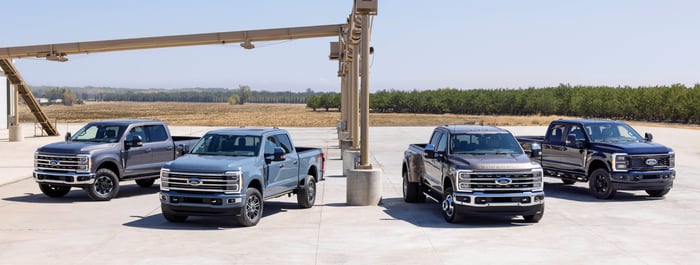
Image source: Ford Motor Company.
First, some of the bad news and staggering figures: So far this year, Ford has issued more recalls than any other automaker in the U.S., generating 39% of this year's recalls, according to the NHTSA. Just as staggering is the fact that the runner-up is RV manufacturer Forest River, with only 9% of this year's recalls.
Ford has issued 105 recalls so far in 2025, with electrical system problems accounting for 23 of the total, while backover-prevention rearview cameras and power train recalls accounted for 14 and 13, respectively. In terms of number of vehicles recalled, Ford's figure has now topped over 7 million, which is the record for any full year, according to Barron's.
If those numbers didn't make enough of an impression, let's look at Ford's warranty payments as a percentage of revenue over time.
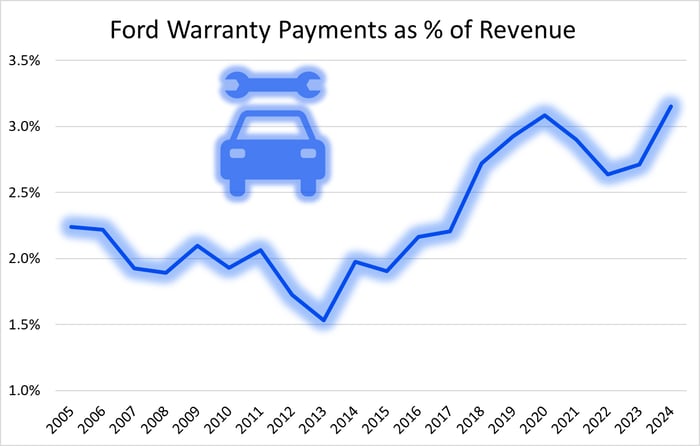
Data source: Ford SEC filings. Graphic source: Author.
You can see that in the early 2000s, Ford's payments-to-revenue percentage was much lower, before spiking to 4% during last year's second quarter, a high percentage for an automaker. For a quick comparison, consider that rival' warranty payments as a percentage of revenue checked in at 2.4% and 2.3% in 2024 and 2023, respectively.
"Clearly our strategic advantages are not falling to the bottom line the way they should," CEO Jim Farley said nearly a year ago on a call with analysts. "Cost, especially warranty, has held back our earnings power. But as we bend that curve, there is significant financial upside for investors."
The silver lining
But not all recalls are created equal. Depending on whether the problem is fixable with updates to software or requires laborious hardware work at a dealership, the volume of vehicles in each recall can vary widely.
In this case, this most recent recall can be fixed free with a software update, making this recall mostly a nonissue when it comes to company financials. Furthermore, management's spin on this recall development is that it's tightening its quality controls, which is resulting in better vehicles for consumers at the expense of higher recall numbers in the NEAR term.
The upside is just as Farley stated: If Ford can slowly but surely turn around its quality problem, those warranty payment costs will trickle down to the bottom line, giving investors more earnings power. That said, despite years of efforts to improve quality, it's sometimes difficult to see progress on paper, and that's absolutely something investors should keep an eye on over the next 12 to 18 months.
