Quantum Computing Showdown: Why Nvidia Crushes Quantum Computing Inc. in the Race for Real Returns

Forget quantum supremacy—the real battle is for investor supremacy.
Nvidia’s not just playing the quantum game; it’s supplying the entire casino. While startups like Quantum Computing Inc. chase qubits, Nvidia’s chips already power the AI and high-performance computing markets that fuel today’s profits.
Hardware That Prints Money—Not Promises
Nvidia’s GPUs are the workhorses of modern computation. They dominate AI training, data centers, and, yes, quantum simulation. That’s revenue you can bank—not science experiments buried in R&D budgets.
Quantum Computing Inc.? Still betting on potential. Nvidia’s delivering now.
Bottom line: In a sector bloated with hype, Nvidia offers the rare combo of cutting-edge tech and actual financial performance. Because in the end, quantum or not, shareholders still care about returns—not just research papers.

Image source: Getty Images.
A look into Quantum Computing Inc.
As a company specializing solely on quantum computing, QCi can dedicate all its resources to the development and commercialization of quantum tech. Unlike a conglomerate such as Nvidia, there's little risk of a priority shift to another part of its business.
This allows QCi to drive hard and fast toward quantum advantage, which marks the point when a quantum device can solve useful, real-world problems more effectively than current computers.
QCi's path to quantum advantage is to employ light particles, called photons, to power its devices. The approach enables a wide range of applications.
For example, it developed remote sensing and imaging equipment for use over long distances and through interference. As a result, QCi won a contract with NASA.
However, its tech hasn't translated into revenue growth. In the second quarter, sales totaled a mere $61,000 compared to $183,000 in the prior year.
While Q2 revenue plunged 67%, QCi's operating expenses soared 91% year over year, resulting in an operating loss of $10.2 million, nearly double its $5.3 million loss in 2024. This is a concerning trend, but the company's cash hoard of $348.8 million on its Q2 balance sheet can sustain operations in the short term while it searches for sales.
Nvidia's quantum computing approach
Nvidia has a long history of building cutting-edge tech. This focus on innovation now extends to the development of chips for quantum computing.
The current AI era was ushered in by Nvidia's seminal work on its graphics processing unit (GPU), invented in 1999. The GPU wasn't designed to replace the classic computer's CPU. Instead, GPUs served as separate processors handling specialized tasks, such as crunching the data used by AI.
Now, Nvidia is applying the same framework to its quantum processing unit (QPU). The company is not trying to supplant the GPU, but rather, have it work in concert with the QPU.
This is important because a key challenge with quantum computers is that the atomic particles that enable phenomenal computational abilities are prone to making mistakes. As the QPU executes calculations, GPUs can deliver real-time error correction.
The new quantum computing frontier could eventually boost Nvidia's revenue much like AI has done. The company's GPU technology produced sales of $46.7 billion in its fiscal second quarter, ended July 27. That's an impressive 56% year-over-year increase, as cloud service providers gobbled up GPUs to power their AI systems.
Propelled by the current AI boom, Nvidia expects strong sales growth to continue in Q3 with estimated revenue of $54 billion, a substantial step up from the prior year's $35.1 billion. Once quantum advantage is reached, quantum computers could lead to the next phase of sustained revenue growth for Nvidia.
Making a choice between Quantum Computing Inc. and Nvidia stock
Although the technology holds the same kind of transformative potential as AI, quantum computers are still nascent. It could be years before these machines are ready for adoption beyond research circles.
Consequently, there's no way to know at this point whether Quantum Computing Inc. or Nvidia's tech will eventually prove successful. So to decide which to invest in now, another factor to consider is share price valuation.
This can be determined by looking at the price-to-sales (P/S) ratio, a commonly used metric measuring how much investors are willing to pay for every dollar of revenue generated over the trailing twelve months.
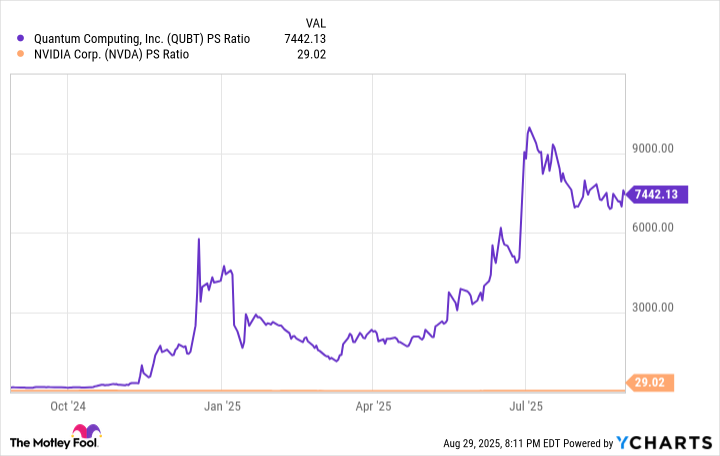
Data by YCharts.
The chart reveals QCi's P/S multiple has soared over the past year, and is shockingly high compared to Nvidia's. This suggests Quantum Computing Inc. shares are overpriced.
Taking into consideration Nvidia's better stock valuation, ongoing sales growth, and history of technological success, the semiconductor giant is the superior investment over QCi in the field of quantum computing.
