3 Critical Tesla Problems Investors Are Still Ignoring in 2025

Tesla's growth engine sputters as hidden risks pile up—while Wall Street keeps hitting the snooze button.
Production Nightmares Deepen
Assembly lines stall under the weight of scaling demands. Ramping three new models simultaneously stretches manufacturing capacity beyond breaking point. Quality control metrics slip as output targets override precision benchmarks.
Battery Supply Chain Craters
Lithium-ion shortages hammer margins just as competitors lock down long-term contracts. Raw material costs surge 40% while Tesla's vertical integration strategy backfires spectacularly. Legacy automakers simply outbid them for critical components.
Autopilot's Regulatory Reckoning
NHTSA's looming mandate requires hardware upgrades for 2 million existing vehicles. Retrofit costs could eclipse quarterly profits while class-action lawsuits pile up like wrecked Cybertrucks. Full self-driving remains perpetually 'two years away'—the automotive equivalent of blockchain's 'next year will be different' promise.
Tesla's cult-like valuation assumes perfection while delivering chaos. Maybe investors should try actually driving one before writing another check.
1. Lawsuits keep mounting
Just earlier this month, Elon Musk and Tesla were sued by shareholders who accused them of securities fraud for hiding the serious risk its self-driving vehicles posed. The proposed class action lawsuit was filed earlier this month and was a black eye after the automaker's first public test of its robotaxis in late June in Austin, Texas.
These lawsuits have a wide range of driving forces, many seemingly from the actions of Musk himself. In fact, as of August 2023, Tesla was already party to over 1,750 lawsuits, a big chunk of them in China, where the company is already struggling to protect market share and profits amid a brutal price war and increased competition from domestic Chinese automakers.
Also earlier this month, a federal jury found Tesla partly liable in a 2019 car crash that killed a pedestrian and left another badly injured while the automobile was on Autopilot. The jury awarded the plaintiffs $43 million in compensatory damages for pain and suffering, plus another $200 million in punitive damages.
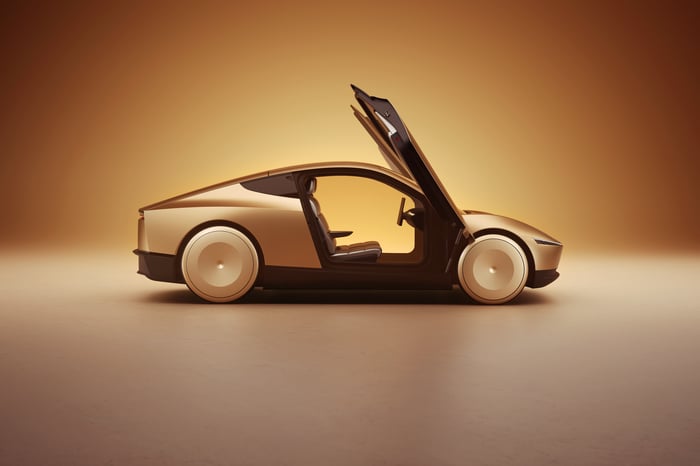
Tesla's upcoming robotaxi could open the doors to even more lawsuits. Image source: Tesla.
These lawsuits are certainly difficult to keep track of, but investors WOULD be wise to remember that these lawsuits are adding up, and some can be very costly in brand image or directly through damages.
2. A concerning talent exodus
Amid the flurry of negative news facing Tesla, many investors brushed off the peppering of executive departures throughout the year. But this is a talent exodus that has become, and should be, concerning to investors.
Here's a look at key departures, to name a few:
- Omead Afshar (VP/Head of Sales and Manufacturing, North America/Europe)
- Milan Kovac (Head of Optimus Humanoid Robot Team)
- Vineet Mehta (Head of Battery Architecture)
- Troy Jones (VP of Sales, Service, and Delivery, North America)
- Pete Bannon (VP of Hardware Engineering, Chip Tech, and Dojo Supercomputer)
- Piero Landolfi (Director of Service, North America)
Those were just a handful of high-profile executives and key personnel departing, and its leaders in key areas such as service, sales, engineering, and even the robotics team. The departures raise concerns about Tesla's leadership, operational challenges, and its current ability to remain competitive.
3. Companies in this space are losing valuable revenue
To say that Tesla and some of its EV competitors are about to lose a significant revenue source is putting it lightly. That's right: Tesla,, and, among others, are about to see billions of dollars in revenue disappear seemingly overnight as U.S. policy essentially ends the zero-emission credit market.
Essentially, the government formerly penalized automakers with lower average fuel economy, or those that produced more gasoline-guzzling vehicles and fewer EVs, but that is no longer. Without penalties being enforced, those companies failing to meet emissions standards are no longer incentivized to purchase zero-emission credits from EV makers to meet standards. And as the market for those zero-emission credits dried up, so too did a significant chunk of revenue for EV makers with a surplus of such credits. The National Highway Traffic Safety Administration (NHTSA) has already stopped issuing compliance letters to automakers that violate the fuel economy standards.
What it all means
When it rains, it pours -- at least that's how it seemed for most of Tesla's developments this year. But savvy investors would be wise to keep abreast of developments with Tesla lawsuits and its massive talent exodus, in addition to losing valuable revenue from zero-emission credits. These haven't been covered enough and raise uncertainty surrounding the EV maker.
Long-term investors should try and weather the storm and stay focused on the company's business long term. But it's also fair to say Tesla is at a crossroads with its future strategy, and investors will have to revisit their investment thesis to see if they are still aligned.
